Kalahastisvara temple, Srikalahasti
Siva temple of the wind linga at the foot of the southern hill of Srikalahasti. It has Chola inscriptions, and a hundred-pillared hall and great gopura (gate tower) that a Telugu inscription of 1516 credits to Krishnadeva Raya. The North Arcot manual says the Chola kings and Krishnadeva Rayalu extended it. Fergusson's revisers list its wind linga among the Pancha-lingams, the five notable symbols of Siva in southern India.
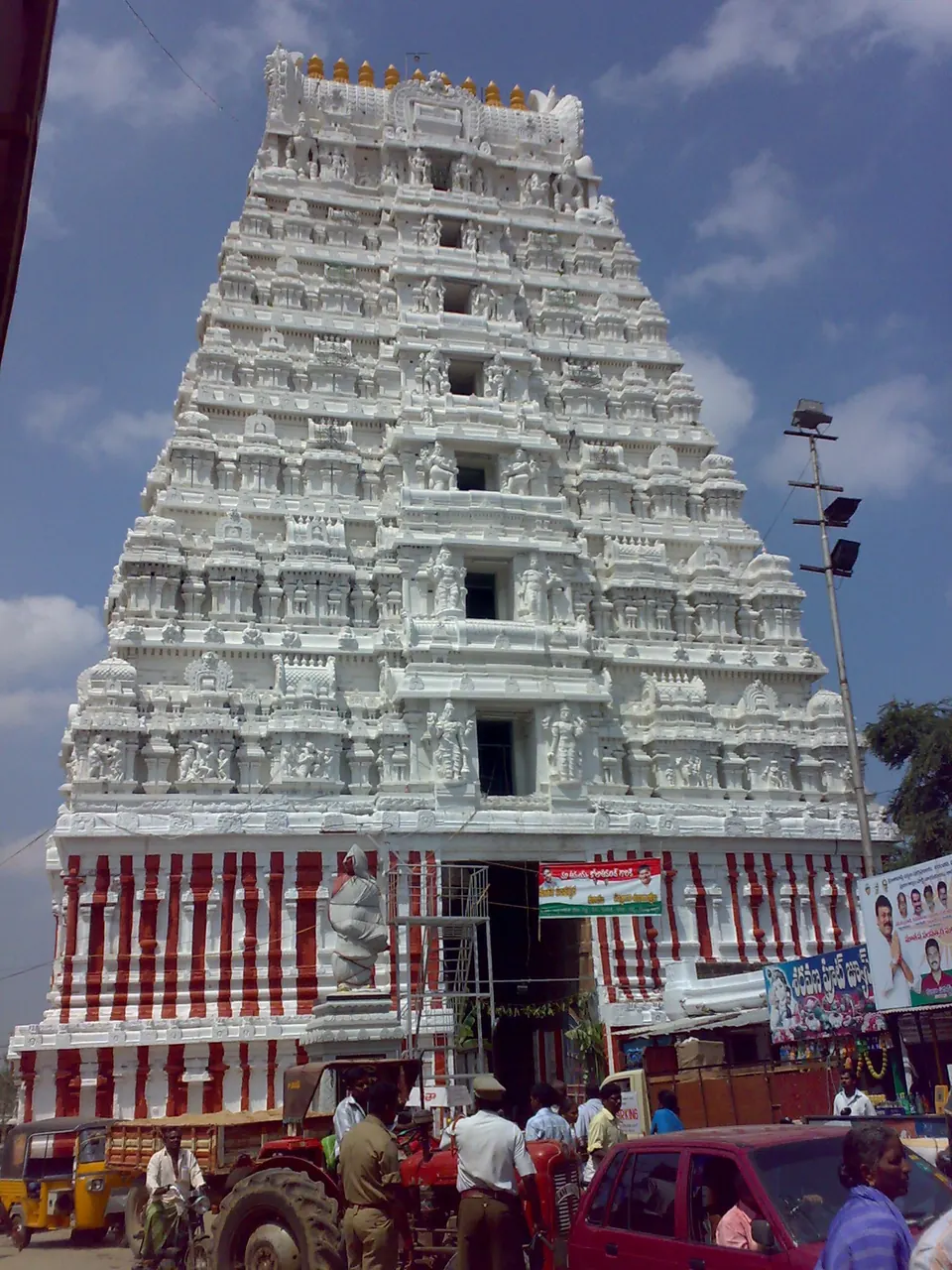
The temple of Srikalahasti, the North Arcot manual of 1894 says, “stands at the base of the southern hill and near the south-west angle of the central square” of the old town.1 “It is said to have been erected by Bramha, in the Krita yuga, when it was of insignificant dimensions”.1 But “it was extended and improved by the Chola kings and by Krishnadeva Rayalu of Vijayanagar.”1
The wind linga
Its god is Siva in the form of a current of air, worshipped as the Vayu or wind linga.1 Over it hangs a lamp that sways all the time.1 The manual explained the motion by a second lamp burning below it.1
James Fergusson’s revisers of 1910 listed the Pancha-lingams, “five notable symbols of Siva in southern India”.2 Among them they named, “at Kalahasti in N. Arkat, the ‘vayu-lingam,’ of which the lamp vibrates with the wind”.2
The manual noted that Europeans could not enter the temple, “but it is said to contain good sculptures”.3 “There are several mantapams, one called the hall of a hundred pillars.”3
Dating
The temple existed under the Cholas.4 V. Rangacharya wrote that it “existed in his [Rajaraja I’s] reign while it was renovated by Kulottunga III”.4 The earliest records he lists in it are Chola inscriptions.4
An inscription dates the Vijayanagara additions.5 Rangacharya’s list describes it: “196 of 1903.—(Telugu.) On the west wall of the second prakara of the same temple.”5 “A record of the Vijayanagara king Virapratapa-Vira-Krishnadeva Maharaya in S. 1438, Dhatri.”5 “Refers to the king’s conquests, his visit to Kalahasti and his building the 100-pillared mantapa and the big gopura.”5 Saka 1438 (Saka is an Indian way of counting years) corresponds to 1516–17. See the Srikalahasti inscription and Krishnadeva Raya.
The Rayavachakamu
S. Krishnaswami Aiyangar summarised the Telugu Rayavachakamu.6 In his summary it says that the king made large grants to the god of Kalahasti and “also constructed at Kalahasti several choultries” (rest houses).6 But it dates his visit to the year Srimukha and does not mention the gopura (gateway tower).6 The manual’s account of the temple does not say which parts are Chola and which Vijayanagara work.1
Footnotes
-
Arthur F. Cox, rev. Harold A. Stuart, Madras District Manuals: North Arcot, Vol. II (1894), p. 364 (archive.org (opens in a new tab)). ↩ ↩2 ↩3 ↩4 ↩5 ↩6 ↩7
-
James Fergusson, History of Indian and Eastern Architecture, Vol. I, revised by James Burgess (1910), p. 374, note 1 (archive.org (opens in a new tab)). ↩ ↩2
-
Cox and Stuart, North Arcot Manual, Vol. II (1894), p. 365 (archive.org (opens in a new tab)). ↩ ↩2
-
V. Rangacharya, A Topographical List of the Inscriptions of the Madras Presidency, Vol. I (1919), p. 480, Chittoor district, Kalahasti (archive.org (opens in a new tab)). ↩ ↩2 ↩3
-
Rangacharya, Topographical List, Vol. I (1919), p. 487, Chittoor No. 135 (archive.org (opens in a new tab)). ↩ ↩2 ↩3 ↩4
-
S. Krishnaswami Aiyangar (ed.), Sources of Vijayanagar History (1919), p. 117, extract from the Rayavachakamu (archive.org (opens in a new tab)). ↩ ↩2 ↩3
Photos
Related
Inscriptions
References
Notes (0)
Sources (4)
Spotted an error on this page? Tell us
Last updated: