Abdul Halim Khan (Nawab of Cuddapah)
The last Pathan Nawab of Cuddapah. He ruled Cuddapah and Sidhout from 1761 until Haidar Ali conquered him in 1779. A Telugu account translated by C. P. Brown says he was freed from prison in the fort of Sidhout in 1761 and became ruler when the Nawab Mohsin Khan left. Gribble says he followed his uncle, whom he calls Mahasim Khan. He paid Haidar money in 1769 and sent him horsemen in 1776, but he sided with the Nizam's general against him. In 1779 Haidar and Mir Sahib defeated his Pathan horsemen near Duvvur, took Cuddapah and forced him to surrender at Sidhout. He died a prisoner at Seringapatam, and his sister became Haidar's wife as Bakhshi Begum.
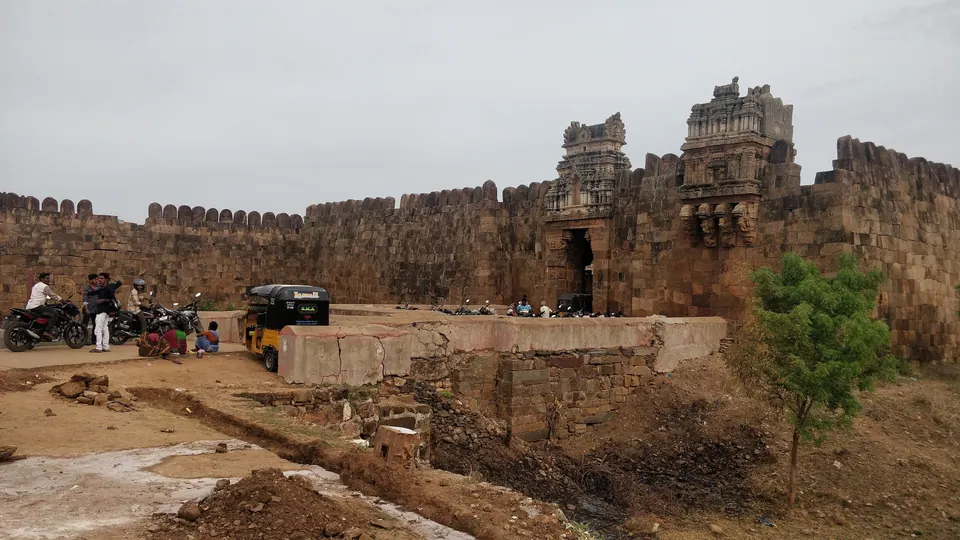
Abdul Halim Khan was the last of the Pathan Nawabs of Cuddapah.123 Wilks calls him “Abd-ul-Halim Khan”, and Kirmani calls him “Huleem Khan, the Hakim of Kirpa”.123 Haidar Ali conquered him in 1779.123 With his surrender at Sidhout, the Nawabship ended.123 See the Nawabs of Cuddapah.
Family and coming to power
Charles Philip Brown translated a Telugu account of the family.4 In it, Abdul Halim Khan is the son of Abdul Masid Khan, “who was son of Abdul Hamid Khan”.4
Gribble tells it another way.5 He says that Mahazid Khan died leaving a baby son, and his brother Mahasim Khan took the Nawabship.5 Mahasim was followed by his nephew, Abdul Alim Khan, “the son of the former Nabob”.5
Gribble also prints a chronology of Sidhout.6 It says that the Nawab “Moochi Meer” imprisoned “the three sons of the former Nabob” in the fort of Sidhout.6 When he died, he left a will that “he should be succeeded by Abdul Allim Khan, the son of the former Nabob whom he had imprisoned”.6
The Telugu account tells the same story in more detail.74 Brown printed it in his edition of the memoirs of Ram Chandra Rao of Punganur.74 He did this because the Marathi and Persian manuscripts left out “the whole story regarding Halim Khan’s downfall”.74
According to this account, in 1760 the Nawab Mohsin Khan of Kadapa (then Cuddapah) quarrelled with Sarvar Khan, the commander of Sidhout.74 In 1761 captains in the fort “released Abdul Halim Khan … from prison in the fort of Siddhavat”.74 Then “they placed him on the chair of state and presented offerings to him”.74 Mohsin Khan left Kadapa for Kurnool, where he soon died, and “thus Halim Khan became ruler of Siddhavatam and also of Kuddapa”.74 See Siddhavatam and Kurnool.
The same account says he gave Pasupula, Uyyalawada and other villages to his younger brothers, Sayad Mirjan Khan and Rahma Mirjan Khan.4 The brothers chased Sarvar Khan to Uyyalawada and killed him.4
Rangacharya lists two Persian inscriptions at Sidhout from Mackenzie’s copies.8 The first records that “Mayana Alam Khan, the Subadar of Cuddapah” built a mosque in the fort in AH 1184 (1770–71; AH is the Islamic way of counting years).8 The second records that “Alam Khan” built the mosque of Bismalla on the rampart in AH 1186 (1772–73).8
Tributary of Haidar
In 1769 Haidar Ali claimed Kadapa and Kurnool under a secret treaty with the Nizam.9 He collected payments from “Kurpa, and Kurnool, the territories of the Patan Nabobs”.9
The memoir of Ram Chandra Rao says that Haidar “marched from Bangalore to Cuddapah and exacted from Halim Khan (the Subadar commandant of that place) two lacks of Rupees”.104 The Telugu account adds that Halim Khan sent his minister, Uttama Chanda Lala, to offer tribute.104 Later he accused the minister of stealing money and had him trampled to death by an elephant.104
In 1776 Haidar called his tributary chiefs to fight the Marathas.11 Wilks lists among them “Abd-ul-Hulleem Khan, Nabob of Kurpa” with 2,000 horse.11
Kirmani says that in the same year “Huleem Khan, the Hakim of Kirpa” acted with the poligar (local chief) of Chitaldurg.2 Together they drove out Haidar’s newswriters and helped the Nizam’s general, Dhoonsa, until the general went back to Hyderabad.2
The Telugu account says that Halim Khan met Dhoonsa near Harihar and plotted Haidar’s destruction.4 On his way home he stayed two days at Kurnool with its Nawab, Munawwar Khan.4 He then besieged a fort of the Matla raja of Chitvel near Duvvur for four months.4 See Ranmast Khan (Munawwar Khan).
Kirmani says that Haidar once spread a false report of his own death.1213 Halim Khan “immediately made presents of sweetmeats to his friends, and beat his Nobut or kettle drums, for joy”.1213 After this Haidar “resolved on the destruction of Huleem Khan”.1213
The conquest of 1779
Wilks says that Halim Khan failed to send his troops, so Haidar sent Mir Sahib against him late in 1778.1415 Wilks writes that “a chosen band of two thousand Patan horse, commanded by the nephew of the chief of Kurpa”, held Mir Sahib off.1415
The sources name the Pathan commanders differently.16417 Kirmani names them as two young men, “Husseini Mean, and Saeed Mean”, sons of a son of Mujeed Khan.16417 The Telugu account names them as Halim Khan’s son Husen Mirjan and his brother Ghafir Mirjan.16417 It dates their night attack on Haidar’s camp to 1 April 1779.16417
Haidar came up by forced marches.1819 He surrounded the Pathan horsemen near Duvvur and forced them to surrender, “and took possession of the town of Kurpa without resistance”.1819 Halim Khan had already withdrawn to Sidhout.1819
Kirmani tells what happened next.20212223 Haidar offered peace for ten lakhs of rupees and the fort of Gandikota.20212223 Halim Khan could not pay, and Mir Sahib took Gandikota in a week.20212223 Halim Khan sent word that he had gathered his family in one room surrounded with gunpowder.20212223 At last he let two companies of Haidar’s troops into Sidhout “merely for the honour of our name”.20212223 He was seized “sitting in his Hall of Audience”.20212223
Wilks dates the surrender to 27 May.1 He says Halim Khan surrendered “on the simple assurance of personal security”.1 See Gandikota.
Captivity
Halim Khan was sent to Srirangapatna (then Seringapatam) with his family.23 Kirmani says they were kept prisoner in the Gunj Aum suburb with an allowance, and one son-in-law escaped to Nagpur.23 He adds, “and in the course of time, they all, one after another, left this vain perishing scene”.23
Wilks says that a plot was discovered, and after it “all the male adults of the family” were secretly killed.124 Gribble says that Halim Khan “died in captivity”.124 The Telugu account says that Haidar placed troops in Sidhout and Kadapa, “which had for eighteen years been ruled by Halim Khan”.25
Wilks says that a sister of Abd-ul-Halim Khan, eighteen years old and unmarried, refused Haidar’s call.2627 After talks the nikah (Muslim marriage) ceremony was performed.2627 She was placed at the head of his household of women as Bakhshi Begum.2627
Footnotes
-
Mark Wilks, Historical Sketches of the South of India, Vol. II (1817), p. 195 (archive.org (opens in a new tab)). ↩ ↩2 ↩3 ↩4 ↩5 ↩6 ↩7 ↩8
-
Kirmani, History of Hydur Naik, tr. Miles (1842), p. 323 (archive.org (opens in a new tab)). ↩ ↩2 ↩3 ↩4 ↩5 ↩6
-
Mir Husain Ali Khan Kirmani, The History of Hydur Naik, tr. W. Miles (1842), p. 351 (archive.org (opens in a new tab)). ↩ ↩2 ↩3 ↩4
-
Ram Chandra Rao Punganuri, Memoirs of Hyder and Tippoo, tr. C. P. Brown (1849), p. 26 (archive.org (opens in a new tab)). ↩ ↩2 ↩3 ↩4 ↩5 ↩6 ↩7 ↩8 ↩9 ↩10 ↩11 ↩12 ↩13 ↩14 ↩15 ↩16 ↩17 ↩18 ↩19 ↩20 ↩21
-
J. D. B. Gribble, A Manual of the District of Cuddapah (1875), p. 91 (archive.org (opens in a new tab)). ↩ ↩2 ↩3
-
Gribble, Cuddapah (1875), p. 51 (archive.org (opens in a new tab)). ↩ ↩2 ↩3
-
Ram Chandra Rao, Memoirs, tr. Brown (1849), p. 25, translator’s note (archive.org (opens in a new tab)). ↩ ↩2 ↩3 ↩4 ↩5 ↩6 ↩7
-
V. Rangacharya, A Topographical List of the Inscriptions of the Madras Presidency, Vol. I (1919), p. 662, Cuddapah district, Siddhavattam, Nos. 928–929 (archive.org (opens in a new tab)). ↩ ↩2 ↩3
-
Wilks, Historical Sketches, Vol. II (1817), p. 131 (archive.org (opens in a new tab)). ↩ ↩2
-
Ram Chandra Rao, Memoirs, tr. Brown (1849), p. 20 (archive.org (opens in a new tab)). ↩ ↩2 ↩3
-
Wilks, Historical Sketches, Vol. II (1817), p. 173 note (archive.org (opens in a new tab)). ↩ ↩2
-
Kirmani, History of Hydur Naik, tr. Miles (1842), p. 352 (archive.org (opens in a new tab)). ↩ ↩2 ↩3
-
Kirmani, History of Hydur Naik, tr. Miles (1842), p. 353 (archive.org (opens in a new tab)). ↩ ↩2 ↩3
-
Wilks, Historical Sketches, Vol. II (1817), p. 187 (archive.org (opens in a new tab)). ↩ ↩2
-
Wilks, Historical Sketches, Vol. II (1817), p. 190 (archive.org (opens in a new tab)). ↩ ↩2
-
Kirmani, History of Hydur Naik, tr. Miles (1842), p. 355 (archive.org (opens in a new tab)). ↩ ↩2 ↩3 ↩4
-
Ram Chandra Rao, Memoirs, tr. Brown (1849), p. 27 (archive.org (opens in a new tab)). ↩ ↩2 ↩3 ↩4
-
Wilks, Historical Sketches, Vol. II (1817), p. 191 (archive.org (opens in a new tab)). ↩ ↩2 ↩3
-
Wilks, Historical Sketches, Vol. II (1817), p. 192 (archive.org (opens in a new tab)). ↩ ↩2 ↩3
-
Kirmani, History of Hydur Naik, tr. Miles (1842), p. 362 (archive.org (opens in a new tab)). ↩ ↩2 ↩3 ↩4 ↩5 ↩6
-
Kirmani, History of Hydur Naik, tr. Miles (1842), p. 363 (archive.org (opens in a new tab)). ↩ ↩2 ↩3 ↩4 ↩5 ↩6
-
Kirmani, History of Hydur Naik, tr. Miles (1842), p. 364 (archive.org (opens in a new tab)). ↩ ↩2 ↩3 ↩4 ↩5 ↩6
-
Kirmani, History of Hydur Naik, tr. Miles (1842), p. 365 (archive.org (opens in a new tab)). ↩ ↩2 ↩3 ↩4 ↩5 ↩6 ↩7 ↩8 ↩9
-
Gribble, Cuddapah (1875), p. 98 (archive.org (opens in a new tab)). ↩ ↩2
-
Ram Chandra Rao, Memoirs, tr. Brown (1849), p. 28 (archive.org (opens in a new tab)). ↩
-
Wilks, Historical Sketches, Vol. II (1817), p. 197 (archive.org (opens in a new tab)). ↩ ↩2 ↩3
-
Wilks, Historical Sketches, Vol. II (1817), p. 198 (archive.org (opens in a new tab)). ↩ ↩2 ↩3
Photos
Related
Dynasties
References
Notes (0)
Sources (6)
Spotted an error on this page? Tell us
Last updated: