Ala-ud-din Ahmad Shah II
Ala-ud-din Ahmad Shah II was the Bahmani sultan from 1435 to 1458, the son of Ahmad Shah I. In his reign Bahmani Telangana was a province under the governor Khan Azim, whose troops fought in the king's wars with Vijayanagara. When the king was thought to be dying, about 1455, his brother-in-law Jalal Khan and Jalal's son Sikandar took over the province. Mahmud Gawan besieged them in their fort, called Balkonda by Haig and the Burhan-i Ma'asir, and they surrendered and were pardoned.
Download
Ala-ud-din Ahmad Shah II was a king of the Bahmani dynasty, who ruled from 1435 to 1458.12 He was the son of Ahmad Shah I, who had conquered Warangal.1 In his reign the Bahmani lands in Telangana formed a province under a governor.34 Its governor and its troops took part in his wars, and late in his reign the province rose against him.54
Telangana troops in his wars
Ala-ud-din came to the throne at Bidar by the will of his father.1 In AH 847 (1443; AH is the Islamic way of counting years), the king of Vijayanagara, whom Ferishta calls Dew Ray, crossed the Tungabhadra and took the fort of Mudgal.6 Ala-ud-din called his troops from Telangana, Daulatabad and Berar to Bidar.6 In the fighting, Khan Azim, “commander of the forces of Berar and Tulingana”, faced the main army of Vijayanagara.5
The rising in Telangana
Late in his reign a sore broke out on the king’s foot, and he had to stay in his palace.34 Rumours of his death spread through the provinces.3 Jalal Khan, a Sayyid who had married a daughter of Ahmad Shah I, believed them.34 Haig wrote that he rose in Telangana to make his son Sikandar its independent ruler.4
Khan Azim, the governor of Telangana, died at this time.3 With no strong officer on the spot, the officers of the province accepted Sikandar Khan.3 Sikandar then asked Sultan Mahmud Khalji of Malwa for help.74 He told him that Ala-ud-din was already dead, and that Berar and Telangana would fall into his hands without a blow.74
The Malwa king invaded Berar, but he went home when he learned that Ala-ud-din was alive and marching against him.24 The king sent Mahmud Gawan to Telangana against the rebels.7 Mahmud Gawan laid siege to their fort, and they surrendered on a promise of pardon.24 Ala-ud-din pardoned them and let them keep the fort.24 Ala-ud-din made his eldest son Humayun his heir, and Sikandar later rose again under him.8
Death
Ala-ud-din died in AH 862 (1458), when the sore on his foot turned to gangrene.28 Ferishta gives his reign as twenty-three years, nine months and twenty days.2
Coins
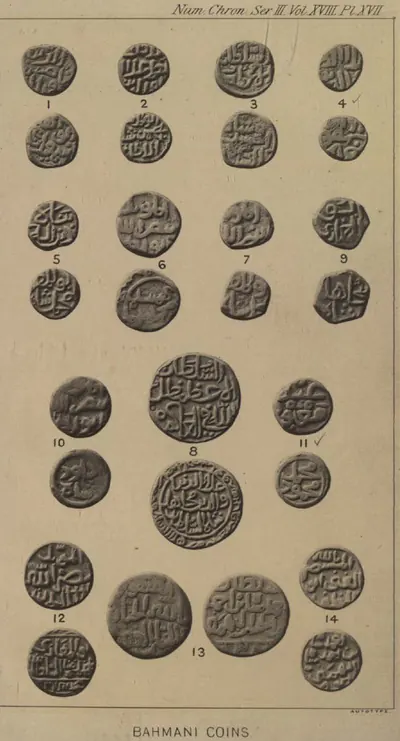
Codrington (1898) listed a gold coin of Ala-ud-din dated AH 860, with no mint name.9 His silver coins were struck at Ahsanabad (Gulbarga) in years from AH 847 to 861.9 Codrington found several kinds of his copper coins common.10
Where the sources disagree
- The name of the rebels’ fort. Briggs’s Ferishta calls it Nowlgoond.32 Haig and the Burhan-i Ma’asir call it Balkonda.411
- The date of the rising. Ferishta places the king’s illness in AH 859 (1455) and the Malwa invasion in AH 860 (1456).37 Haig dates the king’s injury to 1453 and the invasion to 1456.4
- How it ended. Ferishta and Haig say Mahmud Gawan besieged the fort.24 In the Burhan-i Ma’asir the king himself marched towards Balkonda, and Sikandar repented and asked for pardon.1211
- The length of his reign. Ferishta gives 23 years, 9 months and 20 days.2 The Burhan-i Ma’asir gives 23 years, 9 months and 22 days.11
Footnotes
-
Muhammad Qasim Ferishta, tr. John Briggs, History of the Rise of the Mahomedan Power in India, Vol. II (1829), p. 421 (archive.org (opens in a new tab)). ↩ ↩2 ↩3
-
Ferishta, tr. Briggs, Vol. II (1829), p. 449 (archive.org (opens in a new tab)). ↩ ↩2 ↩3 ↩4 ↩5 ↩6 ↩7 ↩8 ↩9
-
Ferishta, tr. Briggs, Vol. II (1829), p. 447 and note (archive.org (opens in a new tab)). ↩ ↩2 ↩3 ↩4 ↩5 ↩6 ↩7 ↩8
-
Wolseley Haig (ed.), The Cambridge History of India, Vol. III (1928), p. 409 (archive.org (opens in a new tab)). ↩ ↩2 ↩3 ↩4 ↩5 ↩6 ↩7 ↩8 ↩9 ↩10 ↩11 ↩12 ↩13
-
Ferishta, tr. Briggs, Vol. II (1829), p. 433 (archive.org (opens in a new tab)). ↩ ↩2
-
Ferishta, tr. Briggs, Vol. II (1829), p. 432 (archive.org (opens in a new tab)). ↩ ↩2
-
Ferishta, tr. Briggs, Vol. II (1829), p. 448 (archive.org (opens in a new tab)). ↩ ↩2 ↩3 ↩4
-
Haig, Cambridge History of India, Vol. III (1928), p. 410 (archive.org (opens in a new tab)). ↩ ↩2
-
O. Codrington, “On the Coins of the Bahmani Dynasty”, Numismatic Chronicle, 3rd series, XVIII (1898), p. 267 (archive.org (opens in a new tab)). ↩ ↩2
-
Codrington, “Coins of the Bahmani Dynasty” (1898), p. 268 (archive.org (opens in a new tab)). ↩
-
King, History of the Bahmani Dynasty (1900), p. 78 (archive.org (opens in a new tab)). ↩ ↩2 ↩3
-
J. S. King, The History of the Bahmani Dynasty, founded on the Burhan-i Ma’asir (1900), p. 77 (archive.org (opens in a new tab)). ↩
Photos
Related
Dynasties
References
Notes (0)
Sources (4)
Spotted an error on this page? Tell us
Last updated: