Mahmud Gawan
Persian merchant who became chief minister of the Bahmani sultanate (c. 1461–1481). He was regent for two boy kings, fought in Telangana and on the west coast, reorganised the provinces and the army, and founded a great college at Bidar. Muhammad Shah III had him executed on a forged charge of treason in 1481.
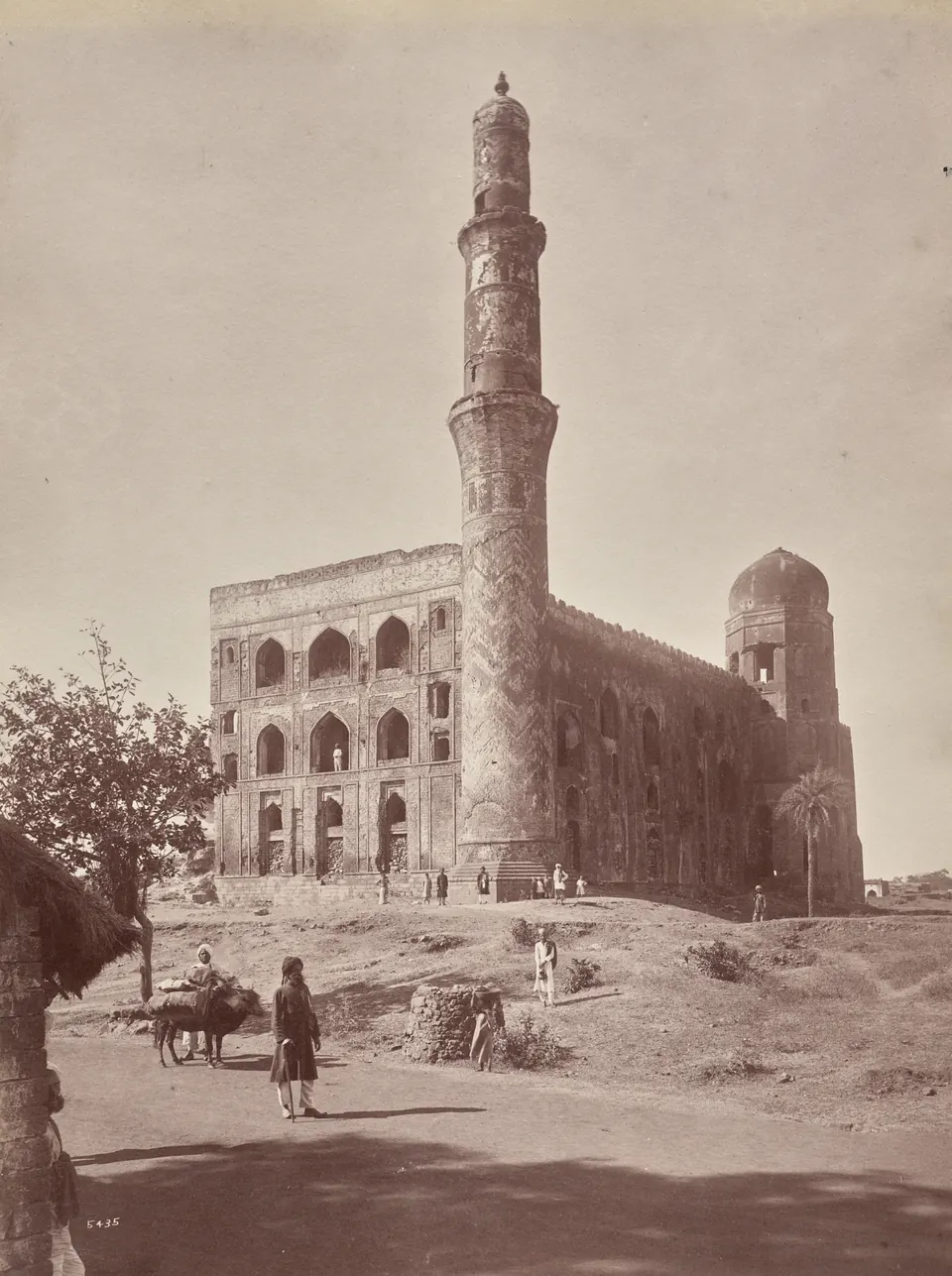
Khwaja Mahmud Gawan was the most powerful minister of the Bahmani sultanate. For about twenty years he served three kings as general, regent and chief minister. His reforms and his execution in 1481 mark the last years in which the kingdom held together. Most of what is known of him comes from the historian Ferishta, who drew on a life written by Mahmud Gawan’s servant, Mulla Abdul Karim Sindhi.1
Origins
According to this life, Mahmud Gawan’s ancestors had for generations served as viziers (ministers) to the princes of Gilan in Persia, and one branch ruled Rasht. He feared the jealousy of the Shah, so he left his birthplace with his mother. He turned down offers of high office in Iraq and Khorasan and became a merchant instead. He travelled widely and sought out learned men.1
In his forty-third year he landed at Dabul on the west coast and went on to the Bahmani capital, Bidar, meaning to continue to Delhi. Sultan Ala-ud-din II persuaded him to stay and made him one of his nobles.1
Ferishta calls him Khwaja Mahmud Gilani, “commonly called Gawan”.2 The life explains the name with a story about a cow lowing beneath the palace terrace.3
In Telangana
In AH 860 (1456; AH is the Islamic way of counting years) Ala-ud-din II sent him against the rebel Jalal Khan in Telingana.24 The rebel’s ally Sikandar Khan gave up to him the fort that Briggs calls Nowlgoond, on a promise of pardon.24
Humayun Shah made him Vakil-us-Sultanat, the chief office of state.56 He also gave him the title Malik-ut-Tujjar (“chief of the merchants”) and the government of Bijapur.56
In AH 864 (1459–60) a Bahmani army was routed before the Telangana fort of Devarakonda.78 Humayun hurried back to his capital and left Mahmud Gawan to hold Telingana.78 Haig dates the campaign to early 1459.910
Regent
On his deathbed Humayun named Mahmud Gawan and Khwaja Jahan Turk as regents for his eight-year-old son, Nizam Shah.1112 They were to act with the queen mother.1112 Mahmud Gawan became vizier and Khwaja Jahan governor of Telingana.1112
Their first test came when the king of Orissa and the chiefs of Telingana invaded by way of Rajahmundry.13 The regents marched out with the young king and drove them back.13 Then Sultan Mahmud Khalji of Malwa took Bidar, and Mahmud Gawan advised calling in the king of Gujarat.1415 With his help Mahmud Gawan drove the Malwa army out of the Deccan by cutting off its supplies, and refused a pitched battle.1415
Under Nizam Shah’s brother, Muhammad Shah III, the queen mother had Khwaja Jahan killed.16 Mahmud Gawan then received his title and office as well.16 He spent three years in the west, taking the fort of Kelna and the port of Goa.1718 On his return he gave away most of his wealth, keeping only his elephants, horses and library.1718
On his advice Muhammad Shah sent the army that took Rajahmundry and Kondapalli.1920 The king stayed three years settling the Telugu country and appointed its governors.1920 When the minister rebuilt a ruined fort in six months, the king exchanged robes with him.21 Ferishta knew of no other king who had paid a subject such an honour.21
Reforms
The kingdom had grown too large for the four provinces laid down by its founder. Mahmud Gawan divided them into eight.222324 Telingana was split between Nizam-ul-Mulk Bahri at Rajahmundry and Azim Khan at Warangal.222324 In his Cambridge History Haig says the plan was completed in the king’s camp at Kondapalli.24
Each governor now kept only one fort in his own hands.2526 The king appointed and paid the officers who held the rest.2526 Pay for every 500 troops was raised, but a commander was charged for each man missing from his quota.2526 Ferishta says these rules brought order and justice, but they made enemies of many ambitious nobles.26
Death
According to Haig, Nizam-ul-Mulk resented the division of Telingana.27 He joined Deccani and Abyssinian nobles in a plot.27 They made the keeper of the minister’s seal drunk and had him seal a paper. Above the seal they wrote a letter to the king of Orissa inviting him to invade.2829
Muhammad Shah, drunk himself, sent for Mahmud Gawan.2829 The minister refused his friends’ advice to flee.2829 Shown the letter, he answered: “The seal is mine, but not the letter.”2829 The king ordered his immediate execution.2829
He died on 5 Safar AH 886, in his seventy-eighth year.308 Briggs converts the date to 5 April 1481, and Haig gives 6 April.308 Later the king asked where the minister’s wealth was hidden.31 His treasurer said that, beyond the pay of his troops, Mahmud Gawan had given his income to the poor.31 He had lived on the profits of the capital he had brought from Persia.31
Haig calls the execution “the primary cause of the dissolution of the Bahmani kingdom”.8 The Imperial Gazetteer says Muhammad Shah’s reign is “notorious” for it.32 In his Cambridge History Haig gives the date as 5 April 1481.33 He says the minister was seventy-eight and had served the dynasty for thirty-five years.33
The Burhan-i Ma’asir’s account
The Burhan-i Ma’asir tells the story with two differences. It says the complaints of the people of Kondavir had already turned the king against Mahmud Gawan.34 These people had rebelled against governors set over them by the king’s ministers.34 It also says the forged letter was addressed not to the king of Orissa but to Narsinha Raya, the chief whose country the king had just invaded.35 It gives the same date, 5 Safar AH 886.35
Learning and the Bidar college
Ferishta says he was skilled in prose, verse and mathematics.3637 His book of letters, the Rauzat-ul-Insha, and some of his poems survived in Deccan libraries in Ferishta’s time.3637 The Persian poet Jami wrote letters to him.3637
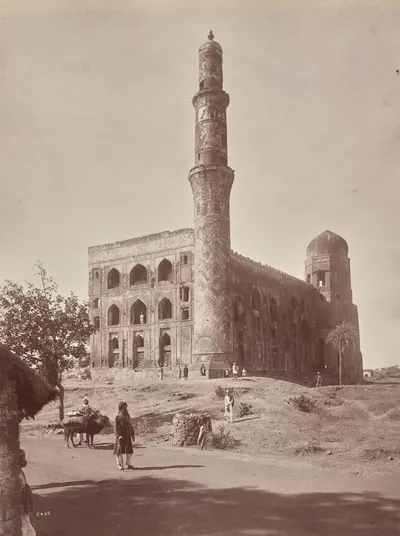
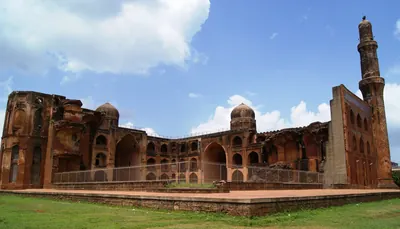
His library is said to have held three thousand volumes, all meant for students.38 Ferishta says that two years before his death he built a college with a mosque at Bidar. The Burhan-i Ma’asir says he founded “four lofty and beautiful domes and colleges in the bazar of Bidar” soon after the conquest of the coast.3940
It gives a chronogram (a phrase whose letters give a date) for AH 876 (1471).3940 It says the buildings were still admired in AH 1000 (1591).3940 Briggs adds that the college was later used to store gunpowder, and much of it was destroyed when the powder exploded.3641 The Imperial Gazetteer describes “the great madrasa or college built by Mahmud Gavan” as in ruins.3641
Footnotes
-
Muhammad Qasim Ferishta, tr. John Briggs, History of the Rise of the Mahomedan Power in India, Vol. II (1829), p. 511 (archive.org (opens in a new tab)). ↩ ↩2 ↩3
-
Ferishta, tr. Briggs, Vol. II (1829), p. 448 (archive.org (opens in a new tab)). ↩ ↩2 ↩3
-
Ferishta, tr. Briggs, Vol. II (1829), p. 512 (archive.org (opens in a new tab)). ↩
-
Ferishta, tr. Briggs, Vol. II (1829), p. 449 (archive.org (opens in a new tab)). ↩ ↩2
-
Ferishta, tr. Briggs, Vol. II (1829), p. 453 (archive.org (opens in a new tab)). ↩ ↩2
-
Ferishta, tr. Briggs, Vol. II (1829), p. 483, note (archive.org (opens in a new tab)). ↩ ↩2
-
Ferishta, tr. Briggs, Vol. II (1829), p. 458 (archive.org (opens in a new tab)). ↩ ↩2
-
T. W. Haig, Historic Landmarks of the Deccan (1907), p. 80 (archive.org (opens in a new tab)); p. 84 (archive.org (opens in a new tab)). ↩ ↩2 ↩3 ↩4 ↩5
-
Wolseley Haig (ed.), The Cambridge History of India, Vol. III (1928), p. 410 (archive.org (opens in a new tab)). ↩
-
Haig, Cambridge History of India, Vol. III (1928), p. 411 (archive.org (opens in a new tab)). ↩
-
Ferishta, tr. Briggs, Vol. II (1829), p. 464 (archive.org (opens in a new tab)). ↩ ↩2 ↩3
-
Ferishta, tr. Briggs, Vol. II (1829), p. 465 (archive.org (opens in a new tab)). ↩ ↩2 ↩3
-
Ferishta, tr. Briggs, Vol. II (1829), pp. 466–468 (archive.org (opens in a new tab)). ↩ ↩2
-
Ferishta, tr. Briggs, Vol. II (1829), pp. 471–472 (archive.org (opens in a new tab)). ↩ ↩2
-
Ferishta, tr. Briggs, Vol. II (1829), p. 473 (archive.org (opens in a new tab)). ↩ ↩2
-
Ferishta, tr. Briggs, Vol. II (1829), pp. 478–479 (archive.org (opens in a new tab)). ↩ ↩2
-
Ferishta, tr. Briggs, Vol. II (1829), pp. 483–485 (archive.org (opens in a new tab)). ↩ ↩2
-
Ferishta, tr. Briggs, Vol. II (1829), p. 486 (archive.org (opens in a new tab)). ↩ ↩2
-
Ferishta, tr. Briggs, Vol. II (1829), pp. 487–488 (archive.org (opens in a new tab)). ↩ ↩2
-
Ferishta, tr. Briggs, Vol. II (1829), pp. 497–498 (archive.org (opens in a new tab)). ↩ ↩2
-
Ferishta, tr. Briggs, Vol. II (1829), p. 499 (archive.org (opens in a new tab)). ↩ ↩2
-
Ferishta, tr. Briggs, Vol. II (1829), pp. 502–503 (archive.org (opens in a new tab)). ↩ ↩2
-
Haig, Historic Landmarks (1907), p. 83 (archive.org (opens in a new tab)). ↩ ↩2
-
Haig, Cambridge History of India, Vol. III (1928), p. 419 (archive.org (opens in a new tab)). ↩ ↩2 ↩3
-
Ferishta, tr. Briggs, Vol. II (1829), pp. 503–504 (archive.org (opens in a new tab)). ↩ ↩2 ↩3
-
Ferishta, tr. Briggs, Vol. II (1829), p. 505 (archive.org (opens in a new tab)); J. D. B. Gribble, A History of the Deccan, Vol. I (1896), pp. 124–125 (archive.org (opens in a new tab)). ↩ ↩2 ↩3 ↩4
-
Haig, Historic Landmarks (1907), p. 82 (archive.org (opens in a new tab)). ↩ ↩2
-
Ferishta, tr. Briggs, Vol. II (1829), pp. 505–508 (archive.org (opens in a new tab)). ↩ ↩2 ↩3 ↩4 ↩5
-
Gribble, History of the Deccan (1896), pp. 125–126 (archive.org (opens in a new tab)). ↩ ↩2 ↩3 ↩4 ↩5
-
Ferishta, tr. Briggs, Vol. II (1829), p. 509 (archive.org (opens in a new tab)). ↩ ↩2
-
Ferishta, tr. Briggs, Vol. II (1829), pp. 512–513 (archive.org (opens in a new tab)). ↩ ↩2 ↩3
-
Imperial Gazetteer of India: Hyderabad State (1909), p. 13 (archive.org (opens in a new tab)). ↩
-
Haig, Cambridge History of India, Vol. III (1928), p. 420 (archive.org (opens in a new tab)). ↩ ↩2
-
King, History of the Bahmani Dynasty (1900), pp. 110–111 (archive.org (opens in a new tab)). ↩ ↩2
-
King, History of the Bahmani Dynasty (1900), p. 113 (archive.org (opens in a new tab)). ↩ ↩2
-
Ferishta, tr. Briggs, Vol. II (1829), p. 510 and note (archive.org (opens in a new tab)). ↩ ↩2 ↩3 ↩4 ↩5
-
Ferishta, tr. Briggs, Vol. II (1829), p. 511 (archive.org (opens in a new tab)). ↩ ↩2 ↩3
-
Ferishta, tr. Briggs, Vol. II (1829), p. 514 (archive.org (opens in a new tab)). ↩
-
J. S. King, The History of the Bahmani Dynasty, founded on the Burhan-i Ma’asir (1900), p. 104 (archive.org (opens in a new tab)). ↩ ↩2 ↩3
-
King, History of the Bahmani Dynasty (1900), p. 105 (archive.org (opens in a new tab)). ↩ ↩2 ↩3
-
Imperial Gazetteer: Hyderabad (1909), p. 291 (archive.org (opens in a new tab)). ↩ ↩2
Photos
References
Notes (0)
Sources (6)
Spotted an error on this page? Tell us
Last updated: