Ahmad Shah I
Ninth Bahmani sultan (1422–1435), called Wali, 'the Saint'. He took the throne from his brother Firuz and defeated Vijayanagara. In 1424 or 1425 he took Warangal, killing its raja, and the Velama rayas of Devarakonda and Rachakonda then paid him tribute. He moved the capital from Gulbarga to Bidar. He had to march into Telangana again to put down the chiefs who rose while he fought Gujarat and Malwa.
Ahmad Shah I was the ninth king of the Bahmani dynasty, and the one who ended the Telugu kingdom of Warangal. Ferishta and the Burhan-i Ma’asir agree that he took the city, and that the Telugu chiefs of the province paid him tribute.123 But they differ on almost every detail.123 Both show the conquest coming apart within a few years.123
Family and coming to the throne
Ahmad was the younger brother of Firuz Shah.45 According to the Burhan-i Ma’asir and Haig, he was, like Firuz, a son of Ahmad Khan, a son of Bahman Shah.45
Ferishta makes both brothers sons of Daud Shah, the fourth king.6 Firuz made him his chief minister with the title Khan Khanan. In Firuz’s last years, two favourites persuaded the sick king to have Ahmad blinded.78 Ahmad fled with a few hundred horsemen, won over the army, and took the throne at Gulbarga in September 1422.78
Firuz died days later.78 The Burhan-i Ma’asir dates the accession to 5 Shawwal AH 825 (AH is the Islamic way of counting years), 22 September 1422. Ferishta adds the tradition that Ahmad had his brother strangled at the urging of his nephew Shir Khan, whom he later put to death.4910
The Burhan-i Ma’asir says Ahmad Shah had seven sons.111213 It names the eldest, Zafar Khan, his heir, and Mahmud Khan and Muhammad Khan.111213 It names Daud Khan elsewhere.111213
One of his daughters married Jalal Khan, a Sayyid.13141516 She was the mother of Sikandar Khan, who later claimed Telingana as Ahmad’s grandson.13141516 The eldest son succeeded him as Ala-ud-din Ahmad Shah II.17
Warangal
Ferishta says that early in the reign Ahmad marched against Vijayanagara.1819 Its king called in the Ray of Warangal, who joined him and then withdrew his troops before the battle.1819
In AH 828 Ahmad marched into Telangana (then Telingana) “with the intention of conquering” it, to punish the Ray.1 He halted at Golconda for twenty-seven days while his general Khan Azim went ahead.1 Khan Azim defeated the Telugu army, killed seven thousand men and took Warangal, “the Ray having been slain in the action”.1
The king moved to Warangal and seized “those treasures, the accumulation of ages, which had till then been preserved from plunder”.1 Khan Azim reduced the rest of Telangana in four months.1 He was left to take the strong places still held by the dead Ray’s heirs.1
Haig dates the campaign to the end of 1424, and makes Warangal the king’s headquarters.20 He says the governor of Bidar, Abd-ul-Latif, “established his authority throughout the country”.20 In Haig’s account, Ahmad extended his eastern frontier “to the sea”.20
The Burhan-i Ma’asir says Ahmad “penetrated to the farthest limits of Tilang” and took the forts of “Mandal” and Warangal, which King could not identify. It adds that “the Rayas of Devarkonda and Rajkonda”, afraid to face his army, sent envoys with presents and agreed to pay tribute.2 The chronicle does not name these rayas. The census survey of 1964 says that Rachakonda was the seat of the Recherla Velama kings for about a century.21 For the family’s hold on Devarakonda, see its page. The date is also uncertain: the Imperial Gazetteer gives 1422.22 Gribble and Bilgrami give 1424.2324 The Kistna Manual gives AH 828 (1425), correcting Elphinstone’s 1421.25
Telangana lost and won back
The Burhan-i Ma’asir says that the king was busy fighting Gujarat and Malwa.326 Meanwhile, it says, “the infidels, even without fighting, had succeeded in getting possession of various districts of Telingana”.326 When he was free he marched back.326 Some forts submitted and agreed to pay revenue.326 Others were stormed, “the strongest of which was the fort of Ramgir”.326
The ruler of Warangal fort, whom it calls “the most intelligent of the infidels of that country”, sent envoys and agreed to pay tribute.326 Ahmad confirmed in their lands the chiefs who submitted.326 He gave Ibrahim Sanjar Khan the command of the army in Telangana, with the fort of Bhonagir as his estate.326 See Bhongir.
Ferishta also says the king marched into Telangana late in his reign “to quell an insurrection of some powerful Hindoo chiefs” (to put down a rising).27 Haig puts this campaign after the peace of 1432 with Malwa. He says Telingana, “though nominally under the government of one of his sons, was in a condition approaching rebellion”.28 He adds that Ahmad put some of its chiefs to death.28
Ferishta names that son.29 In dividing his lands among his sons, Ahmad gave Ramgir, Mahur and Kalam, with part of Berar, to Mahmud Khan.29 He sent Daud Khan, with royal insignia and a number of nobles, “to establish himself in Tulingana”.29 The Burhan-i Ma’asir gives Mahur to Mahmud Khan and Raichur to Daud Khan.12
Bidar, the saint and the coins
Ferishta says Ahmad, hunting near Bidar on his way back from a campaign, chose a well-watered site for a new city, Ahmadabad.3010 It had a great citadel on the site of the old town.3010 The citadel was finished in AH 836 (1432–33).3010
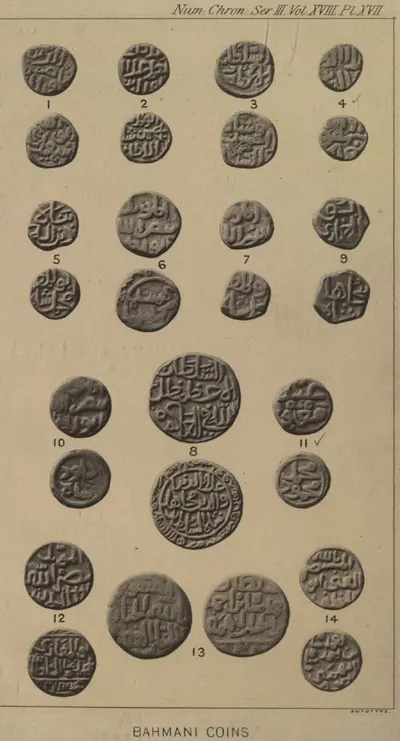
The Burhan-i Ma’asir has the court move to Bidar as early as June 1423.31 Haig dates the new capital to 1429, and the Imperial Gazetteer to 1430.3222 The earliest Bahmani coins naming the mint Muhammadabad are copper pieces of Ahmad dated AH 836 to 838.33 The Tazkirat-ul-Muluk identifies Muhammadabad with Bidar.33
He took the name Wali, “saint”, after his prayers for rain during a famine were answered, Ferishta says, in the sight of the people.341 He honoured the saint Gisu Daraz, who had foretold his reign, and later the family of the Persian saint Shah Ni’matullah. Haig judged from the inscriptions in his tomb at Bidar that they converted him to the Shia faith.83536 Haig adds that he did not impose it on his subjects.83536
Haig also traced to his reign the feud between the “Foreigners” and the Deccanis that later tore the kingdom apart.37
Death
Ferishta dates his death to 28 Rajab AH 838, which Briggs converts to 19 February 1435.38 This came after a reign of twelve years and two months.38 The Burhan-i Ma’asir gives the 25th or 26th of Rajab.12 Haig notes that the date in his tomb can be read as AH 837 or 839.28
Footnotes
-
Ferishta, tr. Briggs, Vol. II (1829), p. 406 (archive.org (opens in a new tab)). ↩ ↩2 ↩3 ↩4 ↩5 ↩6 ↩7 ↩8 ↩9 ↩10
-
King, History of the Bahmani Dynasty (1900), p. 52 and note 65 (archive.org (opens in a new tab)). ↩ ↩2 ↩3 ↩4
-
King, History of the Bahmani Dynasty (1900), p. 61 (archive.org (opens in a new tab)). ↩ ↩2 ↩3 ↩4 ↩5 ↩6 ↩7 ↩8 ↩9 ↩10 ↩11
-
J. S. King, The History of the Bahmani Dynasty, founded on the Burhan-i Ma’asir (1900), p. 49 and note 60 (archive.org (opens in a new tab)). ↩ ↩2 ↩3
-
T. W. Haig, “Some Notes on the Bahmani Dynasty”, Journal of the Asiatic Society of Bengal LXXIII, Part I, extra number (1904), p. 8 (archive.org (opens in a new tab)). ↩ ↩2
-
Muhammad Qasim Ferishta, tr. John Briggs, History of the Rise of the Mahomedan Power in India, Vol. II (1829), p. 357 (archive.org (opens in a new tab)). ↩
-
Wolseley Haig (ed.), The Cambridge History of India, Vol. III (1928), p. 394 (archive.org (opens in a new tab)). ↩ ↩2 ↩3
-
Haig, Cambridge History of India, Vol. III (1928), p. 395 (archive.org (opens in a new tab)). ↩ ↩2 ↩3 ↩4 ↩5
-
Muhammad Qasim Ferishta, tr. John Briggs, History of the Rise of the Mahomedan Power in India, Vol. II (1829), p. 396 (archive.org (opens in a new tab)). ↩
-
Ferishta, tr. Briggs, Vol. II (1829), p. 415 and note (archive.org (opens in a new tab)). ↩ ↩2 ↩3 ↩4
-
King, History of the Bahmani Dynasty (1900), p. 50 (archive.org (opens in a new tab)). ↩ ↩2 ↩3
-
King, History of the Bahmani Dynasty (1900), p. 63 (archive.org (opens in a new tab)). ↩ ↩2 ↩3 ↩4 ↩5
-
Haig, “Some Notes on the Bahmani Dynasty” (1904), p. 10 (archive.org (opens in a new tab)). ↩ ↩2 ↩3 ↩4 ↩5
-
Ferishta, tr. Briggs, Vol. II (1829), p. 447 and note (archive.org (opens in a new tab)). ↩ ↩2
-
Haig, Cambridge History of India, Vol. III (1928), p. 409 (archive.org (opens in a new tab)). ↩ ↩2
-
Haig, Cambridge History of India, Vol. III (1928), p. 410 (archive.org (opens in a new tab)). ↩ ↩2
-
Haig, Cambridge History of India, Vol. III (1928), p. 405 (archive.org (opens in a new tab)). ↩
-
Ferishta, tr. Briggs, Vol. II (1829), p. 400 (archive.org (opens in a new tab)). ↩ ↩2
-
Ferishta, tr. Briggs, Vol. II (1829), p. 401 (archive.org (opens in a new tab)). ↩ ↩2
-
Haig, Cambridge History of India, Vol. III (1928), p. 399 (archive.org (opens in a new tab)). ↩ ↩2 ↩3
-
Census of India 1961, Vol. II, Part VII-B (20): Fairs and Festivals, Nalgonda District (1964), Section I, entry “Rajkonda” (PDF p. 23) (censusindia.gov.in (opens in a new tab)). Paraphrased. ↩
-
Imperial Gazetteer of India: Hyderabad State (1909), p. 12 (archive.org (opens in a new tab)). ↩ ↩2
-
J. D. B. Gribble, A History of the Deccan, Vol. I (1896), p. 86 (archive.org (opens in a new tab)). ↩
-
Syed Ali Asgar Bilgrami, Landmarks of the Deccan (1927), p. 192 (archive.org (opens in a new tab)). ↩
-
Gordon Mackenzie, A Manual of the Kistna District (1883), p. 16 and note (archive.org (opens in a new tab)). ↩
-
King, History of the Bahmani Dynasty (1900), p. 62 (archive.org (opens in a new tab)). ↩ ↩2 ↩3 ↩4 ↩5 ↩6 ↩7 ↩8
-
Ferishta, tr. Briggs, Vol. II (1829), p. 416 (archive.org (opens in a new tab)). ↩
-
Haig, Cambridge History of India, Vol. III (1928), p. 402 and note (archive.org (opens in a new tab)). ↩ ↩2 ↩3
-
Ferishta, tr. Briggs, Vol. II (1829), p. 412 (archive.org (opens in a new tab)). ↩ ↩2 ↩3
-
Ferishta, tr. Briggs, Vol. II (1829), p. 411 (archive.org (opens in a new tab)). ↩ ↩2 ↩3
-
King, History of the Bahmani Dynasty (1900), p. 51 (archive.org (opens in a new tab)). ↩
-
Haig, Cambridge History of India, Vol. III (1928), p. 400 (archive.org (opens in a new tab)). ↩
-
O. Codrington, “On the Coins of the Bahmani Dynasty”, Numismatic Chronicle, 3rd series, XVIII (1898), p. 267 (archive.org (opens in a new tab)). ↩ ↩2
-
Ferishta, tr. Briggs, Vol. II (1829), p. 405 (archive.org (opens in a new tab)). ↩
-
Haig, Cambridge History of India, Vol. III (1928), p. 396 (archive.org (opens in a new tab)). ↩ ↩2
-
Haig, Cambridge History of India, Vol. III (1928), p. 403 (archive.org (opens in a new tab)). ↩ ↩2
-
Haig, Cambridge History of India, Vol. III (1928), p. 404 (archive.org (opens in a new tab)). ↩
-
Ferishta, tr. Briggs, Vol. II (1829), p. 417 (archive.org (opens in a new tab)). ↩ ↩2
Photos
References
Notes (0)
Sources (10)
Spotted an error on this page? Tell us
Last updated: