Anna S. Kugler
Anna Sarah Kugler (born 1856), an American woman doctor, reached Guntur in 1883 for the Lutheran mission and began its medical work for women and children, opening a dispensary in 1886 and planning the women's hospital whose first building opened in 1893.
Download
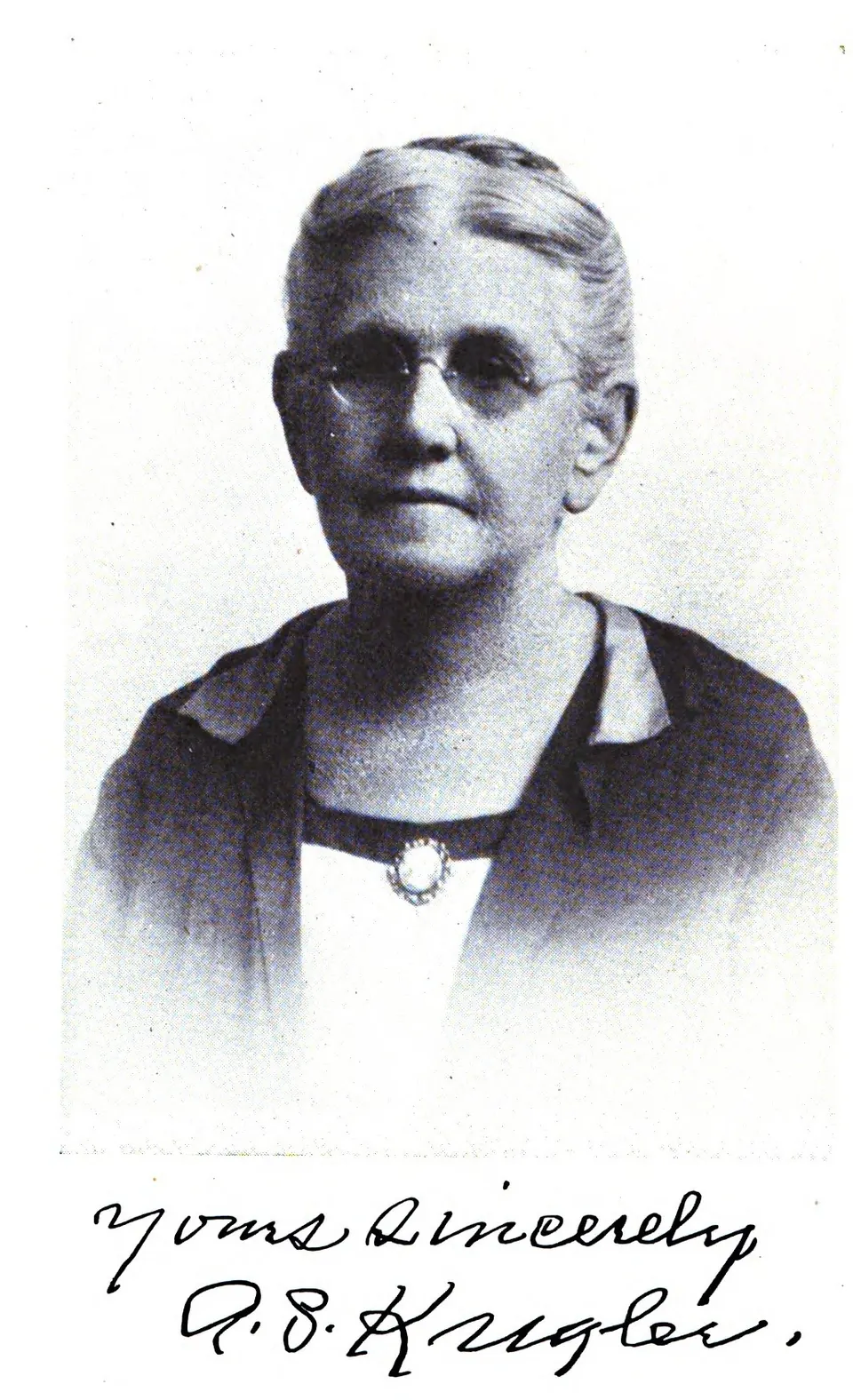
Anna S. Kugler was the first woman doctor of the American Lutheran mission at Guntur.1 She began its medical work, which was aimed above all at women and children.12 Late in life she wrote the hospital’s history herself, Guntur Mission Hospital (1928).3 See Mission methods and Health and medicine.
Training and arrival
She was born at Ardmore, Pennsylvania, on 19 April 1856, and qualified at the Woman’s Medical College of Pennsylvania in 1879.1 She then worked for three years as a doctor at a state asylum.1
She offered to start medical work among women in India, but the mission’s women’s society gave her little encouragement.1 According to the mission’s own history, it sent her only when she agreed to put her medical plans second.1 She reached Guntur on 29 November 1883.1
In her own book, Kugler wrote that the missionary A. D. Rowe had urged her in 1882 to come to Guntur at once.4 He said there was great need for a doctor among the women, but her church was not yet ready to send one.4 She sailed from Philadelphia on 25 August 1883 in a party of seven.5
There was no railway to Guntur then. So the party went up the Buckingham Canal from Madras (now Chennai) in small boats, a journey of fourteen days.5 Guntur then had about 18,000 people, four mission bungalows and a small church.5
The first years
In her first year, her assigned work was schools and zenana visiting (teaching women in their homes), and medicine was “a side issue”.6 Even so, she treated 185 patients in their homes and 276 at the Zenana Home, where she lived.6 Most of the homes she visited were those of high-caste Hindus and Muslims.7
In 1884 she opened schools for Hindu girls at Mangalagiri, Narasaraopet and Bapatla.7 In December 1885 the mission at last appointed her a medical missionary.8 It gave her $50 for rent and medicines, and she saw patients in small rooms of matting on a verandah of the Zenana Home.8
The Guntur dispensaries
Objections at home faded, and late in 1886 she opened a dispensary for out-patients in Guntur.2 It treated 1,353 patients in 1887.2 In 1888 more dispensaries were opened in Guntur and one at Mangalagiri, thirteen miles away.2
Kugler’s own book adds details. In August 1886 she rented a house in the Muslim quarter of the town.8 As far as she knew, it was the first house rented in the Telugu country for medical work for women.8 Two Indian Christian women, P. Evangeline and K. Rangamma, worked there as Bible women and helpers.89
In the house’s first five months, 631 patients came.10 By her count, 96 of them were Christians, 467 Hindus and 67 Muslims.10
While women and children waited, a Bible woman read and taught them, and the doctor spoke with patients as she worked.11 The mission’s historian saw this healing as a way to reach women who could not otherwise be reached.211
Working across caste rules
Kugler soon learned that in a Brahmin home she was ceremonially unclean, so anything she touched was “defiled”.12 She waited in the courtyard while the patient was brought out, and she put medicine bottles down on the floor.12 She wrote that “love was stronger than caste”: after she had saved a mother or a child, families often relaxed their rules with her.12
She also met opposition. She wrote that priests and local doctors often turned the women of a family against calling her in.1013 At first she charged no fees, and she thought this worked in her favour.13
Raising money in the district
The district and taluk boards granted Rs 17,000 for the buildings, after the Collectors recommended it.14 But no money had come for the wall around the compound, which Hindu and Muslim custom required.15 So she toured the district in 1892, 1894 and 1897, and raised Rs 3,500 of the wall’s Rs 5,000 cost from the people.15
On these tours she visited more than fifty villages.15 A Brahmin clerk worked a magic lantern (an early slide projector), and each show was followed by a meeting for the women’s hospital.1516 Only men could attend these meetings, and she wrote that many farmers heard the story of Christ there for the first time.16
The women’s hospital
After her leave in America in 1889–91, she returned in October 1891 and opened a new dispensary for women and children.17 The first building of the new hospital, the out-patient dispensary, opened in February 1893.18 See Guntur Mission Hospital.
In 1893 she went to Chicago to speak for the Lutheran women’s work in India at the religious congress held with the World’s Fair.16 The main hospital building was formally opened on 22 June 1897.19 It took its first patients only in December 1898, while she was on leave.1920 She took charge of it on 2 October 1899, after waiting, as she put it, sixteen years for a hospital.20
Work outside Guntur
From 1906 she began the mission’s medical work in other towns. On 3 February 1906 she opened a dispensary at Chirala and went there by train once a week.21 Another dispensary opened at Tenali on 15 February 1916.22
Honours and last years
In 1905 the British government gave her the silver Kaisar-i-Hind medal, an award for public service in India.23 At the ceremony in Madras, the Governor, Lord Ampthill, said south India owed American missionaries like her “far more than is generally recognized”.23 A silver bar was added to the medal in 1917.23
In 1925 she collapsed and was sent to America, where a long illness stopped her work for two years.24 She wrote her history while she was recovering.3 As the book went to press in 1927, she was at sea, on her way back to Guntur.25
Her own view of the work
Kugler made no secret that the hospital meant to spread Christianity. She wrote that “no apology is offered” for presenting Christ to patients.26 She also wanted patients to pay fees where they could, so that Indians would learn to build and run hospitals for women themselves.2728
She also advised new missionaries to learn that some Indian customs “are really superior to those of the West”.29 In her view, missionaries who did not offend caste needlessly were the most successful.29
Where the sources disagree
The two histories date the first branch dispensaries differently:
- L. B. Wolf (1896) says the dispensary opened “in the latter part of 1886”, and that more dispensaries in Guntur opened in 18882
- Kugler (1928) dates the rented house to August 1886, and the branch dispensaries in Guntur and at Mangalagiri to 188781321
Footnotes
-
L. B. Wolf, After Fifty Years, or an Historical Sketch of the Guntur Mission (1896), p. 157 (archive.org (opens in a new tab)). ↩ ↩2 ↩3 ↩4 ↩5 ↩6 ↩7
-
Wolf, After Fifty Years (1896), p. 193 (archive.org (opens in a new tab)). ↩ ↩2 ↩3 ↩4 ↩5 ↩6
-
Anna S. Kugler, Guntur Mission Hospital, Guntur, India (1928), p. iii (HathiTrust (opens in a new tab)). ↩ ↩2
-
Kugler, Guntur Mission Hospital (1928), p. 1 (HathiTrust (opens in a new tab)). ↩ ↩2
-
Kugler, Guntur Mission Hospital (1928), p. 2 (HathiTrust (opens in a new tab)). ↩ ↩2 ↩3
-
Kugler, Guntur Mission Hospital (1928), p. 3 (HathiTrust (opens in a new tab)). ↩ ↩2
-
Kugler, Guntur Mission Hospital (1928), p. 4 (HathiTrust (opens in a new tab)). ↩ ↩2
-
Kugler, Guntur Mission Hospital (1928), p. 5 (HathiTrust (opens in a new tab)). ↩ ↩2 ↩3 ↩4 ↩5 ↩6
-
Kugler, Guntur Mission Hospital (1928), p. 6 (HathiTrust (opens in a new tab)). ↩
-
Kugler, Guntur Mission Hospital (1928), p. 9 (HathiTrust (opens in a new tab)). ↩ ↩2 ↩3
-
Wolf, After Fifty Years (1896), p. 194 (archive.org (opens in a new tab)). ↩ ↩2
-
Kugler, Guntur Mission Hospital (1928), p. 8 (HathiTrust (opens in a new tab)). ↩ ↩2 ↩3
-
Kugler, Guntur Mission Hospital (1928), p. 10 (HathiTrust (opens in a new tab)). ↩ ↩2 ↩3
-
Kugler, Guntur Mission Hospital (1928), p. 13 (HathiTrust (opens in a new tab)). ↩
-
Kugler, Guntur Mission Hospital (1928), p. 15 (HathiTrust (opens in a new tab)). ↩ ↩2 ↩3 ↩4
-
Kugler, Guntur Mission Hospital (1928), p. 16 (HathiTrust (opens in a new tab)). ↩ ↩2 ↩3
-
Wolf, After Fifty Years (1896), p. 158 (archive.org (opens in a new tab)). ↩
-
Wolf, After Fifty Years (1896), p. 195 (archive.org (opens in a new tab)). ↩
-
Kugler, Guntur Mission Hospital (1928), p. 17 (HathiTrust (opens in a new tab)). ↩ ↩2
-
Kugler, Guntur Mission Hospital (1928), p. 49 (HathiTrust (opens in a new tab)). ↩ ↩2
-
Kugler, Guntur Mission Hospital (1928), p. 99 (HathiTrust (opens in a new tab)). ↩ ↩2
-
Kugler, Guntur Mission Hospital (1928), p. 104 (HathiTrust (opens in a new tab)). ↩
-
Kugler, Guntur Mission Hospital (1928), p. ix (HathiTrust (opens in a new tab)). ↩ ↩2 ↩3
-
Kugler, Guntur Mission Hospital (1928), p. 123 (HathiTrust (opens in a new tab)). ↩
-
Kugler, Guntur Mission Hospital (1928), p. 125 (HathiTrust (opens in a new tab)). ↩
-
Kugler, Guntur Mission Hospital (1928), p. 64 (HathiTrust (opens in a new tab)). ↩
-
Kugler, Guntur Mission Hospital (1928), p. 84 (HathiTrust (opens in a new tab)). ↩
-
Kugler, Guntur Mission Hospital (1928), p. 117 (HathiTrust (opens in a new tab)). ↩
-
Kugler, Guntur Mission Hospital (1928), p. 60 (HathiTrust (opens in a new tab)). ↩ ↩2
Photos
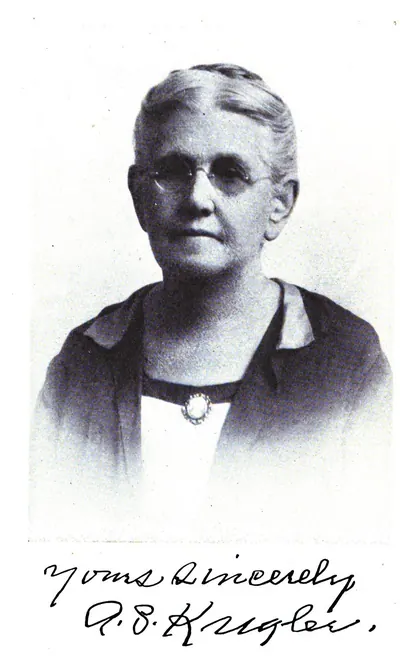 Dr Anna S. Kugler, founder of the Guntur Mission Hospital (frontispiece of her book, 1928)Book plate · 1928
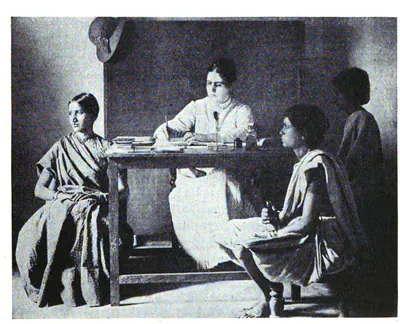 Dr Kugler's consulting room in the first rented dispensary at Guntur, 1886Book plate · 1928
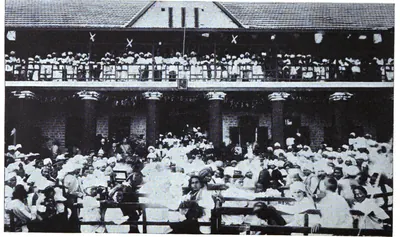 Opening day of the Guntur Mission Hospital, June 1897 (Kugler, 1928)Book plate · 1928
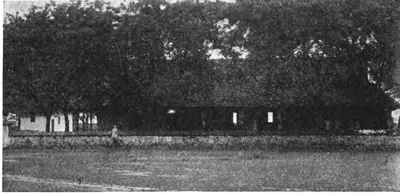 The dispensary at Guntur, "the first building erected for medical work for women in Telugu country" (Kugler, 1928)Book plate · 1928
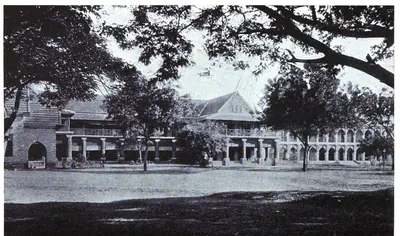 The Guntur Mission Hospital, with its chapel, main building and maternity block (Kugler, 1928)Book plate · 1928
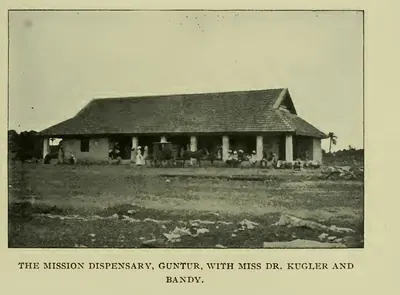 The Lutheran mission dispensary at Guntur, with Dr Anna Kugler's cart, about 1896Book plate · 1896
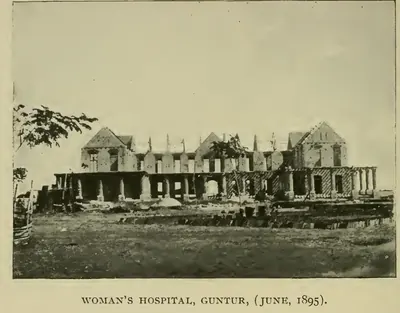 The women's hospital at Guntur being built, June 1895Book plate · 1896
Related
Institutions
References
Notes (0)
Sources (2)
Spotted an error on this page? Tell us
Last updated: