Women in Telugu history
Telugu women from the queens and donors of the inscriptions and the women poets of the courts to the reformers, writers and freedom fighters of the 20th century. The page covers what the census found about child marriage, widowhood and literacy, the women's journals and Mahila Sabhas, women in the salt satyagraha and the picketing of 1932, and women in the Andhra Mahasabha and the Telangana struggle.
Download
Telugu women appear in history as queens, donors, poets, reformers and fighters. The early records are mostly about women of royal and rich families.12 From the late 19th century, census reports, journals and histories let us see the lives of ordinary women too: their marriages, their schooling and their part in public life.345 This page follows that story from the inscriptions to the 1950s.
About the sources. Most records before 1900 were written by men, about men. Women enter them mainly as givers of gifts or as wives and daughters of kings.16 For the 20th century this page uses census reports, Sarojini Regani’s history of the freedom movement and S. Mahaboob Basha’s study of the women’s journal Hindu Sundari.374 For girls’ schools, see Schools and learning.
Queens and donors
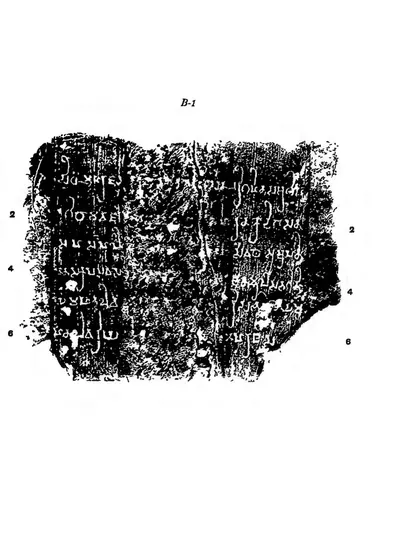
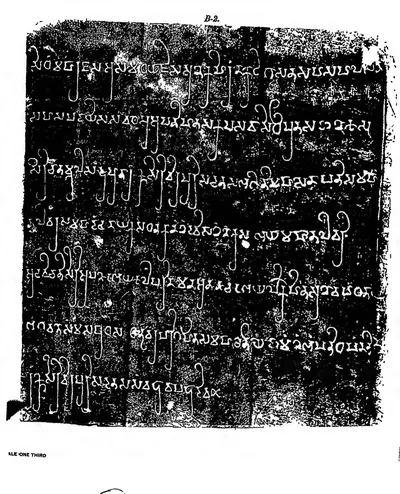
Women gave some of the greatest gifts of early Telugu history. At Nagarjunakonda in the 3rd century, the Buddhist monuments of the Ikshvaku capital were paid for by queens and princesses of the royal house.1 They were led by the king’s sister, Chamtisiri.1 See Society & communities.
A thousand years later, women of the Kakatiya family held real power. Ganapamba, a daughter of Ganapatideva, carried the title Mahamandalesvara (great feudatory lord).6 The 1913–14 report on inscriptions took this to mean that she ruled her husband’s lands herself after his death.6
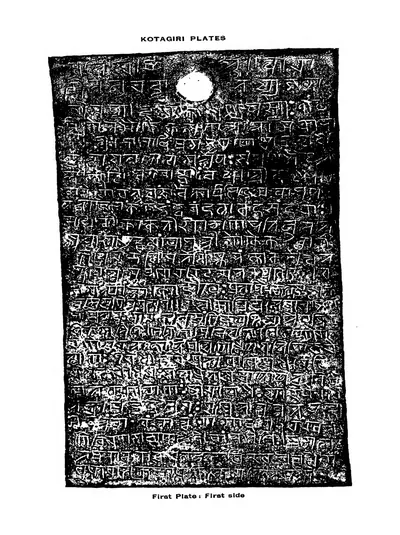
Ganapatideva’s daughter Rudramadevi came to the throne in the Saka year 1182 (1260–61).6 She ruled under the man’s name Rudradeva Maharaja.6 The Imperial Gazetteer notes that Marco Polo mentions her as the ruler of the country.8
Poets and patrons
Women also wrote. P. Chenchiah and Raja M. Bhujanga Rao, in their history of Telugu literature (1928), gave a whole chapter to women poets.2 They wrote that custom and prejudice made it hard for women to win the praise they deserved.2 They also noted that women in power were patrons of poets, as Rudramadevi was.2
Their list begins with women remembered only in tradition, such as Kuppamma, daughter of Nannaya’s friend and helper Narayana Bhatta.9 It goes on to Molla, a potter woman of the early 16th century. They called her Ramayana the most widely read of all the Telugu Ramayanas.9 Later poets such as Muddupalani, Rangajamma and Tarigonda Vengamamba have their own pages. See also Telugu literature, age by age.
Reformers and the first women writers
In the 1870s the reformer Kandukuri Veeresalingam took up the cause of women.10 Besides his journal Vivekavardhini, he started a separate journal for women, called Satihita Bodhini.10 In these journals he wrote against child marriage and argued for the remarriage of widows.10 His first widow remarriage, in 1881, is told on Reform, freedom & people’s movements.
His wife, Kandukuri Rajyalakshmi, born in 1851 at Kanteru in West Godavari, shared this work.11 N. Kanakarathnam calls her the first woman of the Andhra region to take up social reform.11 At the widow remarriages, when Brahmin cooks refused to serve, she carried water from the Godavari and cooked the wedding meals herself.12 She also ran a home and school for widows, which at one time had over 150 women. She died on 11 August 1910.12
Soon women wrote for themselves. The journal Hindu Sundari, begun in April 1902, was the first Telugu women’s journal to be edited by women.13 It printed women’s essays, speeches and news.4 In 1903 it printed a life of Bandaru Achamamba, with her photograph.4 Its pages also carried short lives of other women active in the women’s movement, such as Kotikalapudi Seetamma and Uppuluri Nagaratnamma.4
Women also organised. S. Mahaboob Basha writes that women’s associations grew up all over Andhra from the start of the 20th century.14 By about 1910 they held their own all-Andhra conferences, the Andhra Mahila Sabhas.14 Two later journals carried the work forward:14
- the Gruhalakshmi, published in Madras from 1 March 1928
- the Andhra Mahila, from 15 May 1944, first edited by Durgabayamma, later known as Durgabai Deshmukh14
What the census showed
The census showed how early many girls were married. In 1931 the Madras census found that girls were married youngest in the north of the east coast: in Ganjam and the northern Telugu districts.15 In this northern coastal division, 47 of every 1,000 Hindu girls under five were returned as married, against 21 in 1921.15 Among Hindu girls aged five to ten, 268 in every 1,000 were married.15
The figures for girls under five varied from district to district:15
| District (1931) | Married Hindu girls aged 0–5, per 1,000 | Aged 5–10, per 1,000 |
|---|---|---|
| Visakhapatnam (then Vizagapatam) plains | 111 | 442 |
| East Godavari plains | 104 | 193 |
| Guntur | 103 | 167 |
| West Godavari | 87 | 177 |
| Krishna (then Kistna) | 57 | 145 |
| Nellore | 24 | 86 |
One reason for the high figures was a new law against child marriage, the Sarda Act, which gave six months’ grace before it came into force. The census says that thousands of child marriages took place in those months.3 Still, the census found that Kistna and West Godavari stood fourth and fifth in the Presidency for women’s literacy, and East Godavari seventh.16
In Hyderabad State there was no such law. A bill like the Sarda Act was brought before the Hyderabad Legislative Council by Keshav Rao. Orthodox Hindus opposed it, but a women’s association in Hyderabad supported it fully.17 The census writer noted that the higher Hindu castes forbade widows to marry again. But the Nizam’s government let the widows of jagirdars (holders of land grants) keep their allowances even after a second marriage.18
Schooling for women grew mainly in the city. In Hyderabad city, 137 of every 1,000 women could read and write in 1931, against 44 in 1911.19 In the Warangal district, only 8 women in every 1,000 were literate, the same as in 1921.19
Women in the freedom movement
Women joined the national movement in large numbers. When Gandhi toured the Andhra country after the Congress session at Vijayawada, women gave their jewellery to the Tilak Swaraj Fund. Maganti Annapurnamma was among the first to give all her jewellery and to wear only khaddar (hand-spun cloth).20
In the salt satyagraha of 1930, women formed their own groups. In Guntur, the women’s section of the volunteers was led by Unnava Lakshmibayamma and Rukmini Lakshmipathi.7 In West Godavari about 500 women came to see the salt law broken, and about 100 helped to boil the sea water.7 In Madras, Durgabayamma led women volunteers, and she was sentenced to a year’s simple imprisonment.721 Unnava Lakshmibayamma and Vedantam Kamala Devi of Kakinada were among the women leaders arrested.21
In 1932 thousands of women joined the movement again.5 At Gudivada, Vallabhaneni Sitamahalakshmamma and her companions picketed shops against an order banning meetings. They were sentenced to a year in jail. One of them, Manikyamba, went to jail with a baby six months old.5 The police then left women volunteers in lonely places far from town, and sprayed them with dirty water as they picketed.22
Women in Hyderabad and the Telangana struggle
In Hyderabad State, girls’ schooling in Telugu was itself a political cause. From 1928 the Andhra Jana Sangham took up women’s education.23 It founded the Andhra Balika High School, and in 1934 its first girls taught in Telugu sat for the matriculation examination.23 Osmania University would not recognise the school, because to the university “mother tongue” meant Urdu. So the girls took their examination through the Karve Institute instead.23
The Andhra Mahasabha held a women’s conference, the Andhra Mahila Sabha, alongside its own meetings.24 In 1942, at Dharmavaram, the women felt strong enough to hold their own separate conference.24 Women such as Arutla Kamala Devi went further. She was general secretary of the Hyderabad Women’s Association in 1942–44, and in the struggle of 1946–48 she organised women against the Razakars.25
In his history of the Telangana armed struggle, the Communist leader P. Sundarayya gives a chapter to women.26 He writes that women fought beside men for land and higher wages, and joined the armed squads as fighters, messengers and speakers.26 He calls Chakali Ilamma, who fought to keep her land from the deshmukh (landlord) of Visnur, a symbol of the first phase of the struggle.27 At Mukundapuram, a moneylender, helped by soldiers, had a potter named Mattayya tortured to death for refusing to give up his land. His widow still refused to give it up.27 Sundarayya adds that thousands of women stood with their men to win and keep land.28
Women writers of the Dalit movement
Dalit women wrote too. K. Purushotham notes that a Dalit woman, Gottumukkala Mangayamma, published a short story, Ayyopapam, in 1935.29 A. Satyanarayana calls Ryotu Pilla, by Jala Mangamma, the first Telugu Dalit novel.30 She taught in night schools and set up hostels for Dalit girls in 1928–31.31 See Dalit history.
Where the sources disagree
When did Rudramadevi come to the throne, and who was she? The Imperial Gazetteer of Hyderabad (1909) says that Ganapatideva was succeeded by “his wife or daughter” Rudrama Devi, about 1257.8 The Madras reports on inscriptions call her Ganapatideva’s daughter. They say she came to the throne in the Saka year 1182 (1260–61).632
Footnotes
-
J. Ph. Vogel, “Prakrit Inscriptions from a Buddhist Site at Nagarjunikonda”, Epigraphia Indica XX (1933), p. 4 (archive.org (opens in a new tab)). ↩ ↩2 ↩3 ↩4
-
P. Chenchiah and Raja M. Bhujanga Rao, A History of Telugu Literature (1928), p. 102 (archive.org (opens in a new tab)). ↩ ↩2 ↩3 ↩4
-
Census of India, 1931, Vol. XIV: Madras, Part I, Report (1932), p. 159, child marriage (archive.org (opens in a new tab)). ↩ ↩2 ↩3
-
S. Mahaboob Basha, “Flagging off the Marathon: Print Culture and Women’s Intellectual Movement in Colonial Andhra: Story of the Hindu Sundari, 1902–1947”, Kakatiya Journal of Historical Studies, Vol. V (2010), p. 83 (archive.org (opens in a new tab)). Cite-only; paraphrased. ↩ ↩2 ↩3 ↩4 ↩5
-
Regani, Highlights (1956), p. 131 (archive.org (opens in a new tab)). Cite-only; paraphrased. ↩ ↩2 ↩3
-
Annual Report on Epigraphy, Madras, for 1913–14 (G.O. No. 920, Public, 4 August 1914), Part II, para. 40, p. 104 (archive.org (opens in a new tab)). ↩ ↩2 ↩3 ↩4 ↩5 ↩6
-
Regani, Highlights (1956), p. 116 (archive.org (opens in a new tab)). Cite-only; paraphrased. ↩ ↩2 ↩3 ↩4
-
Imperial Gazetteer of India, Provincial Series: Hyderabad State (1909), p. 164 (archive.org (opens in a new tab)). ↩ ↩2
-
Chenchiah and Bhujanga Rao, A History of Telugu Literature (1928), p. 103 (archive.org (opens in a new tab)). ↩ ↩2
-
Sarojini Regani, Highlights of the Freedom Movement in Andhra Pradesh (1956), p. 18 (archive.org (opens in a new tab)). Cite-only; paraphrased. ↩ ↩2 ↩3
-
N. Kanakarathnam, “Gendered Anomalies and 19th Century Social Reforms: Kandukuri Rajyalakshmi and Girls Education in Madras Presidency”, Kakatiya Journal of Historical Studies, Vol. XV, No. 1 (2020), p. 37 (archive.org (opens in a new tab)). Cite-only; paraphrased. ↩ ↩2
-
Kanakarathnam, “Kandukuri Rajyalakshmi”, KJHS XV (2020), p. 41 (archive.org (opens in a new tab)). Cite-only; paraphrased. ↩ ↩2
-
S. Mahaboob Basha, “Flagging off the Marathon: Print Culture and Women’s Intellectual Movement in Colonial Andhra: Story of the Hindu Sundari, 1902–1947”, Kakatiya Journal of Historical Studies, Vol. V (2010), p. 77 (archive.org (opens in a new tab)). Cite-only; paraphrased. ↩
-
Basha, “Story of the Hindu Sundari”, KJHS V (2010), p. 87, notes (archive.org (opens in a new tab)). Cite-only; paraphrased. ↩ ↩2 ↩3 ↩4
-
Census of India, 1931, Vol. XIV: Madras, Part I (1932), p. 160 (archive.org (opens in a new tab)). ↩ ↩2 ↩3 ↩4
-
Census of India, 1931, Vol. XIV: Madras, Part I (1932), p. 161 (archive.org (opens in a new tab)). ↩
-
Census of India 1931, Vol. XXIII, Part I (1933), p. 106 (archive.org (opens in a new tab)). Paraphrased. ↩
-
Census of India 1931, Vol. XXIII: H.E.H. the Nizam’s Dominions, Part I: Report (1933), p. 105 (archive.org (opens in a new tab)). Paraphrased. ↩
-
Census of India 1931, Vol. XXIII, Part I (1933), p. 198 (archive.org (opens in a new tab)). Paraphrased. ↩ ↩2
-
Regani, Highlights (1956), p. 72 (archive.org (opens in a new tab)). Cite-only; paraphrased. ↩
-
Regani, Highlights (1956), p. 117 (archive.org (opens in a new tab)). Cite-only; paraphrased. ↩ ↩2
-
Regani, Highlights (1956), p. 132 (archive.org (opens in a new tab)). Cite-only; paraphrased. ↩
-
Regani, Highlights (1956), p. 179 (archive.org (opens in a new tab)). Cite-only; paraphrased. ↩ ↩2 ↩3
-
Regani, Highlights (1956), p. 180 (archive.org (opens in a new tab)). Cite-only; paraphrased. ↩ ↩2
-
Sarojini Regani (ed.), Who’s Who of Freedom Struggle in Andhra Pradesh, Vol. II (1980), p. 484 (archive.org (opens in a new tab)). Cite-only; paraphrased. ↩
-
P. Sundarayya, Veera Telangana Viplava Poratam: Gunapathalu (1973), p. 401, chapter 9 (archive.org (opens in a new tab)). Cite-only; paraphrased. ↩ ↩2
-
Sundarayya, Veera Telangana (1973), p. 402 (archive.org (opens in a new tab)). Cite-only; paraphrased. ↩ ↩2
-
Sundarayya, Veera Telangana (1973), p. 403 (archive.org (opens in a new tab)). Cite-only; paraphrased. ↩
-
K. Purushotham, “From Social Reform to Dandora: A Critical Perspective of Telugu Dalit Short Stories in Historical Outline”, Kakatiya Journal of Historical Studies, Vol. XV, No. 1 (2020), p. 6 (archive.org (opens in a new tab)). Cite-only; paraphrased. ↩
-
A. Satyanarayana, “Articulation of Self and the Other: Emergence of the Dalit Movement in Andhra Pradesh”, Kakatiya Journal of Historical Studies, Vol. I, No. 1 (2006), p. 72 (archive.org (opens in a new tab)). Cite-only; paraphrased. ↩
-
Satyanarayana, “Articulation of Self and the Other”, KJHS I (2006), p. 74 (archive.org (opens in a new tab)). Cite-only; paraphrased. ↩
-
Annual Report on Epigraphy, Madras, for 1916–17 (G.O. No. 1035, Home (Education), 10 August 1917), Part II, para. 31, p. 122 (archive.org (opens in a new tab)). ↩
Photos
 "Kulpak inscription", face I (Sreenivasachar, Corpus of Inscriptions in the Telingana Districts II, Plate 27 (PDF p. 274))Inscription rubbing · 1940
 Kotagiri plates of the reign of the Kakatiya queen Rudramamba, A.D. 1273: First plate: first side (Kotagiri Plates 1925)Inscription rubbing · 1925
 Nagarjunakonda: ayaka-pillar inscription B 1 (south side, first pillar) (Epigraphia Indica XX)Inscription rubbing · 1933
 Nagarjunakonda: ayaka-pillar inscription B 2 (south side, second pillar) (Epigraphia Indica XX)Inscription rubbing · 1933
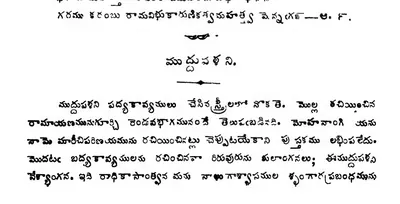 Veeresalingam's entry on Muddupalani in "Andhra Kavula Charitramu", Part III (p. 100)Book plate · 1911
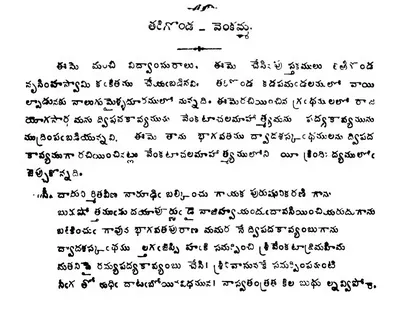 Veeresalingam's entry on Tarigonda Venkamma in "Andhra Kavula Charitramu", Part III (p. 218)Book plate · 1911
References
Notes (0)
Sources (13)
Spotted an error on this page? Tell us
Last updated: