How the missions worked: preaching, schools, hospitals and relief
The methods of the Christian missions in the Telugu country in the 19th and early 20th centuries: preaching at festivals and in streets, touring the villages by cart and tent, tracts and the Telugu Bible, schools from Noble's high-caste school to Mala and Madiga village schools, boarding and training schools, hospitals, zenana visiting and Bible women, famine relief on the Buckingham Canal, help in courts and with officials, and the Indian teachers, catechists and pastors who did most of the daily work.
Download
The missions used many methods to reach people: preaching, touring, printed books, schools, hospitals, relief in famines and help with officials.12 This page describes each in turn, with examples, and names who reported them. Most of the daily work was done by Indian preachers, teachers and Bible women, so they appear throughout.34
About the sources. Nearly all the examples come from the missions’ own books and reports, which were written for supporters.5 Census writers and district manuals add an outside view in places.67 See also How the missions came and Why people converted.
Preaching at festivals and in the streets
Missionaries went where crowds gathered. In 1859 the CMS missionary T. Y. Darling preached at the Sivaratri festival at Vijayawada, where some 40,000 people had come to bathe in the Krishna.8 It was there that the Mala leader Pagolu Venkayya came looking for him.9
Preaching could meet anger. When Samuel Day preached at the Narasimhakonda festival near Nellore, a Brahmin at Zonnavada struck him with his shoe.10 A magistrate insisted on a trial, and the Brahmin was fined five hundred rupees.10 At Ongole in 1866, John Clough’s preachers spoke in the streets while a colporteur sold tracts and parts of the Bible.11
Touring the villages
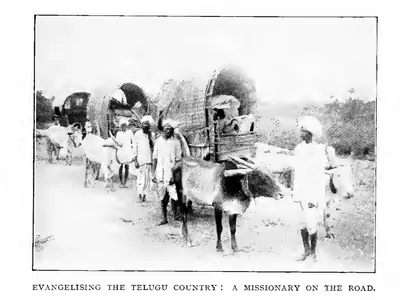
Missionaries toured the villages for weeks at a time. Clough travelled to Tullakondapadu by bullock cart at night, resting by day.12 He pitched his tent in a tamarind grove and sent word to the villages around.12 Joseph Mullens, who visited in 1853, described such long tours as a regular part of the work.1
Tracts and the Telugu Bible
Printed words often went ahead of the preachers. The LMS press at Visakhapatnam printed a revised Telugu New Testament and about twenty thousand tracts a year by 1836.13 Pagolu Venkayya first heard of the “Saviour of the world” from a tract read aloud in his village, because he could not then read.14 For the presses, see Telugu printing.
Tracts could work far from the press. Edward Porter of the LMS wrote in his journal that a convert at Srikakulam, Somanah, had read the Visakhapatnam tract on Jagannath while on pilgrimage there.15 He turned back, went to the mission chapel at Srikakulam and became a Christian.15
Printing was slow at first. In 1837 the LMS missionaries John Smith and J. Howell complained that the Old Testament translations of two LMS men, Gordon and Pritchett, had lain unprinted for years.1617 Only Genesis and part of Exodus had appeared, though Pritchett’s New Testament had long been in use.17 They also noted that the Madras Religious Tract Society had given out only 37,000 Telugu tracts in a year.18
Translation could divide the missions. In 1878 the Canadian Baptist A. V. Timpany published a reply to the LMS missionary J. Hay.19 The quarrel was over the Telugu word for baptism. The Bible Society’s version used snanamu (bathing), while Baptists wanted a word meaning to dip or immerse.20 Timpany said the Bible Society had used shared funds to print a tract against the Baptist view.19
Village schools for Malas and Madigas
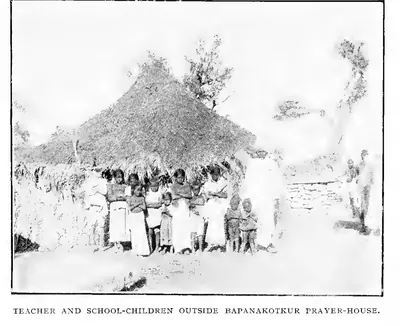
The school stood at the centre of village work. Hibbert-Ware, an SPG missionary, described the rules in 1912.2 A village asking for a teacher had to say how many families wished to join and how many children would come to school.2 The elders signed the request, and the mission’s teachers asked about their motives.2
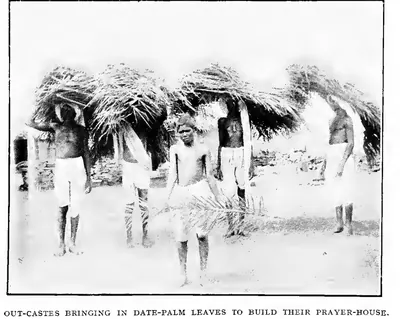
The people then had to build a chapel-school and a house for the teacher.21 While under instruction they had to keep Sunday, stop all worship of the old gods, attend the services and send their children to school.21 If they broke these rules, the teacher was taken away.22
The rule was older than Hibbert-Ware’s book. In the SPG report for 1871–72, J. Clay, the missionary at Mutyalapad, wrote that he gave no teacher to a village until its people had put up a building of their own for worship.2324 He called this “a good test of the earnestness and sincerity” of those asking for teaching.24
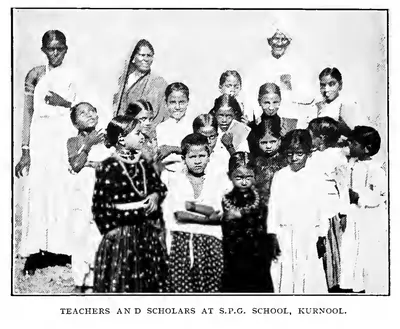
The teacher held prayers morning and evening and called the roll family by family.3 He taught the children by the government’s code, settled quarrels and tried to keep good relations with the landlords.22 In 1909 the SPG mission alone had 184 such schools with 216 teachers.25
Schools for the higher castes
Some missions also opened English schools for high-caste boys. Robert Noble of the CMS opened his school at Machilipatnam on 21 November 1843, with two boys.26 He openly aimed to make his pupils Christians, and about twenty-five of them, mostly Brahmins, were baptised.26 See Noble College and Caste and the church.
Early schools sometimes paid parents to send children. Downie, the Baptist historian, wrote that at Nellore in 1857 parents were still given a small sum for each day scholar.27 He called this “a very doubtful policy” that had long been given up.27
Boarding, girls’ and training schools
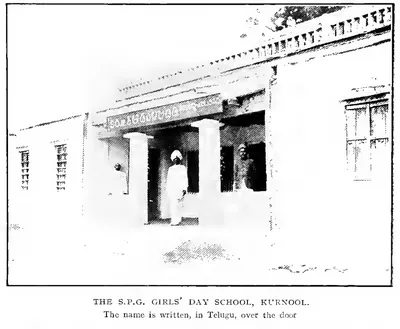
Boarding schools took the best village children and trained them as future teachers. Bishop Henry Whitehead explained the method in 1924: boys were taken at ten, kept in boarding schools till about eighteen, and sent out as teachers.28 The SPG’s teachers came mostly from its training school at Nandyal.25
Girls’ schools grew slowly. At Nellore a new girls’ school was built in 1876, partly with a government grant of three thousand rupees.29 Two years earlier, wrote Downie, even Christian parents had been hard to persuade to send their daughters.29
An earlier girls’ school had met the same doubts. In 1836 Martha Porter opened an orphan and boarding school for girls at Visakhapatnam.30 Her memoir says European residents and Indian gentlemen both opposed it, thinking it useless to teach Hindu girls.30 It had forty girls by 1839.31
Each large mission trained its own workers. The CMS had a training institution at Machilipatnam.32 The American Baptists opened their seminary at Ramapatnam in 1872, and the Canadian Baptists theirs at Samalkot in 1882.3334
Hospitals and dispensaries
Medicine opened doors. A. V. Timpany treated the sick at Ramapatnam, and Downie said this won the people’s trust.35 At first caste people refused medicine mixed with water from the mission, but they soon accepted it.35
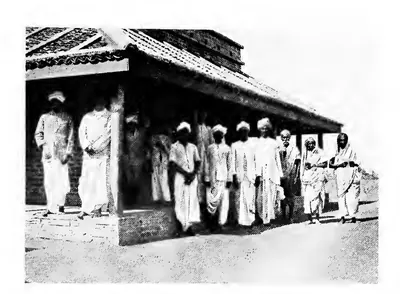
Larger hospitals followed:
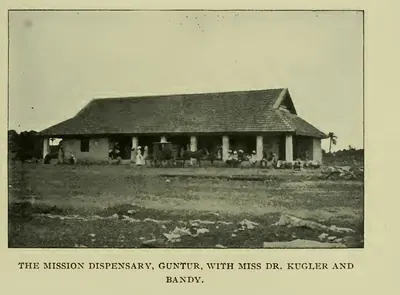
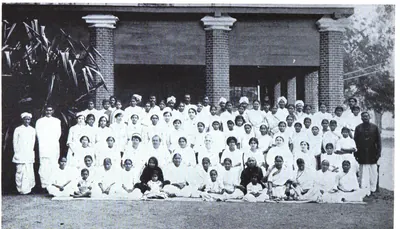
- at Guntur, Dr Anna S. Kugler of the Lutheran mission opened a dispensary in 1886, and treated 1,353 patients in 188736
- at Jammalamadugu, the LMS doctor T. V. Campbell opened a hospital in 1896, which by 1912 treated about 14,000 out-patients a year3738
- at Medak, the Wesleyans ran a hospital for women and children39
- at Hanamkonda, the American Baptists completed a hospital in 190239
- in the Godavari district, the Canadian Baptists ran the Kellock home for leprosy patients and a hospital at Ramachandrapuram34
For mission hospitals at Nellore and Rajahmundry, see Health and medicine.
Zenana visiting and Bible women
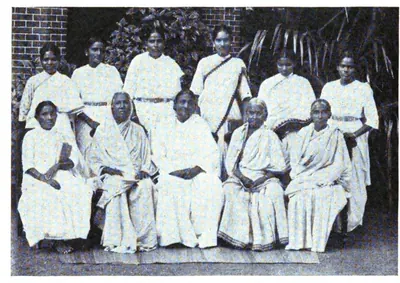
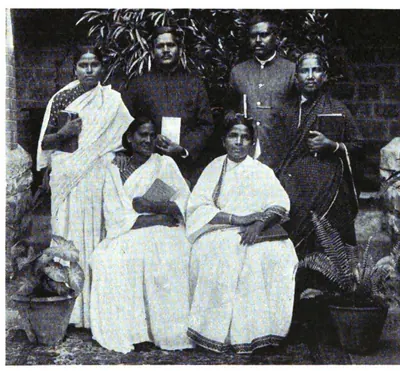
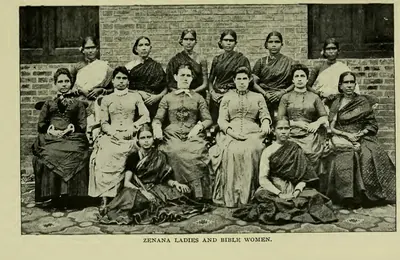
High-caste women in zenanas (women’s quarters) could not come to church or school, so women missionaries went to them. At Machilipatnam the CMS began a “Zenana Mission” in 1873.40 By 1883 its ten workers, including three Bible women (Indian women who taught the Bible in homes), taught 145 women at home and ran five girls’ schools.40 The manual noted that two Sudra women had become Christians.40
The LMS trained Bible women at its girls’ boarding school at Jammalamadugu from 1893.41 Hibbert-Ware thought their visits had a very great effect on the congregations.41
Famine relief and the Buckingham Canal
The great famine of 1876–78 drew the missions into relief work. At Nellore, the Collector paid for a camp in the mission compound, where Mrs Downie fed about a hundred children a day.42 Government relief works included the Buckingham Canal, a canal running north from Madras along the coast.4344
At Ongole, Clough saw that his Madiga Christians would not go to the canal camps. In his memoir he said the overseers could oppress them, and they “preferred to die at home”.45 His preachers asked him to take a contract, with themselves as overseers.45 He did so, and digging began at Razupallem on 24 February 1877, with about 800 workers.4647
The preachers worked beside the diggers and read the Bible to them.48 Hibbert-Ware wrote that preachers were first sent to dig with their own hands, to test them.49 According to Clough’s memoir, the caste people decided that “the Ongole Dhora had made a big Madiga of himself”, though English officials still ate with him.50
The missions did not baptise during the relief. The Ongole mission refused all baptisms for fifteen months, so that no one would join for food.51 See Mass movements for what followed, and Famines and floods for the famine itself.
Help with land, courts and officials
The missions also helped their people in daily troubles. At Kadapa, before 1849, the chaplain W. W. Whitford gave the first Anglican converts land for houses.52 In 1878 Clough gave seed-grain to small farmers who owned land.53
Help in court mattered most. When the Malas of Kudravaram came to Kadapa for a court case against the caste people, Alfred Wood “helped them through their case” and taught them Christianity at the same time.5455 The whole Mala community of the village then asked for instruction.55
Officials noticed this. The 1921 Hyderabad census writer said a convert could be “represented by his spiritual adviser” and have his case put to officials.6 The 1911 Madras census writer said that the convert did not lack “a temporal defender”.56 On loans, the sources used here say almost nothing.
Indian preachers, catechists and teachers
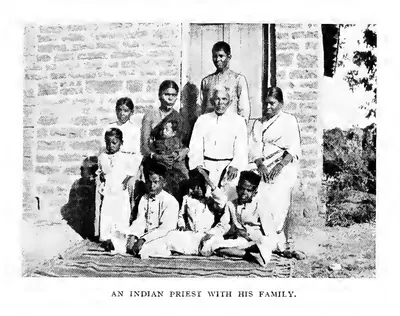
The village teacher was, in Hibbert-Ware’s words, “the backbone” of the work.25 A catechist (senior teacher) visited a circle of villages each month, and an Indian pastor oversaw a larger circle and gave the sacraments.4 At Ongole on 16 April 1880 twenty-four Indian preachers were ordained in one service.57
Indian preachers also began to run their own meetings. At the Baptist jubilee conference at Nellore in February 1886, the Telugu Christians held a session in Telugu.58 They elected the Rev. N. Canakiah, the mission’s first ordained preacher, as chairman, and T. Daniel as clerk.5859 Canakiah remembered that in the early days there were no carts, so tents went on bullocks, and the helper Christian Nursu carried books from village to village on a kavadi (shoulder pole).59
In the late 1890s Telugu Baptists founded their own Telugu Baptist Home Mission Society.60 J. P. Jones, writing in 1900, said it was four years old and run entirely by Telugu Christians.60 It paid preachers to work among peoples the missions had neglected, such as the Yanadis of Nellore and Krishna, the Chenchus of the Nallamala hills and the Savaras of the Parlakimidi hills.60
Pay was low. In 1886 Jacob Chamberlain of the Arcot mission said a village teacher received 30 to 36 dollars a year, most catechists 60 to 90, and the best-paid pastors 150.61 As a boy, T. Rangiah was paid one rupee a month to teach small children at Nellore.62 In 1869 Thomas Gabriel gave up a telegraph post paying seventy rupees a month to preach.63
In the Lutheran mission at Rajahmundry, two long-serving catechists, N. Paulus and T. Joseph, were ordained as pastors at Christmas 1878.6465 Each was to be paid 20 rupees a month.64 Paulus came from a family of weavers in Palnadu who had been baptised by Heyer.66 Joseph, a soldier’s son from Guntur, was baptised in 1852, much against his mother’s wishes.67
Wischan’s book of 1891 said the European missionaries baptised “more slowly and carefully” than the Indian preachers.64 It gave Paulus’s own baptisms as 81 in six months of 1881, rising to 277 in 1884.64 The book also gave the mission’s rates of pay. A Telugu teacher earned 35 to 75 dollars a year and a catechist 90, while a married missionary earned 800 to 1,200.68
In its mass-movement fields, which included the Telugu country, a CMS delegation of 1921–22 described the “teacher-catechist”.6970 By day he taught the children in a village day school.70 After dark, when the people came back from the fields, he led their worship and taught them the faith.70 Where the government was generous, it paid half or even three-quarters of his salary as a grant-in-aid.70
Self-support and church councils
The missions asked congregations to pay their share. Converts built their own chapels, and Hibbert-Ware called the cost “one of the best tests of the sincerity of a village”.71 They also paid weekly gifts towards the teacher.2272
The CMS delegation gave figures for 1920–21. The 40,000 baptised Christians of the CMS Telugu church gave about Rs 30,000 that year, or about 12 annas (three-quarters of a rupee) each.73 With government grants-in-aid, the delegation wrote, this met half the cost of all its pastoral work and village schools.74 It thought the Telugu Christians gave “a very good ratio per head” for “very poor people”.74
Chamberlain wrote that the Madanapalle church gave about one-twentieth of its members’ income in 1885.7576 It paid its own evangelist, Abraham, a convert from Islam.76 Village mothers set aside a handful of grain at each meal for the Sunday offering.77
Church government moved slowly into Indian hands. The CMS held its first Native Church Council in 1876, and such councils later chose men for ordination.7832 In the Dornakal diocese after 1912, Bishop Azariah handed the districts to Indian councils led by Indian priests of Mala and Madiga origin.79 Congregations also judged their own members in a panchayat (council) of five Christians.80
Where the sources disagree
How long was Clough’s stretch of canal? Hibbert-Ware (1912) and Clough’s memoir (1914) say three miles.4981 Downie (1893) says “some four miles”.42 Clough’s memoir also says he began with a contract for one mile.46
Footnotes
-
Joseph Mullens, Missions in South India, Visited and Described (1854), p. 13 (archive.org (opens in a new tab)). ↩ ↩2
-
Hibbert-Ware, Christian Missions in the Telugu Country (1912), p. 97 (archive.org (opens in a new tab)). ↩ ↩2 ↩3 ↩4
-
Hibbert-Ware, Christian Missions in the Telugu Country (1912), p. 99 (archive.org (opens in a new tab)). ↩ ↩2
-
Hibbert-Ware, Christian Missions in the Telugu Country (1912), p. 102 (archive.org (opens in a new tab)). ↩ ↩2
-
David Downie, The Lone Star: The History of the Telugu Mission of the American Baptist Missionary Union (1893), p. 5, preface (archive.org (opens in a new tab)). ↩
-
Census of India, 1921, Vol. XXI: Hyderabad State, Part I, Report (1923), p. 78 (archive.org (opens in a new tab)). ↩ ↩2
-
Mackenzie, Kistna District (1883), p. 290 (archive.org (opens in a new tab)). ↩
-
T. Y. Darling, A Telugu Convert: The Story of P. Venkayya (1893), p. 6 (HathiTrust (opens in a new tab)). ↩
-
Darling, A Telugu Convert (1893), p. 8 (HathiTrust (opens in a new tab)). ↩
-
Downie, The Lone Star (1893), p. 35 (archive.org (opens in a new tab)). ↩ ↩2
-
Downie, The Lone Star (1893), p. 79 (archive.org (opens in a new tab)). ↩
-
Downie, The Lone Star (1893), p. 80 (archive.org (opens in a new tab)). ↩ ↩2
-
Downie, The Lone Star (1893), p. 28 (archive.org (opens in a new tab)). ↩
-
Hibbert-Ware, Christian Missions in the Telugu Country (1912), p. 188 (archive.org (opens in a new tab)). ↩
-
Porter, Short Records (1885), p. 16 (HathiTrust (opens in a new tab)). ↩ ↩2
-
John Smith, The Missionary’s Appeal to British Christians on behalf of Southern India (1841), p. 93 (HathiTrust (opens in a new tab)). ↩
-
Smith, Missionary’s Appeal (1841), p. 99 (HathiTrust (opens in a new tab)). ↩ ↩2
-
Smith, Missionary’s Appeal (1841), p. 100 (HathiTrust (opens in a new tab)). ↩
-
A. V. Timpany, The Teluga Bible: A Reply to a Tract by the Rev. J. Hay, Waltair (1878), p. 3 (archive.org (opens in a new tab)). ↩ ↩2
-
Timpany, The Teluga Bible (1878), p. 4 (archive.org (opens in a new tab)). ↩
-
Hibbert-Ware, Christian Missions in the Telugu Country (1912), p. 98 (archive.org (opens in a new tab)). ↩ ↩2
-
Hibbert-Ware, Christian Missions in the Telugu Country (1912), p. 100 (archive.org (opens in a new tab)). ↩ ↩2 ↩3
-
M. A. Sherring, The History of Protestant Missions in India, 1706–1881 (1884), p. 405 (archive.org (opens in a new tab)). ↩
-
Sherring, Protestant Missions in India (1884), p. 406 (archive.org (opens in a new tab)). ↩ ↩2
-
Hibbert-Ware, Christian Missions in the Telugu Country (1912), p. 101 (archive.org (opens in a new tab)). ↩ ↩2 ↩3
-
Gordon Mackenzie, A Manual of the Kistna District (1883), p. 285 (archive.org (opens in a new tab)). ↩ ↩2
-
Downie, The Lone Star (1893), p. 55 (archive.org (opens in a new tab)). ↩ ↩2
-
Whitehead, Indian Problems (1924), p. 81 (archive.org (opens in a new tab)). ↩
-
Downie, The Lone Star (1893), p. 69 (archive.org (opens in a new tab)). ↩ ↩2
-
Martha Porter, his widow (compiler), Short Records of the Missionary Work of the Rev. Edward Porter of the London Missionary Society in Vizagapatam and Cuddapah, 1835–1868 (1885), p. 6 (HathiTrust (opens in a new tab)). ↩ ↩2
-
Porter, Short Records (1885), p. 7 (HathiTrust (opens in a new tab)). ↩
-
Hibbert-Ware, Christian Missions in the Telugu Country (1912), pp. 194–195 (archive.org (opens in a new tab)). ↩ ↩2
-
Downie, The Lone Star (1893), p. 143 (archive.org (opens in a new tab)). ↩
-
F. R. Hemingway, Madras District Gazetteers: Godavari, Vol. I (1907), p. 41 (archive.org (opens in a new tab)). ↩ ↩2
-
Downie, The Lone Star (1893), p. 138 (archive.org (opens in a new tab)). ↩ ↩2
-
L. B. Wolf, After Fifty Years, or an Historical Sketch of the Guntur Mission (1896), p. 193 (archive.org (opens in a new tab)). ↩
-
Hibbert-Ware, Christian Missions in the Telugu Country (1912), p. 200 (archive.org (opens in a new tab)). ↩
-
Hibbert-Ware, Christian Missions in the Telugu Country (1912), p. 201 (archive.org (opens in a new tab)). ↩
-
Imperial Gazetteer of India: Hyderabad State (1909), p. 25 (archive.org (opens in a new tab)). ↩ ↩2
-
Mackenzie, Kistna District (1883), p. 288 (archive.org (opens in a new tab)). ↩ ↩2 ↩3
-
Hibbert-Ware, Christian Missions in the Telugu Country (1912), p. 199 (archive.org (opens in a new tab)). ↩ ↩2
-
Downie, The Lone Star (1893), p. 102 (archive.org (opens in a new tab)). ↩ ↩2
-
Downie, The Lone Star (1893), p. 101 (archive.org (opens in a new tab)). ↩
-
Clough, Social Christianity in the Orient (1914), p. 240 (archive.org (opens in a new tab)). ↩
-
Clough, Social Christianity in the Orient (1914), p. 241 (archive.org (opens in a new tab)). ↩ ↩2
-
Clough, Social Christianity in the Orient (1914), p. 242 (archive.org (opens in a new tab)). ↩ ↩2
-
Clough, Social Christianity in the Orient (1914), p. 243 (archive.org (opens in a new tab)). ↩
-
Clough, Social Christianity in the Orient (1914), p. 248 (archive.org (opens in a new tab)). ↩
-
Hibbert-Ware, Christian Missions in the Telugu Country (1912), p. 203 (archive.org (opens in a new tab)). ↩ ↩2
-
Clough, Social Christianity in the Orient (1914), p. 249 (archive.org (opens in a new tab)). ↩
-
Downie, The Lone Star (1893), p. 111 (archive.org (opens in a new tab)). ↩
-
G. Hibbert-Ware, Christian Missions in the Telugu Country (1912), p. 52 (archive.org (opens in a new tab)). ↩
-
Downie, The Lone Star (1893), p. 113, quoting Clough’s report for 1878 (archive.org (opens in a new tab)). ↩
-
Hibbert-Ware, Christian Missions in the Telugu Country (1912), p. 53 (archive.org (opens in a new tab)). ↩
-
Hibbert-Ware, Christian Missions in the Telugu Country (1912), p. 54 (archive.org (opens in a new tab)). ↩ ↩2
-
Census of India, 1911, Vol. XII: Madras, Part I, Report (1912), p. 57 (archive.org (opens in a new tab)). ↩
-
Downie, The Lone Star (1893), p. 120 (archive.org (opens in a new tab)). ↩
-
The “Lone Star” Jubilee: Papers and Discussions of the Conference held in Nellore, February 5–10, 1886 (1886), p. 23 (HathiTrust (opens in a new tab)). ↩ ↩2
-
“Lone Star” Jubilee (1886), p. 24 (HathiTrust (opens in a new tab)). ↩ ↩2
-
J. P. Jones, Volume in Commemoration of the Opening of the 20th Century by South India Protestant Missions (1900), p. 24 (HathiTrust (opens in a new tab)). ↩ ↩2 ↩3
-
Jacob Chamberlain, How Hindu Christians Give (1886), p. 2 (HathiTrust (opens in a new tab)). ↩
-
Mrs Lyman Jewett, John Rangiah, the First Telugu Foreign Missionary (1913), first page of text, unnumbered (HathiTrust (opens in a new tab)). ↩
-
John Craig and others (eds.), Telugu Trophies (1924), p. 9, “Pastor Thomas Gabriel” (archive.org (opens in a new tab)). ↩
-
Wischan, Wilhelm Grönning (1891), p. 101 (HathiTrust (opens in a new tab)). In German; translated. ↩ ↩2 ↩3 ↩4
-
Wischan, Wilhelm Grönning (1891), p. 103 (HathiTrust (opens in a new tab)). In German; translated. ↩
-
F. Wischan (ed.), Wilhelm Grönning, Missionar im Telugu-Lande, in Indien (1891), p. 100 (HathiTrust (opens in a new tab)). In German; translated. ↩
-
Wischan, Wilhelm Grönning (1891), p. 102 (HathiTrust (opens in a new tab)). In German; translated. ↩
-
Wischan, Wilhelm Grönning (1891), p. 299 (HathiTrust (opens in a new tab)). In German; translated. ↩
-
Church Missionary Society, Report of the Church Missionary Society’s Delegation to India, 1921–1922 (1922), p. 73 (HathiTrust (opens in a new tab)). ↩
-
CMS, Delegation to India (1922), p. 74 (HathiTrust (opens in a new tab)). ↩ ↩2 ↩3 ↩4
-
Hibbert-Ware, Christian Missions in the Telugu Country (1912), pp. 67–68, quoting an SPG missionary’s journal (archive.org (opens in a new tab)). ↩
-
Hibbert-Ware, Christian Missions in the Telugu Country (1912), p. 208 (archive.org (opens in a new tab)). ↩
-
CMS, Delegation to India (1922), p. 86 (HathiTrust (opens in a new tab)). ↩
-
CMS, Delegation to India (1922), p. 87 (HathiTrust (opens in a new tab)). ↩ ↩2
-
Chamberlain, How Hindu Christians Give (1886), p. 4 (HathiTrust (opens in a new tab)). ↩
-
Chamberlain, How Hindu Christians Give (1886), p. 5 (HathiTrust (opens in a new tab)). ↩ ↩2
-
Chamberlain, How Hindu Christians Give (1886), p. 6 (HathiTrust (opens in a new tab)). ↩
-
Hibbert-Ware, Christian Missions in the Telugu Country (1912), p. 185 (archive.org (opens in a new tab)). ↩
-
Henry Whitehead, Indian Problems in Religion, Education, Politics (1924), p. 79 (archive.org (opens in a new tab)). ↩
-
Hibbert-Ware, Christian Missions in the Telugu Country (1912), p. 209 (archive.org (opens in a new tab)). ↩
-
John E. Clough, Social Christianity in the Orient: The Story of a Man, a Mission and a Movement (1914), p. 23 (archive.org (opens in a new tab)). ↩
Photos
 A missionary touring the villages by bullock cart, Kurnool district (1912)Book plate · 1912
 A teacher and schoolchildren outside the village prayer-house at Bapanakotkur, Kurnool district (1912)Book plate · 1912
 A Telugu clergyman of the SPG mission with his family (1912)Book plate · 1912
 Bible women of the Guntur Mission Hospital (Kugler, 1928)Book plate · 1928
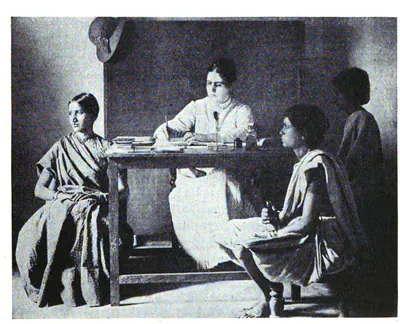 Dr Kugler's consulting room in the first rented dispensary at Guntur, 1886Book plate · 1928
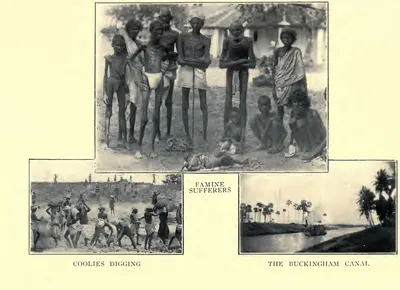 Famine relief work on the Buckingham Canal near Ongole, 1876–78 (Clough, Social Christianity in the Orient, 1914)Book plate · 1914
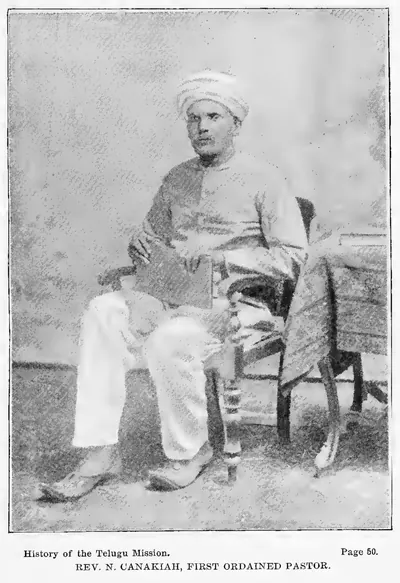 N. Canakiah, the first Telugu pastor ordained by the American Baptist mission (Downie, 1893)Book plate · 1893
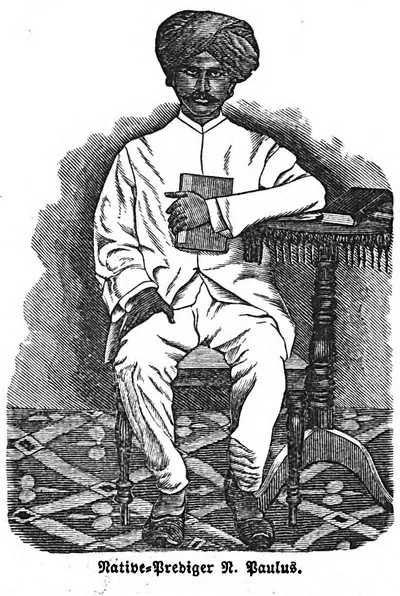 N. Paulus, an Indian preacher of the Lutheran mission at Rajahmundry, ordained pastor in 1878 (engraving, 1891)Book plate · 1891
 Preachers and Bible women of the Guntur hospital, with P. Sarah and M. Harriet seated (Kugler, 1928)Book plate · 1928
 Teachers and girl pupils of the SPG school at Kurnool (1912)Book plate · 1912
 The Lutheran mission dispensary at Guntur, with Dr Anna Kugler's cart, about 1896Book plate · 1896
 The mission dispensary at Nandyal (1912)Book plate · 1912
Show all (16)
 The SPG girls' day school at Kurnool, with its name in Telugu over the door (1912)Book plate · 1912
 The staff of the Guntur Mission Hospital in 1923, with Bible women, doctors, nurses and men employees (Kugler, 1928)Book plate · 1928
 Villagers carrying date-palm leaves to build their own prayer-house, Kurnool district (1912)Book plate · 1912
 Women missionaries and Telugu Bible women of the Guntur mission, about 1896Book plate · 1896
Related
People
A. V. Timpany
before 1885 CE
A. V. Timpany (died 1885) was a Canadian Baptist missionary who opened the American Baptist station at Ramapatnam in 1870 and its theological seminary in 1872, then led the Canadian Baptist mission at Kakinada from 1879. He treated the sick, argued over the Telugu Bible's word for baptism, and died of cholera at Kakinada in 1885.
Jacob Chamberlain
Jacob Chamberlain was a missionary of the Arcot Mission of the Reformed Church in America who led its Telugu work, first at Palamaner from 1861 and then at Madanapalle from 1863. In 1886 he gave an address describing how poor Telugu Christians gave to their churches.
Institutions
Ramapatnam Theological Seminary
1872 CE
The American Baptist mission's theological seminary at Ramapatnam, on the coast between Nellore and Ongole, opened in April 1872 to train Telugu preachers. Funded by an endowment that John Clough raised in America, it paid its students a small allowance, taught the Bible and preaching, and sent its students to preach in the villages around.
Guntur Mission Hospital
1886 CE
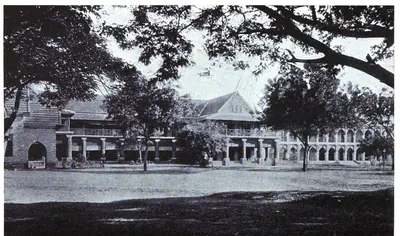
The American Lutheran mission's medical work for women and children at Guntur, begun by Dr Anna S. Kugler with a dispensary in 1886. Dispensaries followed in other parts of Guntur and at Mangalagiri, and a women's hospital was planned from 1885 with money raised by Lutheran women in America; its first building opened in 1893.
Themes
References
Notes (0)
Sources (23)
Spotted an error on this page? Tell us
Last updated: