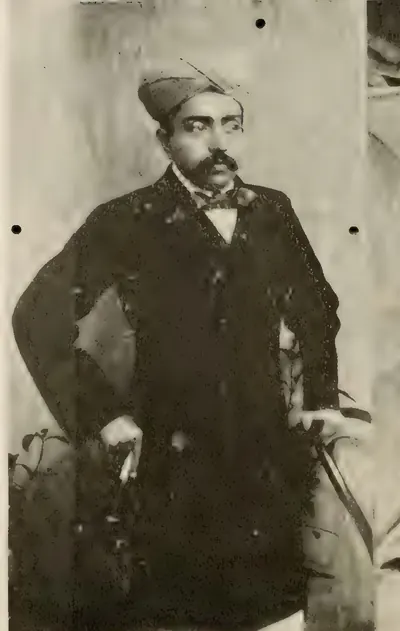
Asad Ali Khan (Muzaffar-ul-Mulk) of Banganapalle
Co-ruler of the Banganapalle jagir (land grant) in the late eighteenth century, titled Muzaffar-ul-Mulk. Through his mother he was a grandson of the line of the Mughal killedar (fort commander) Muhammad Beg Khan. He held Chenchelimala and managed Banganapalle for his young nephews. When Tipu Sultan seized the jagir in 1783, he took refuge with a poligar. In 1790, with troops from the Nizam, he and his nephew Ghulam Ali Khan beat Tipu's officer at Tammadapalle and recovered the country. He served the Nizam against Tipu in 1791 and was briefly subahdar of Cuddapah. In 1800 the Nizam stipulated with the Company that the jagir should be continued to him and his nephew.
Asad Ali Khan was the most active of the men who held Banganapalle through the wars of Haidar Ali and Tipu Sultan. The Kurnool district manual (1886) calls him “a man of great valour”.1 It names him by his later title, Muzaffar Mulk.2 The Imperial Gazetteer (1908) worked from the family’s papers.3 It says that he and his nephew Ghulam Ali Khan were treated as joint jagirdars (holders of the land grant) in the correspondence of 1800.3 See the Banganapalle State.
Family
According to Chetty’s manual, Asad Ali Khan and his elder brother Husain Ali Khan were the sons of Saiyid Muhammad Khan Nagadi.2 He was a Persian who had served Saadatullah Khan of Arcot.2 Their mother was Avautul Batul Khanum, the sister of the Nawab Fazl Ali Khan, called Gulli Nawab.2
The same manual makes Gulli Nawab the grandson of Muhammad Beg Khan, the first killedar (fort commander) of Banganapalle.2 Muhammad Beg’s son, also named Fazl Ali Khan, had died before him.2 Gulli Nawab had no children, and he treated his sister’s sons as his own.2 He gave Banganapalle to Husain Ali Khan and the neighbouring fort of Chenchelimala to Asad Ali Khan.2 See Saadatullah Khan.
Tipu Sultan and the battle of Tammadapalle
When Husain Ali Khan died, his four sons were minors, and their uncle “managed the territory for them”.2 The manual says that in 1783 “Tipu Sultan of Mysore summoned Asaad Ali Khan to appear before him”.2 Asad Ali Khan, it goes on, “disobeyed the summons and took shelter with the Hindu Poligar of Mutialpad”, a local chief.2 Tipu occupied the country and put in a killedar, Muhammad Yusuf, who held it for seven years.2 See Tipu Sultan.
Husain Ali Khan’s widow and children had fled to Hyderabad.2 They came back “with some force supplied by the Nizam and expelled Yusuf”.2 A Mysore force came to retake the town.2 It was met at Tammadapalle, near Banganapalle, in 1203 of the Hijra (1790), “in which Qutb was defeated and Asaad Ali Khan was victorious”.2 The youngest of the brothers, Fateh Ali Khan, was killed.2
The Imperial Gazetteer gives the family tradition in the same form.43 Tipu’s deputy was beaten “in a pitched battle by Ghulam Ali Khan and his uncle Asad Ali Khan about seven years after Ghulam Ali Khan’s expulsion”.43 The gazetteer mentions an order of the Nizam dated 1790 that conferred Banganapalle on the two men.43 It thought the order “of doubtful authenticity”.43
In the Nizam’s service
After the victory Ghulam Ali Khan took the management of Banganapalle and left Chenchelimala to his uncle.1 The manual says that in 1791 Asad Ali Khan “accompanied the Nizam’s forces to join the British army in their wars with Tipu Sultan and distinguished himself there”.1 The Nizam made him subahdar (governor) of Kadapa (then Cuddapah).1 It was one of the provinces that fell to the Nizam by the partition treaty.1 The manual adds that, “owing to a misunderstanding, however, with Mir Aalim, the minister of Hyderabad, he soon resigned the post”.1
The family later fell into debt, and this led to the Madras government taking over the jagir (land grant).1 The manual blamed these debts on him.1 They had been “originally incurred chiefly by Asaad Ali Khan, while Subadar of Cuddapah”.1 See Kadapa and Mir Alam.
He had four sons and one daughter.1 He married the daughter to his nephew, the jagirdar, and gave him Chenchelimala too.1 The condition was that the jagirdar treat his sons as his own brothers.1 If they disobeyed him, they might be dismissed “with a horse and a purse of Rs. 500 each”.1
The cession of 1800
In 1800 the Nizam ceded his southern districts to the Company.3 The Imperial Gazetteer says that he stipulated that the jagir “was the sole means of subsistence of a numerous family”.3 So “the jagir should be continued to Asad Ali Khan and Ghulam Ali Khan, and this was agreed to by the British representative”.3
Aitchison’s collection of treaties (1892) says that the jagir “was then conferred on Muzaffar-ul-Mulk and his heirs in perpetuity”.5 It says the Nizam’s minister had stipulated “that this jagir should be continued to Muzaffar-ul-Mulk and his family”.5
The Imperial Gazetteer calls Ghulam Ali Khan “the sole jagirdar after 1815”.36 It says that the present family traces its descent from Ghulam Ali Khan, “who survived his uncle”.36 See Ghulam Ali Khan.
Where the sources disagree
A. Vadivelu’s family history of 1903 tells the story with different names:78
- He calls the uncle who led the Nizam’s 800 horse to Banganapalle “Saiyid Hussain Ali Khan”, their paternal uncle, with the title Mazafar-ul-Mulk.78
- He dates the battle “of Thammadapalli” to 1205 of the Hijra, “or 1787 A. D.”.78
- Elsewhere he names Asad Ali Khan, “brother of Mansurud-daulah”, as the subahdar of Kadapa who ran up the family’s debts.78
The manual and the Imperial Gazetteer both make the leader at Tammadapalle Asad Ali Khan, the brother of Ghulam Ali’s father.24 The manual dates the battle to 1790.24
The Hijri years in the two books do not match their Christian years.729 According to the conversion tables of Sewell and Dikshit, Vadivelu’s Hijri year 1205 began on 10 September 1790.9 The manual’s Hijri year 1203 began on 2 October 1788.9
Footnotes
-
Chetty, Kurnool District (1886), p. 248 (archive.org (opens in a new tab)). ↩ ↩2 ↩3 ↩4 ↩5 ↩6 ↩7 ↩8 ↩9 ↩10 ↩11 ↩12 ↩13
-
Narahari Gopalakristnamah Chetty, A Manual of the Kurnool District (1886), p. 247 and note (archive.org (opens in a new tab)). ↩ ↩2 ↩3 ↩4 ↩5 ↩6 ↩7 ↩8 ↩9 ↩10 ↩11 ↩12 ↩13 ↩14 ↩15 ↩16 ↩17 ↩18 ↩19 ↩20
-
Imperial Gazetteer: Madras, Vol. II (1908), p. 473 (archive.org (opens in a new tab)). ↩ ↩2 ↩3 ↩4 ↩5 ↩6 ↩7 ↩8 ↩9 ↩10 ↩11
-
Imperial Gazetteer of India, Provincial Series: Madras, Vol. II (1908), p. 472, “Banganapalle State” (archive.org (opens in a new tab)). ↩ ↩2 ↩3 ↩4 ↩5 ↩6
-
C. U. Aitchison, A Collection of Treaties, Engagements and Sanads, Vol. VIII (1892), Part I, p. 97, “Banganapalle” (archive.org (opens in a new tab)). ↩ ↩2
-
Imperial Gazetteer: Madras, Vol. II (1908), p. 477 (archive.org (opens in a new tab)). ↩ ↩2
-
A. Vadivelu, The Aristocracy of Southern India (1903), p. 8 (archive.org (opens in a new tab)). ↩ ↩2 ↩3 ↩4 ↩5
-
Vadivelu, Aristocracy of Southern India (1903), p. 10 (archive.org (opens in a new tab)). ↩ ↩2 ↩3 ↩4
-
Robert Sewell and S. B. Dikshit, The Indian Calendar (1896), Table XVI, p. cxxxv (archive.org (opens in a new tab)). ↩ ↩2 ↩3
Related
Dynasties
References
Notes (0)
Sources (5)
Spotted an error on this page? Tell us
Last updated: