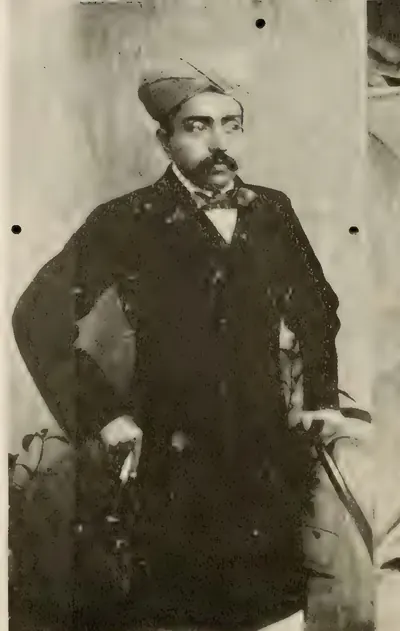
Husain Ali Khan II of Banganapalle
Saiyid Husain Ali Khan, the elder son of Ghulam Ali Khan (Mansur-ud-daula), was the jagirdar (holder of the land grant) of Banganapalle from about 1821 until 1848. His father placed him on the musnad (throne) in his own lifetime. The family was deep in debt, and disorder followed. The Madras government took over the management, from 1825 in the Kurnool manual and Aitchison or from 1832 in the Imperial Gazetteer and the 1961 Census handbook, and ran the jagir until 1848. The jagir was given back to him in July 1848, but he died before the sanad (deed of grant) was issued. His nephew, adopted son and son-in-law Ghulam Muhammad Ali Khan followed him.
Download
Husain Ali Khan was the head of the Banganapalle family for more than twenty-five years.1 But for most of that time the Madras government, not he, ran the jagir (land grant).12 During his rule the family’s debts nearly cost it the State.3 See the Banganapalle State.
Succession
Ghulam Ali Khan (Mansur-ud-daula) had two sons, Saiyid Husain Ali Khan and Saiyid Fateh Ali Khan.1 The Kurnool manual says that he placed the elder on the musnad (throne) during his own lifetime, in 1237 of the Hijra (1821).1 A. Vadivelu’s family history (1903) says that the father gave Banganapalle to Husain Ali Khan because the second son already held a jagir at Hyderabad.4 The District Census Handbook of Kurnool (1961, printed 1964) dates the succession to 1822.5 See Ghulam Ali Khan (Mansur-ud-daula).
Debt and disorder
The family was “burdened with debts”, the manual says.1 Most had been run up by Asad Ali Khan while he was governor of Kadapa (then Cuddapah).1 Husain Ali Khan could not pay his creditors, and disorder followed.1 See Asad Ali Khan.
The Census handbook says that under him the administration “got from bad to worse”.5 At last he had to flee to Koilkuntla, in the nearby British territory.5 The Imperial Gazetteer (1908) does not name the jagirdar (holder of the land grant).2 It says that “internal government now went from bad to worse”, and that in 1831 “the jagirdar was driven out of the country and took refuge in British territory”.2 By the manual’s dates Husain Ali Khan was the jagirdar then.1
The government takes over
The sources tell the takeover in different ways:1632
- The manual says that the Madras government “assumed the management in 1825” because of the disorders.1
- Vadivelu says that it did so “at the request of the Nawab himself” from 1825.6
- Aitchison says that in 1825 the government proposed to annex the jagir and give the family a pension.3
- The Imperial Gazetteer says that the government took the jagir back in 1832 and announced this in 1835.2
Aitchison says that the jagirdar refused the pension and protested against the government’s right to take his jagir.3 Then the government found that in 1800 the Nizam had made it a condition that the jagir should stay with the family.3 So the Court of Directors decided that the holder must be treated as “an hereditary jagirdar”.3 The Collector of Cuddapah was told to settle the creditors’ claims, and three-quarters of the net revenue went to them.3 The Imperial Gazetteer says that the State was run by the Madras government from 1835 to 1848.2
Restoration and death, 1848
“In 1848 the accounts were closed”, Aitchison writes, “and the jagir was restored to Husain Ali Khan, the eldest surviving heir”.3 The sanad (deed of grant) printed by Vadivelu says that on 12 July 1848 the Madras government granted Banganapalle to “Hoossain Ali Khan and his heirs for ever”.6 The grant was “free of peshcush and pecuniary demand”, that is, without tribute.6
But Husain Ali Khan died before the sanad could be issued.13 He had no son.4 He had adopted his nephew Ghulam Muhammad Ali Khan, the younger son of his brother Fateh Ali Khan, and married him to his daughter, Imdad Begum.14 The nephew received the sanad in 1849.3 See Ghulam Muhammad Ali Khan.
Where the sources disagree
- When the government took over. The manual, Vadivelu and Aitchison give 1825.163 The Imperial Gazetteer and the Census handbook give 1832.25
- Why it took over. Vadivelu says the Nawab asked for it, and the Census handbook says it was done at the jagirdar’s own wish.65 Aitchison says that the jagirdar protested against the plan to annex the jagir.3
- To whom the jagir was restored. Aitchison, the manual and Vadivelu say it was restored to Husain Ali Khan in 1848.316 The Imperial Gazetteer says it was restored to Ghulam Muhammad Ali.2
- When he succeeded. The manual says 1821, in his father’s lifetime.1 The Census handbook says 1822.5
Footnotes
-
Narahari Gopalakristnamah Chetty, A Manual of the Kurnool District (1886), p. 248 (archive.org (opens in a new tab)). ↩ ↩2 ↩3 ↩4 ↩5 ↩6 ↩7 ↩8 ↩9 ↩10 ↩11 ↩12 ↩13 ↩14 ↩15
-
Imperial Gazetteer of India, Provincial Series: Madras, Vol. II (1908), p. 473, “Banganapalle State” (archive.org (opens in a new tab)). ↩ ↩2 ↩3 ↩4 ↩5 ↩6 ↩7 ↩8
-
C. U. Aitchison, A Collection of Treaties, Engagements and Sanads, Vol. VIII (1892), Part I, p. 97, “Banganapalle” (archive.org (opens in a new tab)). ↩ ↩2 ↩3 ↩4 ↩5 ↩6 ↩7 ↩8 ↩9 ↩10 ↩11 ↩12 ↩13
-
A. Vadivelu, The Aristocracy of Southern India (1903), p. 9 (archive.org (opens in a new tab)). ↩ ↩2 ↩3
-
A. Chandra Sekhar, Census of India 1961, Andhra Pradesh: District Census Handbook, Kurnool District (1964), p. xxxi (PDF p. 52) (censusindia.gov.in (opens in a new tab)). Paraphrased (Public domain in India). ↩ ↩2 ↩3 ↩4 ↩5 ↩6
-
Vadivelu, Aristocracy of Southern India (1903), p. 10, with the sanad of 1849 (archive.org (opens in a new tab)). ↩ ↩2 ↩3 ↩4 ↩5 ↩6 ↩7
Related
Dynasties
References
Notes (0)
Sources (5)
Spotted an error on this page? Tell us
Last updated: