Ali Adil Shah I
Fifth Adil Shahi sultan of Bijapur (r. 1558–1580). He was first an ally of Aliya Rama Raya, but then joined the league of Deccan sultans that defeated and killed Rama Raya in January 1565. Afterwards he won back Raichur and Mudgal, took Adoni in 1568 and turned south against the Aravidu kings, besieging Penukonda. The date and details of that siege are disputed. He was the husband of Chand Bibi.
Ali was a son of Ibrahim Adil Shah I.12 His father kept him a prisoner in the fort of Miraj because of his Shia faith.12 He was released to become king when his father died in AH 965 (1557–58; AH is the Islamic way of counting years).12 See the Adil Shahis of Bijapur.
Cousens gives his full name, from inscriptions in the fort of Raichur, as Abu-l-Muzaffar Ali Adil Shah.2 H. Krishna Sastri identified him as the “Yedula-Sahi” of a Telugu inscription at Penukonda.3
From ally to enemy of Rama Raya
Ali began his reign as the friend of Ramraj, Aliya Rama Raya of Vijayanagara.2 Cousens says that he “paid a visit of condolence to him at Vijayanagar on hearing of the death of his son”.2 With Rama Raya’s help he attacked Ahmadnagar.2
But the Vijayanagara troops plundered Bijapur land as freely as the enemy’s.2 Ali was “thoroughly disgusted with the arrogance and overbearing of this kafir king” (kafir means unbeliever).2 He drew Ahmadnagar and Golconda into a league against him.2
Ferishta says that Ali needed an excuse for war.4 He sent an envoy to demand the return of “Etgeer, Bagrakote, Rachore, and Moodkul, which had at different times been wrested from him”.4 Ramraj drove out the envoy “with disgrace from his court”.4
Talikota
The four sultans met on the plains of Bijapur and marched south to Talikota.4 Ferishta notes that “as the country on the north bank belonged to Ally Adil Shah, he entertained his allies with great splendour”.4
The battle was fought south of the Krishna in January 1565.56 Ali led the right wing of the allies, facing Ramraj’s brother Venkatadri.56 The Hindu charge threw both wings into disorder, “and Ally Adil Shah and Ibrahim Kootb Shah began to despair of victory, and even to prepare for retreat”.56 Then Husain Nizam Shah’s centre broke Ramraj’s division, and Ramraj was taken and beheaded.56
Cousens says that by the victory Ali “obtained possession … of the forts of Raichur and Mudgal”.7 He spent his share of the plunder of Vijayanagara on a wall round the whole city of Bijapur, finished in AH 973 (1565).7 See Talikota and Vijayanagara.
Soon afterwards Ali tried to gain from Vijayanagara’s weakness.89 Ferishta says he “moved with an army to Anagoondy, in order to place Timraj, the son of Ramraj, on the musnud of Penkonda, and to depose Venkatadry”.89 (A musnud is a throne.) But he withdrew when the queen-regent of Ahmadnagar marched on Bijapur.89
Adoni and the south
Ferishta says that in AH 976 (1568) Ali sent his general Ankus Khan against Adoni, with eight thousand horse and a train of artillery.10 Adoni was then held by “one of the principal officers of the late Ramraj, who, on the death of his master, had assumed independence”.10
After several battles that settled nothing, the chief was shut up in the fort.10 The fort, “though well supplied with stores and provisions, yet, owing to the vigour with which Ankoos Khan carried on the siege, it submitted to his arms”.10
Ferishta describes Adoni as standing on a high hill, “fortified with eleven walls, one within another”.1011 He says the kings of Vijayanagara, “regarding it as impregnable, had all contributed to make it a convenient asylum for their families”.1011 The Bellary gazetteer adds that the town below the fort “is apparently not older than the Musalman occupation in 1568”.12
Ali then made an agreement with Murtaza Nizam Shah.11 Ahmadnagar would take Berar, while Bijapur might “conquer as much of the dependencies of Beejanuggur as he thought proper”.11 The Anantapur gazetteer (1905) puts it the same way.13 The two kings agreed “to take different lines of conquest”, and Bijapur “proceeded to invade the country south of the Kistna, including the Bellary and Anantapur districts”.13
In the next years Ali’s minister Mustafa Khan Ardistani took several places in the Kanarese country.1114 These were Torgal, Dharwar (AH 981, 1573), Bankapur and Chandragutti.1114 Ferishta has Venkatadri, “the brother of Ramraj”, write to a rebel chief at this time.1114 Venkatadri said he could barely hold “Penkonda and Chundergeery, the only places which the kings of Islam had left him”.1114
Penukonda
Ferishta tells the story of the attack on Penukonda.15 Mustafa Khan proposed the campaign.15 The king marched to Adoni and on to Penukonda.15 Its ruler “Venkatadry” left the place to one of his nobles and went to Chandragiri.15
The blockade lasted three months, until the garrison “were nearly submitting for want of provisions”.15 Then Venkatadri bribed Hundiatum Naik, chief of the Bergi (Maratha) horse in the king’s army, to desert.15 The bribe was “with twenty-four lacks of rupees and five elephants”, and Ali had to give up the siege.15
An inscription at the north gate of Penukonda is dated 1576–77.316 It records that the Vijayanagara officer Channappa Nayudu drove off Muslim generals there three times:316
H. Krishna Sastri read this as Ali’s siege.316 The Anantapur gazetteer dates the blockade to 1577.1718 See the Penukonda inscription of 1577, Penukonda and the Penukonda fort.
Henry Heras, the historian of the Aravidu dynasty (1927), argued that Ferishta’s story is “evidently out of place”.1920 He wrote that a ruler of Penukonda retiring to Chandragiri could not belong to 1576–77.1920 He moved the story of the bribed Bergis to the reign of Venkata II.1920
Heras used Telugu chronicles to tell Ali’s southern wars in a different way:19212223
- a first advance on Penukonda, turned back with help from Golconda
- a battle about 1576, in which the emperor Sriranga was taken prisoner and the country north of Penukonda was lost for good
- a siege in 1577, in which Jagadeva Raya defeated four of Ali’s generals and forced the Bijapur army to withdraw19212223
Charles Brown translated the Annals of Hande Anantapuram in 1853.24 They say that after Sriranga’s capture the Hande chief Malakappa Nayudu “betook himself to the Pachas, and behaved obediently in their service”.24 He received Bukkapatnam and Anantasagaram, “and also the title ‘Padshah Vazir’”.24
Death
Ferishta says that in AH 987 Ali, who had no son, named his nephew Ibrahim to rule after him.2526 Ibrahim was the son of Ali’s brother Tahmasp.2526 In the following year Ali was murdered by a eunuch.2526 He was buried at Bijapur.2526
Ferishta says that “the jooma musjid, the howz-i-shapoor, the city wall, and the aqueducts which convey water throughout all the streets, were constructed by his orders”.2526 Cousens dates his death to AH 988 (1580).27 He says Ali was the first of his line to be buried at Bijapur.27
His queen was Chand Bibi, a daughter of Husain Nizam Shah of Ahmadnagar.28 She was married to Ali “at the time that the confederacy of the four kings was formed against Ramraj”.28 See Ibrahim Adil Shah II.
Footnotes
-
Henry Cousens, Bijapur and its Architectural Remains (Archaeological Survey of India, Imperial Series, Vol. XXXVII, 1916), p. 7 (archive.org (opens in a new tab)). ↩ ↩2 ↩3
-
Cousens, Bijapur and its Architectural Remains (1916), p. 8 (archive.org (opens in a new tab)). ↩ ↩2 ↩3 ↩4 ↩5 ↩6 ↩7 ↩8 ↩9 ↩10
-
H. Krishna Sastri, “The Third Vijayanagara Dynasty; its Viceroys and Ministers”, Archaeological Survey of India, Annual Report 1911–12 (1915), p. 184 (archive.org (opens in a new tab)). ↩ ↩2 ↩3 ↩4 ↩5
-
Muhammad Qasim Ferishta, tr. John Briggs, History of the Rise of the Mahomedan Power in India, Vol. III (1829), p. 126 (archive.org (opens in a new tab)). ↩ ↩2 ↩3 ↩4 ↩5
-
Ferishta, tr. Briggs, Vol. III (1829), p. 129 (archive.org (opens in a new tab)). ↩ ↩2 ↩3 ↩4
-
Ferishta, tr. Briggs, Vol. III (1829), p. 130 (archive.org (opens in a new tab)). ↩ ↩2 ↩3 ↩4
-
Cousens, Bijapur and its Architectural Remains (1916), p. 9 (archive.org (opens in a new tab)). ↩ ↩2
-
Ferishta, tr. Briggs, Vol. III (1829), p. 131 (archive.org (opens in a new tab)). ↩ ↩2 ↩3
-
Ferishta, tr. Briggs, Vol. III (1829), p. 132 (archive.org (opens in a new tab)). ↩ ↩2 ↩3
-
Ferishta, tr. Briggs, Vol. III (1829), p. 134 (archive.org (opens in a new tab)). ↩ ↩2 ↩3 ↩4 ↩5 ↩6
-
Ferishta, tr. Briggs, Vol. III (1829), p. 135 (archive.org (opens in a new tab)). ↩ ↩2 ↩3 ↩4 ↩5 ↩6 ↩7 ↩8
-
W. Francis, Madras District Gazetteers: Bellary (1904), p. 199 (archive.org (opens in a new tab)). ↩
-
W. Francis, Madras District Gazetteers: Anantapur (1905), p. 21 (archive.org (opens in a new tab)). ↩ ↩2
-
Ferishta, tr. Briggs, Vol. III (1829), p. 136 (archive.org (opens in a new tab)). ↩ ↩2 ↩3 ↩4
-
Ferishta, tr. Briggs, Vol. III (1829), p. 141 (archive.org (opens in a new tab)). ↩ ↩2 ↩3 ↩4 ↩5 ↩6 ↩7
-
Krishna Sastri, “The Third Vijayanagara Dynasty”, ASI Annual Report 1911–12 (1915), p. 185 (archive.org (opens in a new tab)). ↩ ↩2 ↩3 ↩4
-
Francis, Anantapur (1905), p. 22 (archive.org (opens in a new tab)). ↩
-
Francis, Anantapur (1905), p. 191 (archive.org (opens in a new tab)). ↩
-
Henry Heras, The Aravidu Dynasty of Vijayanagara, Vol. I (1927), p. 269 and note 3 (archive.org (opens in a new tab)). ↩ ↩2 ↩3 ↩4 ↩5
-
Heras, Aravidu Dynasty I (1927), p. 336 and note 1 (archive.org (opens in a new tab)). ↩ ↩2 ↩3
-
Heras, Aravidu Dynasty I (1927), p. 270 (archive.org (opens in a new tab)). ↩ ↩2
-
Heras, Aravidu Dynasty I (1927), p. 271 (archive.org (opens in a new tab)). ↩ ↩2
-
Heras, Aravidu Dynasty I (1927), p. 272 and note 3 (archive.org (opens in a new tab)). ↩ ↩2
-
The Wars of the Rajas, being the History of Anantapuram, tr. C. P. Brown (1853), p. 6 (archive.org (opens in a new tab)). ↩ ↩2 ↩3
-
Ferishta, tr. Briggs, Vol. III (1829), p. 142 (archive.org (opens in a new tab)). ↩ ↩2 ↩3 ↩4 ↩5
-
Ferishta, tr. Briggs, Vol. III (1829), p. 143 (archive.org (opens in a new tab)). ↩ ↩2 ↩3 ↩4 ↩5
-
Cousens, Bijapur and its Architectural Remains (1916), p. 10 (archive.org (opens in a new tab)). ↩ ↩2
-
Cousens, Bijapur and its Architectural Remains (1916), p. 12 (archive.org (opens in a new tab)). ↩ ↩2
Photos
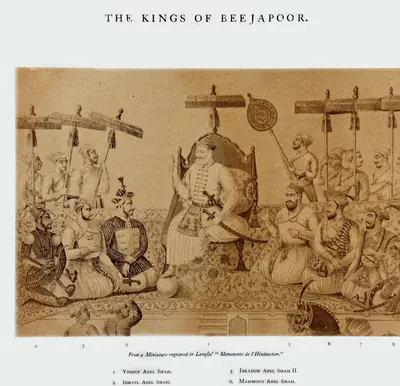 "The Kings of Beejapoor": the eight Adil Shahi kings from Yusuf to Sikandar, from a miniature engraved in Langlès' Monuments de l'Hindoustan (Taylor and Fergusson, Architecture at Beejapoor, 1866, frontispiece)Book plate · 1866
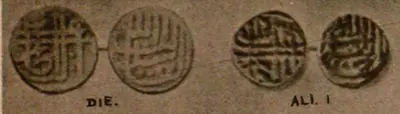 Copper coins of Ali Adil Shah I with the reconstructed die (Cousens 1916, pl. CXV, row 1)Coin · 1916
Related
Dynasties
References
Notes (0)
Sources (7)
Spotted an error on this page? Tell us
Last updated: