Mujahid Shah
Mujahid Shah, the elder son of Muhammad Shah I, was the third Bahmani sultan, from about 1375 to 1378. He went to war with Bukka I of Vijayanagara and laid siege to the hill-fort of Adoni, which Ferishta calls the strongest fortress in the Deccan. Ferishta, Haig and the Bellary gazetteer say the siege lasted nine months and failed when rain refilled the fort's tanks. The Burhan-i Ma'asir says a year, and adds that the garrison had agreed to surrender before the rain came. He was murdered in 1378.
Download
Mujahid Shah was the third king of the Bahmani dynasty of the Deccan.12 He was the elder son of Muhammad Shah I.2 In his short reign he fought Bukka I of Vijayanagara.2 The main event of that war in the Telugu country was his long siege of the hill-fort of Adoni.34
Who he was
The Persian history Burhan-i Ma’asir says that the people of the Deccan called him “Balwant”, that is, “strong-bodied”.1 Wolseley Haig, in the Cambridge History of India (1928), described him as handsome, very strong and headstrong.2 Haig dates his father’s death, and his own accession, to the spring or early summer of 1377.2
The war with Vijayanagara
Soon after he came to the throne, Mujahid demanded from Bukka the country between the Ghatprabha and the Tungabhadra rivers.2 Bukka answered by asking for the elephants that Mujahid’s father had taken in the last war.2 So Mujahid gathered the armies of Daulatabad, Bidar and Berar and crossed the Krishna and the Tungabhadra.5
He came first to Adoni, which Ferishta calls “the strongest fortification in the Deccan”.5 He left Safdar Khan Sistani with the army of Berar to besiege it.62 Then he marched against Bukka himself.6 He followed Bukka for months and reached the outer defences of Vijayanagara, but he could not take the city.278
The siege of Adoni
Mujahid then fell back on Adoni with sixty or seventy thousand captives.37 There he took charge of the siege himself.3 Ferishta says it lasted nine months.3 The garrison was about to give in for lack of water, when heavy rain fell and they held out.3 Grain then ran short in the royal camp, and many soldiers died of disease.39
The minister Saif-ud-din Ghori came from Gulbarga to see the fort.9 He told the king privately that a place with fifteen forts joined together could not be taken quickly.9 So Mujahid made peace with Bukka and turned for home.97 The Bellary gazetteer of 1904 also records the nine months’ siege “in vain”.4
Death
On the way home, Ferishta says, Daud Khan and others killed him in his tent by night.10 Haig calls Daud his uncle.7 Haig dates the murder to the night of 15 April 1378.7 Daud was proclaimed king.7
Coins
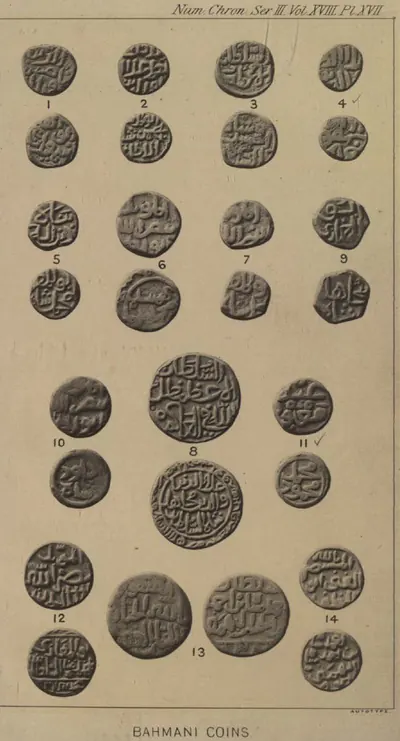
O. Codrington, who wrote on the Bahmani coins in 1898, dated Mujahid’s reign AH 776–780 (AH is the Islamic way of counting years).11 He published a gold coin of AH 777, probably struck at Ahsanabad (Gulbarga).1112
Where the sources disagree
- When his reign began. Codrington dates it from AH 776 (1374–75).11 Haig dates his father’s death to 1377.2
- How long the siege lasted. Ferishta, Haig and the Bellary gazetteer give nine months.374 The Burhan-i Ma’asir gives a year.1
- How it ended. In the Burhan-i Ma’asir, the thirsty garrison agreed to surrender, and its governor came out and made a written treaty.1 That night rain fell, and the garrison killed Mujahid’s deputy and fired his head from a gun towards the army.13 In Ferishta, the rain simply let the fort hold out, and the king left on his minister’s advice.39
- How he died. Ferishta and Haig say he was killed in his tent on the march, and Ferishta names Daud Khan.107 The Burhan-i Ma’asir says he went back to Ahsanabad (Gulbarga) and was found headless on his throne, a deed people blamed on jinns (spirits).13
Footnotes
-
J. S. King, The History of the Bahmani Dynasty, founded on the Burhan-i Ma’asir (1900), p. 30 (archive.org (opens in a new tab)). ↩ ↩2 ↩3 ↩4
-
Wolseley Haig (ed.), The Cambridge History of India, Vol. III (1928), p. 383 (archive.org (opens in a new tab)). ↩ ↩2 ↩3 ↩4 ↩5 ↩6 ↩7 ↩8 ↩9 ↩10
-
Ferishta, tr. Briggs, Vol. II (1829), p. 338 (archive.org (opens in a new tab)). ↩ ↩2 ↩3 ↩4 ↩5 ↩6 ↩7 ↩8
-
Francis, Bellary (1904), p. 34 (archive.org (opens in a new tab)). ↩ ↩2 ↩3
-
Muhammad Qasim Ferishta, tr. John Briggs, History of the Rise of the Mahomedan Power in India, Vol. II (1829), p. 330 (archive.org (opens in a new tab)). ↩ ↩2
-
Ferishta, tr. Briggs, Vol. II (1829), p. 331 (archive.org (opens in a new tab)). ↩ ↩2
-
Haig, Cambridge History of India, Vol. III (1928), p. 384 (archive.org (opens in a new tab)). ↩ ↩2 ↩3 ↩4 ↩5 ↩6 ↩7 ↩8
-
W. Francis, Madras District Gazetteers: Bellary (1904), p. 33 (archive.org (opens in a new tab)). ↩
-
Ferishta, tr. Briggs, Vol. II (1829), p. 339 (archive.org (opens in a new tab)). ↩ ↩2 ↩3 ↩4 ↩5
-
Ferishta, tr. Briggs, Vol. II (1829), p. 340 (archive.org (opens in a new tab)). ↩ ↩2
-
O. Codrington, “On the Coins of the Bahmani Dynasty”, Numismatic Chronicle, 3rd series, XVIII (1898), p. 264 (archive.org (opens in a new tab)). ↩ ↩2 ↩3
-
Codrington, “Coins of the Bahmani Dynasty” (1898), p. 265 (archive.org (opens in a new tab)). ↩
-
King, History of the Bahmani Dynasty (1900), p. 31 (archive.org (opens in a new tab)). ↩ ↩2
Photos
Related
Dynasties
References
Notes (0)
Sources (5)
Spotted an error on this page? Tell us
Last updated: