Muhammad Shah I
Second Bahmani sultan (1358–1375), son of the founder. He organised the court, the army and the four provinces, struck the dynasty's own gold coin, and fought the first great wars with Warangal and Vijayanagara. In Ferishta's account the ruler of Warangal ceded Golconda to him and gave up a jewelled throne, the Takht-i-Feroza or turquoise throne. The Burhan-i Ma'asir tells of the Telingana war in a single sentence.
Muhammad Shah I was the second king of the Bahmani dynasty. His reign brought the first open war between the Bahmanis and the Telugu rulers of Warangal. In Ferishta’s account of this war, Warangal ceded Golconda and gave the king a jewelled throne. This account became the standard story of how the Bahmanis first gained a hold in eastern Telangana. The other main history of the dynasty, the Burhan-i Ma’asir, says almost nothing about it.12
Family and coming to the throne
Muhammad Shah I was the eldest son of Ala-ud-din Bahman Shah.34 His father made him his heir and gave him his own former title of Zafar Khan.34 Ferishta says his father married him to a daughter of the minister Saif-ud-din Ghori.5 He succeeded in 1358, when the founder died.6
The Burhan-i Ma’asir says he began by seeing to the needs of his army and his subjects and by giving presents.78 Then he set out to conquer new lands.78
The court and the provinces
Ferishta credits him with ordering the court:910
- he divided the nobles into four ranks910
- he formed a bodyguard of four thousand men910
- he formed a corps of two hundred young nobles to carry the king’s arms910
- he gave each provincial governor the title of tarafdar910
Haig describes the eight ministers of state and the royal guard of his reign.611 He says these institutions lasted as long as the kingdom of his successors.611 They also “were closely imitated in the smaller states which rose on its ruins”.611
Haig adds that the king’s mother returned from a pilgrimage to Mecca in 1361.6 She brought a patent (letter of grant) from the caliph in Egypt, recognising her son as king of the Deccan.6
Gold coins and the Hindu bankers
Haig says the founder had struck few or no gold coins.12 But Muhammad, he says, objected to the use of Hindu money in his kingdom, and he struck gold in large quantities.12
Ferishta says the Hindu bankers melted down every Bahmani coin that came into their hands.13 They did this “at the instigation of the Rajas of Beejanuggur and Tulingana”, that is, on the urging of the rulers of Vijayanagara and Telingana.13 The king put many of them to death.13 He gave the business of the mint and the bank to Khatris from Delhi.13 Haig dates the massacre of the bankers to May or June 1360.12
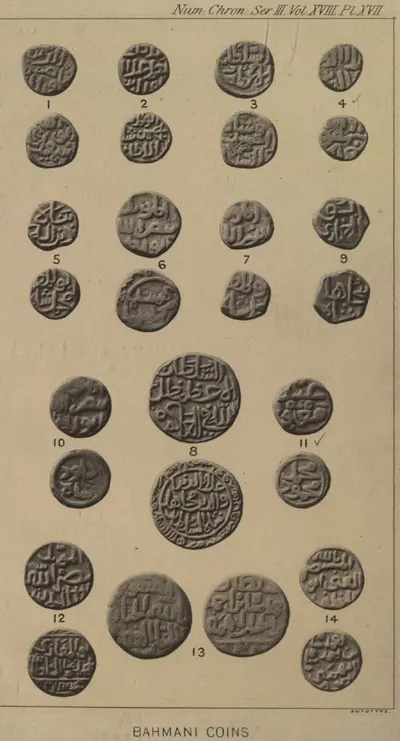
The coin catalogues record his gold of AH 768 (AH is the Islamic way of counting years) and of 775, and his silver of 760 to 776.1415 The gold of AH 768 was struck at Ahsanabad, the new name of Gulbarga.1415
The war with Warangal
Ferishta says that early in the reign the rajas of Vijayanagara and Telingana demanded back the lands taken by the late king.16 Muhammad kept their envoys waiting for eighteen months while he prepared, then demanded elephants and treasure.16 The Raja of Telingana sent his son, Vinaik Dew, to recover Kaulas.16 But the Bahmani general Bahadur Khan defeated him and forced the raja to pay a large sum and twenty-five elephants.16 Haig names the raja Kanhayya (see Kapaya Nayaka) and the prince Venayek Deva.17
Ferishta then tells how the king heard that Vinaik Dew had seized horses meant for him at Velumputtun.18 The king rode there with four thousand horse and took the town.19 He had the prince’s tongue cut out and his body thrown from a catapult into a fire.19 He was wounded in the arm on the retreat, and he lost most of his small force before the main army met him at Kaulas.181920 Haig calls the town Vailampallam, “on the sea coast”, and dates the raid to 1362.17
In the last campaign, Ferishta says, the king sent the troops of Bidar against Golconda and those of Berar against Warangal.1 He stayed nearly two years in Telingana.21 The raja gave three hundred elephants, two hundred horses and thirty-three lakhs of rupees.121 He ceded “in perpetuity” (for ever) “the hill-fort of Golconda, with its dependencies”.121 He also accepted a treaty fixing Golconda as the boundary.121
His envoys then presented a throne set with jewels.22 The raja had first made it as a present for Muhammad bin Tughluq.22 The king named it the Takht-i-Feroza, from its sky-blue enamel.22 Ferishta had heard about it from old men who had seen it under Mahmud Shah.22 They said it was six cubits long, made of ebony covered with gold and jewels.22
Haig calls it the turquoise throne and says the king first sat on it at Gulbarga on 21 March 1365.23 The Kistna Manual calls it the Azure Throne.24 See Golconda and the Musunuri Nayakas.
The Burhan-i Ma’asir tells this differently. After a victory over Vijayanagara, it says, the king “proceeded towards Fllampatan (?)” and conquered that country.82 It adds that “in the latter days of his reign” the king was “seized with the desire of conquering Telingana”.82 Then “the whole of the country came into the possession of the agents of his government”.82 It says nothing of Golconda or the throne. The dates are uncertain:162526
- Briggs’s Ferishta puts the horse affair in AH 773 (1371), after the cession of Golconda16
- Bilgrami dates the cession to 136225
- the Imperial Gazetteer gives a war with Warangal in 137126
Vijayanagara and the Gulbarga mosque
As Ferishta tells it, the king, while drunk, ordered a troupe of musicians to be paid by a draft on the treasury of Vijayanagara.272829 This order began a war, in which the raja took Mudgal and massacred its garrison.272829 Muhammad swore to kill a hundred thousand Hindus in revenge.272829
Haig describes the battle near Kauthal early in 1367.3031 He says that at its end both sides agreed to spare non-combatants (people not fighting) in future.3031
Ferishta claims that nearly five hundred thousand people were killed in his reign.32 Briggs, his translator, condemned this “exultation” (rejoicing).32 He said it showed “how deluded the minds of the greatest men may become by the force of precept and education”.32
An inscription in the great mosque of Gulbarga records that it was built in his reign by Rafi, son of Shams, of Qazvin.33 It is dated in AH 769, which Haig, who edited it, converts to 1 September 1367.33 In his history Haig says the king completed the mosque that year.3334
Death and succession
Ferishta dates his death to 19 Zi’l-qa’da AH 776, 21 March 1375, after a reign of seventeen years.3532 The Burhan-i Ma’asir gives AH 775 (1373), after seventeen years and seven months.2 Haig gives “the spring or early summer of 1377”.34
His elder son Mujahid succeeded him.236 The Burhan-i Ma’asir names a younger son, Fath Khan.236 Mujahid was murdered in 1378 by Daud, who then reigned for about a month.37
Ferishta calls Daud the late king’s uncle, a son of Bahman Shah.38 The Burhan-i Ma’asir first calls Daud “a younger brother, or—according to one history—a cousin” of Mujahid.3940 Later it calls him, “according to the most authentic accounts”, a son of Mahmud Khan, Bahman Shah’s son.3940 Haig preferred Ferishta here.36
Footnotes
-
Ferishta, tr. Briggs, Vol. II (1829), p. 305 (archive.org (opens in a new tab)). ↩ ↩2 ↩3 ↩4 ↩5
-
King, History of the Bahmani Dynasty (1900), p. 28 (archive.org (opens in a new tab)). ↩ ↩2 ↩3 ↩4 ↩5 ↩6 ↩7
-
J. S. King, The History of the Bahmani Dynasty, founded on the Burhan-i Ma’asir (1900), p. 22 (archive.org (opens in a new tab)). ↩ ↩2
-
King, History of the Bahmani Dynasty (1900), p. 23 (archive.org (opens in a new tab)). ↩ ↩2
-
Muhammad Qasim Ferishta, tr. John Briggs, History of the Rise of the Mahomedan Power in India, Vol. II (1829), p. 293 (archive.org (opens in a new tab)). ↩
-
Wolseley Haig (ed.), The Cambridge History of India, Vol. III (1928), p. 376 (archive.org (opens in a new tab)). ↩ ↩2 ↩3 ↩4 ↩5 ↩6
-
King, History of the Bahmani Dynasty (1900), p. 26 (archive.org (opens in a new tab)). ↩ ↩2
-
King, History of the Bahmani Dynasty (1900), p. 27 (archive.org (opens in a new tab)). ↩ ↩2 ↩3 ↩4 ↩5
-
Ferishta, tr. Briggs, Vol. II (1829), p. 298 (archive.org (opens in a new tab)). ↩ ↩2 ↩3 ↩4 ↩5
-
Ferishta, tr. Briggs, Vol. II (1829), p. 299 (archive.org (opens in a new tab)). ↩ ↩2 ↩3 ↩4 ↩5
-
Haig, Cambridge History of India, Vol. III (1928), p. 377 (archive.org (opens in a new tab)). ↩ ↩2 ↩3
-
Haig, Cambridge History of India, Vol. III (1928), p. 378 (archive.org (opens in a new tab)). ↩ ↩2 ↩3
-
Ferishta, tr. Briggs, Vol. II (1829), pp. 300–301 (archive.org (opens in a new tab)). ↩ ↩2 ↩3 ↩4
-
O. Codrington, “On the Coins of the Bahmani Dynasty”, Numismatic Chronicle, 3rd series, XVIII (1898), pp. 263–264 (archive.org (opens in a new tab)). ↩ ↩2
-
H. Nelson Wright, Catalogue of the Coins in the Indian Museum, Calcutta, Vol. II (1907), p. 199 (archive.org (opens in a new tab)). ↩ ↩2
-
Ferishta, tr. Briggs, Vol. II (1829), p. 301 (archive.org (opens in a new tab)). ↩ ↩2 ↩3 ↩4 ↩5 ↩6
-
Haig, Cambridge History of India, Vol. III (1928), p. 379 (archive.org (opens in a new tab)). ↩ ↩2
-
Ferishta, tr. Briggs, Vol. II (1829), p. 302 (archive.org (opens in a new tab)). ↩ ↩2
-
Ferishta, tr. Briggs, Vol. II (1829), p. 303 (archive.org (opens in a new tab)). ↩ ↩2 ↩3
-
Ferishta, tr. Briggs, Vol. II (1829), p. 304 (archive.org (opens in a new tab)). ↩
-
Ferishta, tr. Briggs, Vol. II (1829), p. 306 (archive.org (opens in a new tab)). ↩ ↩2 ↩3 ↩4
-
Ferishta, tr. Briggs, Vol. II (1829), p. 307 (archive.org (opens in a new tab)). ↩ ↩2 ↩3 ↩4 ↩5
-
Haig, Cambridge History of India, Vol. III (1928), p. 380 (archive.org (opens in a new tab)). ↩
-
Gordon Mackenzie, A Manual of the Kistna District (1883), p. 16 (archive.org (opens in a new tab)). ↩
-
Syed Ali Asgar Bilgrami, Landmarks of the Deccan (1927), p. 192 (archive.org (opens in a new tab)). ↩ ↩2
-
Imperial Gazetteer of India: Hyderabad State (1909), p. 12 (archive.org (opens in a new tab)). ↩ ↩2
-
Ferishta, tr. Briggs, Vol. II (1829), p. 308 (archive.org (opens in a new tab)). ↩ ↩2 ↩3
-
Ferishta, tr. Briggs, Vol. II (1829), p. 309 (archive.org (opens in a new tab)). ↩ ↩2 ↩3
-
Ferishta, tr. Briggs, Vol. II (1829), pp. 310–311 (archive.org (opens in a new tab)). ↩ ↩2 ↩3
-
Haig, Cambridge History of India, Vol. III (1928), p. 381 (archive.org (opens in a new tab)). ↩ ↩2
-
Haig, Cambridge History of India, Vol. III (1928), p. 382 (archive.org (opens in a new tab)). ↩ ↩2
-
Ferishta, tr. Briggs, Vol. II (1829), p. 327 and note (archive.org (opens in a new tab)). ↩ ↩2 ↩3 ↩4
-
T. W. Haig, “Inscriptions in Gulbarga”, Epigraphia Indo-Moslemica 1907–08 (1909), p. 2 (archive.org (opens in a new tab)). ↩ ↩2 ↩3
-
Haig, Cambridge History of India, Vol. III (1928), p. 383 (archive.org (opens in a new tab)). ↩ ↩2
-
Ferishta, tr. Briggs, Vol. II (1829), p. 326 (archive.org (opens in a new tab)). ↩
-
T. W. Haig, “Some Notes on the Bahmani Dynasty”, Journal of the Asiatic Society of Bengal LXXIII, Part I, extra number (1904), pp. 5–6 (archive.org (opens in a new tab)). ↩ ↩2 ↩3
-
Haig, Cambridge History of India, Vol. III (1928), p. 384 (archive.org (opens in a new tab)). ↩
-
Ferishta, tr. Briggs, Vol. II (1829), p. 341 (archive.org (opens in a new tab)). ↩
-
King, History of the Bahmani Dynasty (1900), p. 29 (archive.org (opens in a new tab)). ↩ ↩2
-
King, History of the Bahmani Dynasty (1900), p. 31 (archive.org (opens in a new tab)). ↩ ↩2
Photos
References
Notes (0)
Sources (10)
Spotted an error on this page? Tell us
Last updated: