Firuz Shah
Eighth Bahmani sultan (1397–1422), a grandson of the founder. A learned and tolerant king in his early years, he fought Vijayanagara for most of his reign. The Burhan-i Ma'asir credits him with conquering Telingana as far as Rajahmundry. In 1417 he took tribute from the raja of Telingana, but then lost a two-year siege of Pangal to Vijayanagara and the raja of Telingana together. He gave up the throne to his brother Ahmad in 1422 and died days later.
Firuz Shah was the eighth king of the Bahmani dynasty and, in Ferishta’s judgement, the king under whom it “attained its greatest splendour”.1 His wars were mostly with Vijayanagara over the land between the Krishna and the Tungabhadra. But the Telugu country shaped the end of his reign.23 A raja of Telangana (then Telingana) helped Vijayanagara defeat him at Pangal in 1419, and the defeat cost him his throne.23
Family
According to the Burhan-i Ma’asir, Firuz and his younger brother Ahmad were sons of Ahmad Khan, a son of the founder Ala-ud-din Bahman Shah.45 Ferishta makes them sons of Daud Shah, the fourth king.6 He says their uncle brought them up after their father’s death.6
T. W. Haig preferred the Burhan-i Ma’asir, which is supported by the Tazkirat-ul-Muluk.5 He pointed out that neither brother names his father on his coins or in his inscriptions, as kings descended from a reigning king usually did.5
The two princes were brought up at the court of their cousin, the fifth king, and married two of his daughters.7 The fifth king, Muhammad Shah II, was a son of Mahmud Khan, Bahman Shah’s son, according to the Burhan-i Ma’asir and the Tabaqat-i Akbari.8910 All his known coins bear the name Muhammad.8910
Ferishta calls this king Mahmud and makes him the youngest son of Bahman Shah.118 The Imperial Gazetteer calls Ferishta’s name an error “unfortunately followed by many modern historians”.12
Muhammad II’s two sons reigned after him in 1397.79 The first was Ghiyas-ud-din, blinded and deposed after a few weeks by a Turkish slave named Tughalchin.79 The second was his younger half-brother Shams-ud-din Daud, Tughalchin’s puppet.79
Coming to the throne
Firuz and Ahmad rose against Tughalchin, failed, and were taken back into favour. On 15 November 1397, Haig says, they entered the palace with a few armed men and seized the king and the regent.713 Firuz took the throne as Taj-ud-din Firuz Shah.713 The Burhan-i Ma’asir says most histories date the event to 23 Safar AH 800 (AH is the Islamic way of counting years).4
Haig describes the new king as “an amiable, generous, accomplished, and tolerant prince”.13 He made his brother Ahmad his chief minister, and employed Brahmans more widely in high posts.13
Ferishta credits him with twenty-four campaigns.14 He says Firuz “subjected the greater part of Tulingana to the yoke of Islam”.14 He also says Firuz was the first Deccan king to wear a jewelled crown.14 Ferishta adds that Firuz regretted only two faults, drinking wine and listening to music.14
Firuz built a pleasure town, Firuzabad, on the Bhima.1516 His wars with Vijayanagara won him a Vijayanagara princess and the fort of Bankapur.1712 This happened in 1406 according to Haig, and in 1404 according to the Imperial Gazetteer.1712
Telingana and the defeat at Pangal
The Burhan-i Ma’asir says Firuz marched into Telingana and took many forts and districts as far as the neighbourhood of Rajahmundry.18 He handed the whole territory to his officers.18 So, it says, “from Telingana to Rajamundri and from Vijayanagar to Raichur the whole country was conquered by his army”.18
Ferishta gives a narrower account: in AH 820 (1417) the king sent envoys to the Ray of Telingana “demanding some years’ arrears of tribute”.19 The Ray paid, with valuable presents besides.19 Haig says that in 1417 Firuz led an expedition into Telingana, whose raja had withheld tribute.2 The raja acknowledged his suzerainty (overlordship) and paid the arrears.2
In the same year Firuz laid siege to Pangal.23 Haig places it some twenty-five miles north of the meeting of the Krishna and the Tungabhadra.23 He says it had been part of the district of Golconda given up to Muhammad I, and had since been taken by Vijayanagara.23
Ferishta calls it “Pangul, now called Bilcondah”.1920 His translator Briggs added that it had no other name and lay some seventy miles from Adoni.1920 The siege lasted two years, until disease broke out in the camp and officers began to leave.20
The king of Vijayanagara then marched to its relief, “having obtained assistance from all the surrounding princes, including the Raja of Tulingana”.2021 Firuz fought against advice.2021 His general Mir Fazlullah was killed by one of his own attendants, and the Bahmani army was routed and pursued into its own country.2021
The Imperial Gazetteer calls the relieving army that of “the Rajas of Vijayanagar and Warangal and other chiefs”.12 For who ruled Telangana at this time, see the Recherla Velamas.
The Burhan-i Ma’asir describes a night sally (an attack out of the fort) by the garrison, which turned the battle.1822 It says the victors built platforms of the bodies of the Muslim leaders.1822 It adds that many people blamed the defeat on the saint Gisu Daraz, whose goodwill the king had lost.1822 Haig and Ferishta both describe the king’s quarrel with the saint, who predicted the throne for Ahmad.219
Giving up the throne, and death
After Pangal the king, now in poor health, left business to two former slaves, Hushyar and Bidar.2123324 They tried to secure the succession for his son Hasan Khan, and had Ahmad’s blinding ordered.2123324 Ahmad fled, won over the army, and took Gulbarga.2123324
Ferishta says Firuz received his brother, and asked him to take the throne and to care for his son.25 In his account, Ahmad was crowned on 5 Shawwal AH 825, and Firuz died ten days later.25 Briggs converts the dates to 15 and 25 September 1422.25
The Burhan-i Ma’asir dates the accession to 22 September and the death to 11 Shawwal, 28 September.2627 It calls the most authentic account the one in which Ahmad, urged on by his sister’s son Shir Khan, had his brother strangled.2627 Ferishta records the same tradition.25 The Tazkirat-ul-Muluk, as King translates it, has Firuz stabbed by an Abyssinian keeper of his wardrobe whom Ahmad had won over.2826
Firuz left several sons.2930 The Burhan-i Ma’asir says Ahmad sent “Hasan Khan and all the other sons of the late king” to Firuzabad.2930 In another place it names Mubarak Khan, son of Firuz, as the father of Humayun Shah’s queen.2930
Coins
Firuz’s silver coins were struck at Ahsanabad (Gulbarga), and are dated in nearly every year of his reign.311 Codrington wrote in 1898 that they are “by no means scarce”.31 His coins give him the title Roz Afzun, “whose prosperity increases daily”.311 Wright’s catalogue lists eleven of his silver pieces in the Indian Museum.3233
Footnotes
-
Ferishta, tr. Briggs, Vol. II (1829), p. 363 and note (archive.org (opens in a new tab)). ↩ ↩2 ↩3
-
Haig, Cambridge History of India, Vol. III (1928), p. 393 (archive.org (opens in a new tab)). ↩ ↩2 ↩3 ↩4 ↩5 ↩6 ↩7 ↩8
-
Haig, Cambridge History of India, Vol. III (1928), p. 394 (archive.org (opens in a new tab)). ↩ ↩2 ↩3 ↩4 ↩5 ↩6 ↩7 ↩8
-
J. S. King, The History of the Bahmani Dynasty, founded on the Burhan-i Ma’asir (1900), p. 36 and note 47 (archive.org (opens in a new tab)). ↩ ↩2
-
Haig, “Some Notes on the Bahmani Dynasty” (1904), p. 8 (archive.org (opens in a new tab)). ↩ ↩2 ↩3
-
Ferishta, tr. Briggs, Vol. II (1829), p. 357 (archive.org (opens in a new tab)). ↩ ↩2
-
Wolseley Haig (ed.), The Cambridge History of India, Vol. III (1928), p. 386 (archive.org (opens in a new tab)). ↩ ↩2 ↩3 ↩4 ↩5 ↩6
-
T. W. Haig, “Some Notes on the Bahmani Dynasty”, Journal of the Asiatic Society of Bengal LXXIII, Part I, extra number (1904), p. 6 (archive.org (opens in a new tab)). ↩ ↩2 ↩3
-
Haig, “Some Notes on the Bahmani Dynasty” (1904), p. 7 (archive.org (opens in a new tab)). ↩ ↩2 ↩3 ↩4 ↩5
-
O. Codrington, “On the Coins of the Bahmani Dynasty”, Numismatic Chronicle, 3rd series, XVIII (1898), pp. 260–261 (archive.org (opens in a new tab)). ↩ ↩2
-
Muhammad Qasim Ferishta, tr. John Briggs, History of the Rise of the Mahomedan Power in India, Vol. II (1829), p. 345 (archive.org (opens in a new tab)). ↩
-
Imperial Gazetteer of India: Hyderabad State (1909), p. 12 and note (archive.org (opens in a new tab)). ↩ ↩2 ↩3 ↩4
-
Haig, Cambridge History of India, Vol. III (1928), p. 387 (archive.org (opens in a new tab)). ↩ ↩2 ↩3 ↩4
-
Ferishta, tr. Briggs, Vol. II (1829), p. 364 (archive.org (opens in a new tab)). ↩ ↩2 ↩3 ↩4
-
Haig, Cambridge History of India, Vol. III (1928), p. 391 (archive.org (opens in a new tab)). ↩
-
King, History of the Bahmani Dynasty (1900), p. 38 (archive.org (opens in a new tab)). ↩
-
Haig, Cambridge History of India, Vol. III (1928), p. 392 (archive.org (opens in a new tab)). ↩ ↩2
-
King, History of the Bahmani Dynasty (1900), p. 40 (archive.org (opens in a new tab)). ↩ ↩2 ↩3 ↩4 ↩5 ↩6
-
Ferishta, tr. Briggs, Vol. II (1829), p. 389 (archive.org (opens in a new tab)). ↩ ↩2 ↩3 ↩4 ↩5
-
Ferishta, tr. Briggs, Vol. II (1829), p. 390 and note (archive.org (opens in a new tab)). ↩ ↩2 ↩3 ↩4 ↩5 ↩6
-
Ferishta, tr. Briggs, Vol. II (1829), p. 391 (archive.org (opens in a new tab)). ↩ ↩2 ↩3 ↩4 ↩5 ↩6
-
King, History of the Bahmani Dynasty (1900), p. 41 (archive.org (opens in a new tab)). ↩ ↩2 ↩3
-
Ferishta, tr. Briggs, Vol. II (1829), pp. 392–395 (archive.org (opens in a new tab)). ↩ ↩2 ↩3
-
Haig, Cambridge History of India, Vol. III (1928), p. 395 (archive.org (opens in a new tab)). ↩ ↩2 ↩3
-
Ferishta, tr. Briggs, Vol. II (1829), p. 396 (archive.org (opens in a new tab)). ↩ ↩2 ↩3 ↩4
-
King, History of the Bahmani Dynasty (1900), p. 49 (archive.org (opens in a new tab)). ↩ ↩2 ↩3
-
King, History of the Bahmani Dynasty (1900), p. 46 (archive.org (opens in a new tab)). ↩ ↩2
-
King, History of the Bahmani Dynasty (1900), p. 48 (archive.org (opens in a new tab)). ↩
-
King, History of the Bahmani Dynasty (1900), p. 47 (archive.org (opens in a new tab)). ↩ ↩2 ↩3
-
Haig, “Some Notes on the Bahmani Dynasty” (1904), pp. 9–10 (archive.org (opens in a new tab)). ↩ ↩2 ↩3
-
Codrington, “Coins of the Bahmani Dynasty” (1898), p. 266 (archive.org (opens in a new tab)). ↩ ↩2 ↩3
-
H. Nelson Wright, Catalogue of the Coins in the Indian Museum, Calcutta, Vol. II (1907), p. 199 (archive.org (opens in a new tab)). ↩
-
Wright, Coins in the Indian Museum, Vol. II (1907), p. 200 (archive.org (opens in a new tab)). ↩
Photos
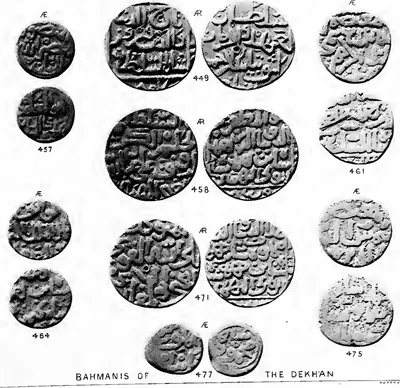 "Bahmanis of the Dekhan": coins of the Bahmani kings in the British Museum (Stanley Lane-Poole, The Coins of the Muhammadan States of India (1885), Plate XI, lower part)Coin · 1885
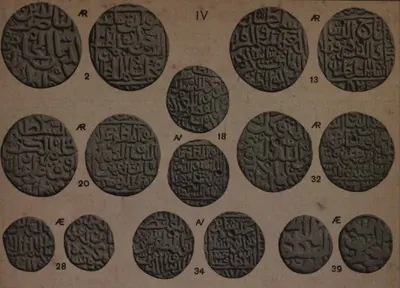 "IV. Bahmanis of Kulbarga": coins of the Bahmani kings in the Indian Museum, Calcutta (H. Nelson Wright, Catalogue of the Coins in the Indian Museum, Vol. II (1907), Plate VIII, upper part)Coin · 1907
References
Notes (0)
Sources (7)
Spotted an error on this page? Tell us
Last updated: