Sarvaya Papadu (Pap Rai)
Telangana rebel of the early eighteenth century, a toddy-drawer by caste, whom the Mughal historian Khafi Khan calls Pap Rai. From forts at Shahpur in the Bhongir country and at a second stronghold, he plundered the roads and killed Mughal officers. In 1708 he sacked Warangal. He was betrayed, captured and executed, and his head was sent to the emperor's court. Telangana tradition remembers him as Sarvaya Papadu, a Goundla hero who robbed the rich, fed the poor and held Golconda for three hours.
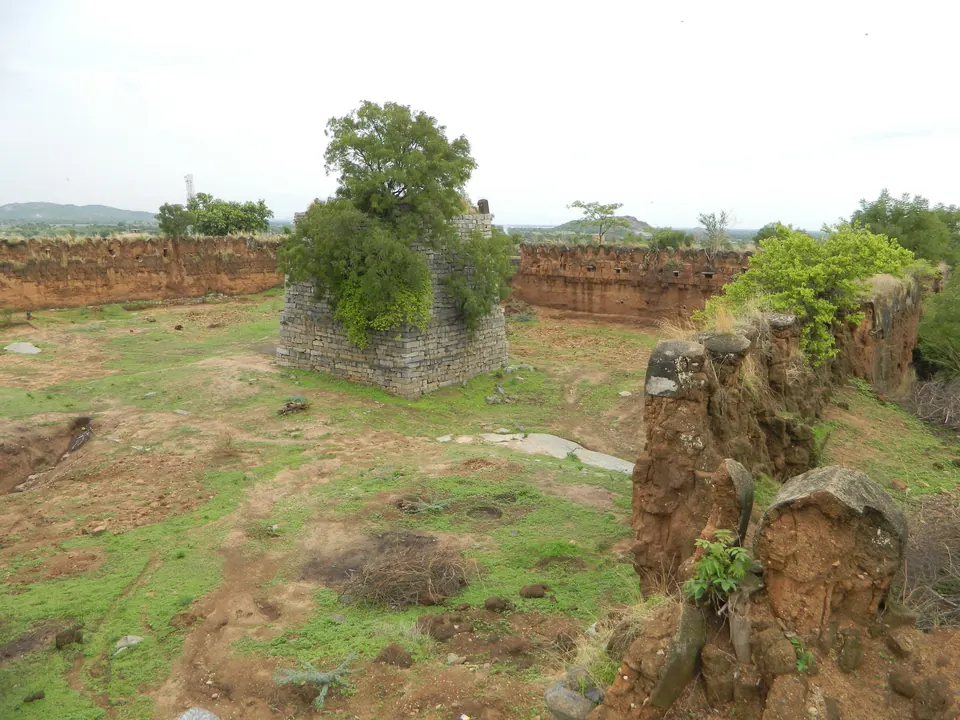
Papadu led a rising in Telangana in the years of disorder after the death of Aurangzeb. The Mughal historian Khafi Khan calls him Pap Rai, and the Kistna district manual calls him Sarva Papadu.12 The contemporary record of him is a Mughal one and treats him as a robber. Telangana tradition remembers him as a champion of the poor. This page keeps the two apart.123 See the Mughals in the Telugu country.
The Mughal record
Khafi Khan’s history of the period includes a long account of “The Freebooter Pap Rai”.1 Elliot and Dowson printed it in summary in 1877 “as an illustration of the condition of the Dakhin at this time”.1 The account begins in the reign of Bahadur Shah.1 The qazi (judge) of Warangal and the chief men of the country came to the court “with grievous complaints” against Pap Rai.1
Pap Rai, Khafi Khan says, was “by birth a toddy-seller”.1 He robbed and tortured his widowed sister for her money.14 He enlisted footmen, built a stronghold on a small hill and began to rob travellers.4
The local officers and zamindars (landholders) tried to arrest him.4 He fled to Venkat Rao, zamindar of Kolas, and entered his service.4 Venkat Rao imprisoned him for plundering on his own account.4 He was released when the zamindar’s wife freed all prisoners to save her sick son.4
He then went to Shahpur, in the pargana (sub-district) of Narganda in the sarkar (district) of Bhongir.4 There he joined “another noted ruffian named Sarwa” and built a mud fort on the rocks.4 The faujdar (military officer) of Kulpak sent an Afghan, Qasim Khan, against him.4 Qasim Khan drove him off but was killed by a musket-ball in the pursuit.4
A two months’ siege of Shahpur failed.4 When the troops left, Pap Rai and Sarwa rebuilt the fort in stone and lime and armed it with cannon.4 Sarwa was mortally wounded fighting Pur Dil Khan, who was himself killed.45
Khafi Khan places Bhongir “upon a line drawn from Warangal to Haidarabad”, with the other places north of it.4 See Bhongir and Kolanupaka, the Kulpak of the chronicle.4
Pap Rai next turned to taking forts.5 Khafi Khan says that “In Muharram, 1120” (March–April 1708) “he attacked and plundered the flourishing town of Warangal”.5 There he “killed from twelve to thirteen thousand men, women and children”.5 He almost took the fort of Bhongir, plundered its town and carried off two or three thousand prisoners.5 He built another fort near “Tarikanda”, four kos (an old measure of distance) from Shahpur.5
The emperor appointed Yusuf Khan as subahdar (provincial governor) to suppress him.5 While Pap Rai was away besieging Kulpak, his prisoners at Shahpur broke loose and seized the fort, and he fled to Tarikanda.5 There he was besieged for nine months, until his men deserted and his food ran out.5
He slipped away alone to Hasanabad, a place he had founded.5 There, in Khafi Khan’s words, “he was betrayed. He was wounded, captured, and executed. His head was sent to Court, and his limbs were exposed over the gate of Haidarabad.”5
Irvine identifies the subahdar of Bahadur Shah’s reign as Yusuf Khan Roz-bihani.67 He was still in office in 1713.67 The Imperial Gazetteer of Hyderabad (1909) summarises the episode under Bhongir, dating it to 1709.8
The Kistna district version
Gordon Mackenzie’s manual of the Krishna (then Kistna) district (1883) tells a different story. It calls him “an obscure villager of the toddy-drawer’s caste who lived near Nandigama”.2 He began by robbing travellers on the road past that town with his relations.2 His band, armed with matchlocks, reached as far as Nalgonda.2 He built a fort commanding the road, and “intercourse between Haidarabad and the Northern Circars was for the time at an end”.2 The renters of the Kondapalli country took the chance to defy the Mughal commandant there.2
In this account it was the subahdar Mubariz Khan who marched against him.2 “Sarva Papadu was defeated and slain by a Sirdar named Abid Khan”.2 The manual does not say where this account comes from. Its version places the rebel in the Krishna valley rather than north of the Warangal–Hyderabad road.24 It also moves his end to the time of Mubariz Khan.24
The legend
The census of 1961 recorded the stories told about him at Tatikonda in the Warangal district.3 Two forts stand there, one on the hill and one at its foot.3 They are said to have been built by Sarvaya Papadu, a Goundla.3
The census account, which is paraphrased here, gives several versions. In one version, Papadu was a Goundla (toddy-tapper) born in Belgaum and brought up at Tatikonda.3 He was of the Nasanollu family, who lived by tapping and herding.3 Pilgrims on their way from Kasi to Rameswaram found him asleep under a banyan tree, with a cobra shading his face.3 They foretold that he would rule a province.3
He took his mother’s savings, raised an army and built forts at Tatikonda and Shahpur.3 He robbed the rich and the nawabs and fed the poor.3 He seized Golconda and held it for seven ghadiyas, about three hours.3 When the nawab returned with a larger army, Papadu would not be taken alive and died by his own dagger.9
In another version, he built the Shahpur fort in the Bhongir taluk with another bandit, Sarvaya, and named it after himself.9 A tunnel was believed to run from Tatikonda to Shahpur.9 A Khasim Khan who attacked Shahpur was killed.9 The earthen fort was destroyed after a siege of two months, but the two escaped and rebuilt it in stone.9
Aurangzeb himself is said to have been asked to suppress him.9 A governor named Rustam Khan besieged the fort for three months in vain and went away with presents.9
When he raided Warangal in Muharram 1708, the story goes, he carried off the wife and daughter of a Khwaja Mohamed Syed.9 Generals named Yousuf Khan and Rujibiyani, sent by Bahadur Shah, then took Shahpur and his other forts by treachery.9 After a nine months’ struggle at Tatikonda, he was betrayed by his own men and killed.9
A well on the hill is named after his concubine, Yerukala Nanchari.9 A temple on the hill is said to date from his time.9 At Bhongir the census heard that Sarva Paparayudu had held the fort and climbed its steep sides with the help of an iguana.10
Record and legend compared
The tradition and Khafi Khan agree on much:459
- the caste
- the fort at Shahpur
- the companion Sarvaya or Sarwa
- the death of a Qasim or Khasim Khan
- the two months’ siege
- the rebuilding in stone
- the sack of Warangal in Muharram 1708
- a nine months’ siege of his last fort
- betrayal at the end459
The two generals of the tradition, Yousuf Khan and Rujibiyani, look like the subahdar whom Irvine calls Yusuf Khan Roz-bihani, split into two men.96 Tatikonda in the census and Tarikanda in Khafi Khan both stand for his second fort, four kos from Shahpur in the chronicle, but the sources do not say they are one place. The chronicle does not record the cobra, the prophecy or the robbing of the rich to feed the poor.53
The chronicle also does not record the three hours on the throne of Golconda or the death by his own hand.53 Khafi Khan says instead that he was captured and executed.5
The name itself differs between the sources.4210 Khafi Khan treats Pap Rai and Sarwa as two men.4 The Kistna manual and the Nalgonda tradition join the names as Sarva Papadu or Sarva Paparayudu.210 See Tatikonda and Warangal.
Footnotes
-
Khafi Khan, Muntakhabu-l Lubab, in H. M. Elliot and John Dowson (eds.), The History of India as Told by Its Own Historians, Vol. VII (1877), p. 410 and note (archive.org (opens in a new tab)). ↩ ↩2 ↩3 ↩4 ↩5 ↩6 ↩7 ↩8
-
Gordon Mackenzie, A Manual of the Kistna District (1883), p. 40 (archive.org (opens in a new tab)). ↩ ↩2 ↩3 ↩4 ↩5 ↩6 ↩7 ↩8 ↩9 ↩10 ↩11 ↩12 ↩13
-
A. Chandra Sekhar (ed.), Census of India 1961, Vol. II, Part VII-B (18): Fairs and Festivals, Warangal District (1964), p. 18, entry “Thatikonda” (PDF p. 41) (censusindia.gov.in (opens in a new tab)). Paraphrased. ↩ ↩2 ↩3 ↩4 ↩5 ↩6 ↩7 ↩8 ↩9 ↩10 ↩11 ↩12 ↩13
-
Khafi Khan, in Elliot and Dowson, History of India, Vol. VII (1877), p. 411 and note (archive.org (opens in a new tab)). ↩ ↩2 ↩3 ↩4 ↩5 ↩6 ↩7 ↩8 ↩9 ↩10 ↩11 ↩12 ↩13 ↩14 ↩15 ↩16 ↩17 ↩18 ↩19 ↩20 ↩21
-
Khafi Khan, in Elliot and Dowson, History of India, Vol. VII (1877), p. 412 (archive.org (opens in a new tab)). ↩ ↩2 ↩3 ↩4 ↩5 ↩6 ↩7 ↩8 ↩9 ↩10 ↩11 ↩12 ↩13 ↩14 ↩15 ↩16
-
William Irvine, ed. Jadunath Sarkar, Later Mughals, Vol. I (1922), p. 223, note (archive.org (opens in a new tab)). ↩ ↩2 ↩3
-
Irvine, Later Mughals, Vol. I (1922), p. 263 (archive.org (opens in a new tab)). ↩ ↩2
-
Imperial Gazetteer of India: Hyderabad State (1909), pp. 159–160 (archive.org (opens in a new tab)). ↩
-
Chandra Sekhar (ed.), Census of India 1961, Vol. II, Part VII-B (18): Fairs and Festivals, Warangal District (1964), p. 19, entry “Thatikonda” (PDF p. 42) (censusindia.gov.in (opens in a new tab)). Paraphrased. ↩ ↩2 ↩3 ↩4 ↩5 ↩6 ↩7 ↩8 ↩9 ↩10 ↩11 ↩12 ↩13 ↩14 ↩15
-
Chandra Sekhar (ed.), Census of India 1961, Vol. II, Part VII-B (20): Fairs and Festivals, Nalgonda District (1964), p. 71, entry “Bhongir” (PDF p. 109) (censusindia.gov.in (opens in a new tab)). Paraphrased. ↩ ↩2 ↩3
Photos
References
Notes (0)
Sources (6)
Spotted an error on this page? Tell us
Last updated: