Shahji Bhonsle
Maratha captain of hired soldiers and father of Shivaji. He served the Nizam Shahs of Ahmadnagar, and from 1636 the Adil Shahs of Bijapur. As second in command to Randaula Khan, he took part in Bijapur's conquest of the Karnatak. He was given a jagir (land grant) round Bangalore and Kolar, a country taken from the forebears of the Telugu poligars of Punganur. He kept a court at Bangalore and died in 1664. His son Vyankoji inherited his Karnatak jagir.
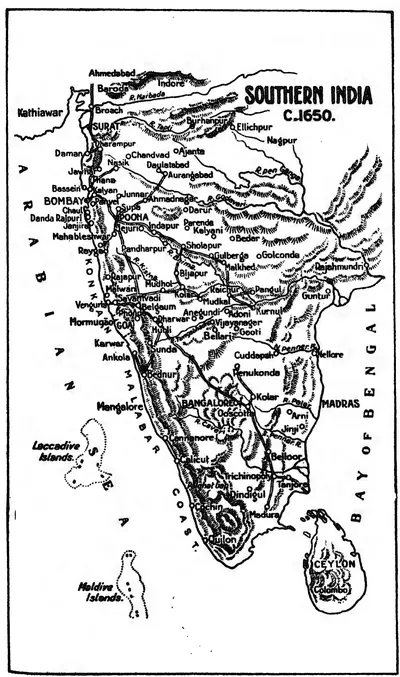
Shahji Bhonsle was, in Jadunath Sarkar’s words, “a captain of mercenaries” (hired soldiers).1 His Maratha family had come from Daulatabad into the service of the Nizam Shahi sultans of Ahmadnagar.1 He is remembered above all as the father of Shivaji.1 But his own career in the service of Bijapur took him into the old Vijayanagara country south of the Tungabhadra.23 His jagir (land grant) there became the starting point of his son’s Karnatak expedition of 1677.4 See the Marathas in the Telugu country and the Adil Shahis of Bijapur.
Wives and sons
His first wife, Jija Bai, was the daughter of Lukhji Jadav of Sindkhed, and Shivaji was her son.1 Sarkar says that Shahji left Jija Bai and her baby son and took a younger wife, Tuka Bai Mohite.5 On her and her son Vyankoji he “lavished all his affection and wealth”.5
Shahji went to Bijapur in 1636.5 His lands near Poona were then put in the charge of a Brahmin manager, Dadaji Kond-dev, and Jija Bai and Shivaji lived with him.5
In the service of Bijapur
The Jedhe chronology records that in 1635–36, after the fall of Ahmadnagar, Shahji was besieged at Mahuli.6 The besiegers were the Bijapur general Randaula Khan and the Mughal governor.6 After this he “entered Adilshahi service”.6
Grant Duff says that an expedition against the Karnatak was planned, and “Shahjee was nominated second in command, under his friend Rendoollah Khan”.2 He was promised a jagir of Kolar, Bangalore, Hoskote, Balapur and Sira, “which were afterwards made over to him”.2
The court poem Shiva-Bharat is translated in the Source Book of Maratha History (1928).3 It lists the kings he conquered for Randaula.3 Among them were the kings of Bednur, Mysore, Tanjore, Jinji and Madura, “the formidable King of Piluganda, named Venkata”, and “the wise Srirangaraja, King of Vidyanagar”.3
The poem says that Randaula gave him Bangalore, which had been taken from Kempe Gauda.3 Shahji “made his residence” there.3 The editors note that when Randaula Khan returned, Shahji governed the lands of Bijapur in the Karnatak.7
Kolar and the Punganur poligars
The Bijapur conquest of Kolar fell on a Telugu family.89 The North Arcot manual (1894) draws on the family’s own history.89 It says that the forebears of the poligars (local chiefs) of Punganur had founded and fortified Kolar.89
At that time a woman named Hulsammal was regent.89 Then “Tenésha Padshah, of Bijapur, sent Ranadhulla Khan into the country, who invested Kólár and Uskóta”.89 The regent went back with her young nephew to Avulapalli in 1639.89 The sultan then confirmed him in Punganur and the nearby districts.89
Gribble’s Cuddapah manual (1875) follows Munro’s report on the poligars.108 It says that the family’s jagirs of Hoskote and Kolar were taken by the Marathas, “probably by Shahjee”, and dates this to about 1612.108 The North Arcot manual’s date is 1639.108 See Punganur.
Captivity, Bangalore and death
The Source Book sums up the accounts of his arrest.11 The Bijapur king believed that Shahji had become too powerful in the Karnatak.11 He sent Mustafa Khan, who seized Shahji in a dawn attack on his camp.11 Shahji was set free only on condition that Bangalore and Sinhgad were given up.11
The editors write that afterwards he was sent again to the Karnatak.12 He “appears to have kept a splendid court at Bangalore, and patronised men of learning on a liberal scale”.12 They date his death to 1664.12 They say that his son Vyankoji, or Ekoji, “inherited Shahaji’s jagir in the Karnatak”.12 Shivaji claimed half of that inheritance, and this was one of the aims of his expedition of 1677.4
Footnotes
-
Jadunath Sarkar, Shivaji and his Times (2nd ed., 1920), p. 19 (archive.org (opens in a new tab)). ↩ ↩2 ↩3 ↩4
-
James Grant Duff, A History of the Mahrattas, Vol. I (1826), p. 121 (archive.org (opens in a new tab)). ↩ ↩2 ↩3
-
Patwardhan and Rawlinson, Source Book of Maratha History (1928), p. 13, translating the Shiva-Bharat (archive.org (opens in a new tab)). ↩ ↩2 ↩3 ↩4 ↩5 ↩6
-
Patwardhan and Rawlinson, Source Book of Maratha History (1928), pp. 170–172, Shivaji’s letter to Vyankoji (archive.org (opens in a new tab)). ↩ ↩2
-
Sarkar, Shivaji and his Times (1920), pp. 21–22 (archive.org (opens in a new tab)). ↩ ↩2 ↩3 ↩4
-
Patwardhan and Rawlinson, Source Book of Maratha History (1928), p. 33, translating the Jedhe chronology (archive.org (opens in a new tab)). ↩ ↩2 ↩3
-
R. P. Patwardhan and H. G. Rawlinson (eds.), Source Book of Maratha History (1928), p. 12 (archive.org (opens in a new tab)). ↩
-
Arthur F. Cox, rev. Harold A. Stuart, Madras District Manuals: North Arcot, Vol. II (1894), p. 407 (archive.org (opens in a new tab)). ↩ ↩2 ↩3 ↩4 ↩5 ↩6 ↩7 ↩8 ↩9 ↩10
-
Cox and Stuart, North Arcot, Vol. II (1894), p. 408 (archive.org (opens in a new tab)). ↩ ↩2 ↩3 ↩4 ↩5 ↩6 ↩7
-
J. D. B. Gribble, A Manual of the District of Cuddapah (1875), p. 89 (archive.org (opens in a new tab)). ↩ ↩2 ↩3
-
Patwardhan and Rawlinson, Source Book of Maratha History (1928), p. 14 (archive.org (opens in a new tab)). ↩ ↩2 ↩3 ↩4
-
Patwardhan and Rawlinson, Source Book of Maratha History (1928), p. 26 (archive.org (opens in a new tab)). ↩ ↩2 ↩3 ↩4
Photos
Related
Dynasties
References
Notes (0)
Sources (5)
Spotted an error on this page? Tell us
Last updated: