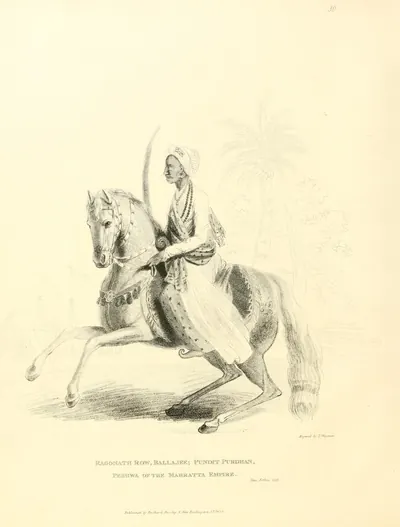
Raghunath Rao
Maratha general and statesman, called Raghoba. He was the brother of the Peshwa Balaji Baji Rao and, from 1761, regent for his nephew Madhavrao I. In 1763, after Nizam Ali had plundered Poona, he marched on Hyderabad. The city wall kept him out, but he took a payment from the suburbs. He then routed the Nizam's army on the Godavari at Rakshasbhuvan. He held the Peshwaship briefly in 1773–74, when Haidar Ali took Sira and Gurramkonda from the Marathas.
Raghunath Rao, known as Raghoba, was the brother of the Peshwa Balaji Baji Rao.12 The Peshwa trusted him with the main military arrangements.12 When his nephew Madhavrao I became Peshwa in 1761, Raghunath Rao acted “as regent”.12 He is remembered in the Telugu country for one campaign, the war of 1763 against Nizam Ali Khan, which brought a Maratha army to the walls of Hyderabad. See the Marathas in the Telugu country.
The peace of 1761–1762
Nizam Ali invaded the Maratha country after Panipat and came within fourteen miles of Poona.3 Grant Duff describes the settlement that followed.3 He says that “cessions to the amount of twenty-seven lacks of rupees of annual revenue from Aurungabad and Beder, were relinquished by Rugonath Rao as the price of peace”.3
In 1762 Raghunath quarrelled with his nephew and went to Aurangabad.45 There he was given Mughal troops.45 He promised Nizam Ali forts and land worth fifty-one lakhs for his help, but only Daulatabad was actually given up.45
Hyderabad and Rakshasbhuvan, 1763
The Nizam’s minister, Vithal Sundar, then persuaded his master that the Marathas could be overthrown.678 The war started again in 1763.678 Raghunath Rao avoided a pitched battle and failed to storm Aurangabad.678 He plundered Berar and the Mughal country.678 Nizam Ali marched on Poona and sacked it.678 Then “Rugonath Rao, for the purpose of retaliation, proceeded towards Hyderabad”.678
Grant Duff writes that “the wall which surrounds the city of Hyderabad had prevented him from making any impression on the Moghul capital”.8 Still, “he exacted a contribution of one lack and eighty thousand rupees from the suburbs”.8
Gribble’s second volume (1924) gives another account.9 It says that the Marathas, after being driven back at Aurangabad, “marched to Hyderabad, where also they were defeated, and had to retire, although not without levying a considerable amount of blackmail”.9 See Hyderabad.
Raghunath Rao then followed the Nizam’s army north.1011 He bought over the Bhonsle raja Janoji with a promise of land worth thirty-two lakhs.1011 Nizam Ali was already across the Godavari.1011 Raghunath caught the Nizam’s rearguard under the Diwan at “Rakisbone”, on the south bank of the river.1011 He attacked, and “after a sanguinary conflict, finally routed them with immense slaughter”.1011
The Diwan was killed.1011 At one point Raghunath was “almost alone … completely surrounded and cut off from his troops”, and his nephew rescued him.1011 Afterwards he forgave Nizam Ali.12 Against his ministers’ advice, he gave the Nizam land worth ten lakhs by a new treaty in October.12
Later years
Raghunath Rao became Peshwa himself after the murder of Narayan Rao in 1773.13 The contents of Grant Duff’s eighth chapter record that in 1774 he went to the Carnatic and “concludes an arrangement with Hyder”.13 Then a league of ministers turned against him.13
Grant Duff says that in the confusion Haidar completed “his conquests of the whole of the Mahratta districts south of the Toongbuddra”.1415 Haidar attacked Sira in person while Tipu besieged Gurramkonda, and both fell.1415 At the same time Basalat Jang, from Adoni, raided the Maratha country.1415 See Gurramkonda and Adoni.
The Kurnool manual calls Fateh Singh, whose army overran the Kurnool district in 1741, “apparently an officer of Ragoba”.1617 Grant Duff names Fateh Singh Bhonsle among the chiefs of Raghoji Bhonsle’s Carnatic army of 1740.1617
Footnotes
-
Grant Duff, History of the Mahrattas, Vol. II (1826), p. 73 (archive.org (opens in a new tab)). ↩ ↩2 ↩3
-
James Grant Duff, A History of the Mahrattas, Vol. II (1826), contents to ch. VI, p. ix (archive.org (opens in a new tab)). ↩ ↩2 ↩3
-
Grant Duff, History of the Mahrattas, Vol. II (1826), p. 166 (archive.org (opens in a new tab)). ↩ ↩2 ↩3
-
Grant Duff, History of the Mahrattas, Vol. II (1826), p. 168 (archive.org (opens in a new tab)). ↩ ↩2 ↩3
-
Grant Duff, History of the Mahrattas, Vol. II (1826), p. 169 (archive.org (opens in a new tab)). ↩ ↩2 ↩3
-
Grant Duff, History of the Mahrattas, Vol. II (1826), p. 171 (archive.org (opens in a new tab)). ↩ ↩2 ↩3 ↩4 ↩5 ↩6
-
Grant Duff, History of the Mahrattas, Vol. II (1826), p. 172 (archive.org (opens in a new tab)). ↩ ↩2 ↩3 ↩4 ↩5 ↩6
-
Grant Duff, History of the Mahrattas, Vol. II (1826), p. 173 (archive.org (opens in a new tab)). ↩ ↩2 ↩3 ↩4 ↩5 ↩6 ↩7 ↩8
-
J. D. B. Gribble and Mary Pendlebury, A History of the Deccan, Vol. II (1924), p. 83 (archive.org (opens in a new tab)). ↩ ↩2
-
Grant Duff, History of the Mahrattas, Vol. II (1826), p. 174 (archive.org (opens in a new tab)). ↩ ↩2 ↩3 ↩4 ↩5 ↩6 ↩7
-
Grant Duff, History of the Mahrattas, Vol. II (1826), p. 175 (archive.org (opens in a new tab)). ↩ ↩2 ↩3 ↩4 ↩5 ↩6 ↩7
-
Grant Duff, History of the Mahrattas, Vol. II (1826), p. 176 (archive.org (opens in a new tab)). ↩ ↩2
-
Grant Duff, History of the Mahrattas, Vol. II (1826), contents to ch. VIII, pp. xii–xiii (archive.org (opens in a new tab)). ↩ ↩2 ↩3
-
Grant Duff, History of the Mahrattas, Vol. II (1826), p. 268 (archive.org (opens in a new tab)). ↩ ↩2 ↩3
-
Mark Wilks, Historical Sketches of the South of India, Vol. II (1817), p. 159 (archive.org (opens in a new tab)). ↩ ↩2 ↩3
-
Narahari Gopalakristnamah Chetty, A Manual of the Kurnool District (1886), p. 31 (archive.org (opens in a new tab)). ↩ ↩2
-
Grant Duff, History of the Mahrattas, Vol. II (1826), p. 2 (archive.org (opens in a new tab)). ↩ ↩2
Photos
References
Notes (0)
Sources (4)
Spotted an error on this page? Tell us
Last updated: