Pampa (Adi Pampa)
Kannada poet, born in 902 into a Brahmana family from the Vengi country that had become Jaina. At the court of the Chalukya king Arikesari II of Vemulavada he wrote the Adipurana and the Vikramarjunavijaya or 'Pampa Bharata' (941). In the second poem he made his patron the epic hero Arjuna. A rock inscription of his younger brother Jinavallabha on the Bommala Gutta at Kurikyal, near Karimnagar, gives his family and the village the king granted him.
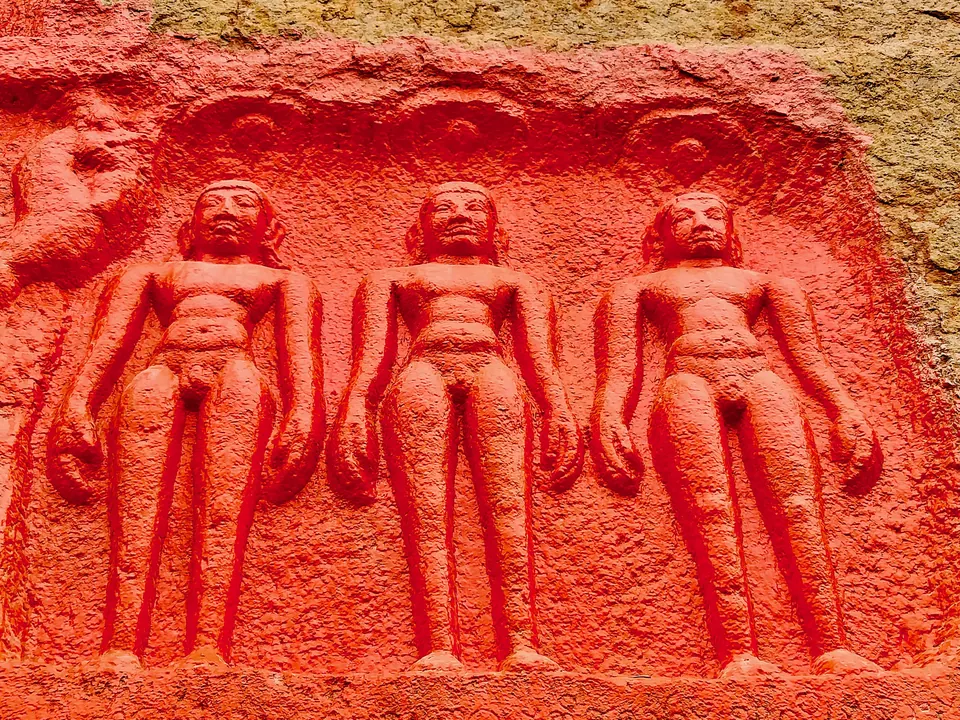
Pampa was one of the founders of classical Kannada literature. He is called Adi Pampa (“the first Pampa”) to set him apart from a later poet of the same name.1 He wrote his two great poems at the court of Arikesari II, king of the Chalukyas of Vemulavada in today’s Karimnagar district.12
Family and origin
Pampa was born in 902.31 He gives his family at the end of the Vikramarjunavijaya.45 B. Lewis Rice summed up his account like this:45
- his ancestor was Madhava Somayaji of the Vatsa gotra (clan), of the town of Vengipalu in the Vengi country
- his son was Abhiramachandra
- Abhiramachandra’s son was Komarayya
- Komarayya’s son was Abhirama-Devaraya
- Abhirama-Devaraya’s son was Pampa, called Kavitagunarnava45
Pampa adds that his father made the Jaina faith his own.45 His father believed it to be “the truest and chief in dharmma”.45 Rice concluded that Pampa was a Brahmana from Vengi, between the mouths of the Krishna and the Godavari.6 In Rice’s view Pampa was a Jaina because his father had become one.6
The Kurkyal inscription of Pampa’s younger brother, Jinavallabha, gives a fuller account. N. Venkataramanayya read it as calling Jinavallabha a Kamme-Brahmana of the Srivatsa gotra.78
In his reading, Jinavallabha came from Vangiparru, one of the seven villages of Bengi-nadu.78 In the same reading, it names him the son of Bhimapayya and Vabbanabbe, and the younger brother of Pampa, author of the Vikramarjunavijaya.78 The printed text of Pampa’s poem names his father Abhimanadevaraya. Venkataramanayya pointed out that manuscripts at Poona and Agra read “Bhima” in the same verse, and he accepted that reading because it agrees with the inscription. He suggested that Vabbanabbe was Pampa’s stepmother, which would explain why Pampa leaves her and Jinavallabha out.9
Venkataramanayya located Vangiparru at Vangipuram in the Guntur district.2 His book of 1953 put it in the Narasaraopet taluk, but his paper on the Kurkyal inscription put it in the Bapatla taluk.210 He thought that Pampa’s father, after becoming a Jaina, left the coastal country for Vemulavada.11 There, in his view, Jainism flourished under royal patronage and the people spoke Telugu.11
At Arikesari’s court
Pampa wrote both his poems, the Adipurana and the Vikramarjunavijaya, in Saka 863 (941; Saka is an Indian way of counting years).12 He says that he wrote the Bharata in six months and the Adipurana in three.12 Edward Rice gave his age as thirty-nine when he composed them “in a single year”.1 Venkataramanayya argued that the Vikramarjunavijaya was the later of the two, since it mentions the Adipurana.13 On this view it was written after 941.13
Pampa calls himself Kavitagunarnava, after his patron’s title Gunarnava.14 In his version of the Mahabharata, Arjuna is the chief hero and Draupadi is wife to him alone.14 The poem ends with Arjuna and Subhadra crowned at Hastinapura.14 He made Arikesari himself the hero, saying that he had identified the king with Arjuna.1516
According to Pampa, the king sent for him and gave him great gifts.56 He asked for a poem that would make his own fame last.56 As a reward he gave Pampa an agrahara (village granted to Brahmins), Dharmmavuram in the Bachche Thousand.56
Pampa also describes himself as a soldier who, “in his own king’s war caused the crowns of the hostile chiefs to be surrendered”.5 Venkataramanayya took this to mean that Arikesari employed him as a commander in the army.2
Where he wrote
Pampa says that he wrote in “the pithy … Kannada of Puligere, the royal city”.17 Puligere is Lakshmeshwar in the Dharwar district, and Rice, Fleet and Edward Rice took it to have been Arikesari’s capital.12181 Fleet identified the gift village, Dharmapura, with Dambal, near Lakshmeshwar.12181
After the Vemulavada and Kurkyal inscriptions were read, Venkataramanayya located Pampa’s patron at Vemulavada in Telangana.2 He looked for the village Dharmavaram or Dharmapuram in Sabbi-nadu, the Karimnagar country.21910 He found several places of that name there, but could not choose between them.21910
Fame
Rice noted that later poets refer to him with reverence as “Guru Hampa”.6 In the 12th century Nagachandra took the name Abhinava Pampa, the new Pampa.6 Edward Rice called Pampa, Ponna and Ranna the “Three Gems” of tenth-century Kannada poetry.1
A pillar inscription brought from the old fort wall at Bodhan stands on a memorial that local tradition calls Pampa’s tomb. It records that a Jaina monk named Subhanandi, a disciple of Devendra Siddhanta, attained samadhi (a holy death). The inscription does not mention Pampa. Sitarama Jagirdar, who published it, argued that Subhanandi was the name Pampa took as a monk, because the Adipurana gives him another name, Subha.2021
Footnotes
-
Edward P. Rice, A History of Kanarese Literature (2nd ed., 1921), p. 30 (archive.org (opens in a new tab)). ↩ ↩2 ↩3 ↩4 ↩5 ↩6 ↩7
-
N. Venkataramanayya, The Chalukyas of L(V)emulavada (1953), p. 45 (archive.org (opens in a new tab)). Paraphrased. ↩ ↩2 ↩3 ↩4 ↩5 ↩6 ↩7
-
J. F. Fleet, “Dynasties of the Kanarese Districts”, Gazetteer of the Bombay Presidency I, pt. II (1896), p. 380 (archive.org (opens in a new tab)). ↩
-
Rice, Pampa Bharata (1898), introduction, p. 10 (archive.org (opens in a new tab)). ↩ ↩2 ↩3 ↩4 ↩5
-
Rice, Pampa Bharata (1898), introduction, p. 11 (archive.org (opens in a new tab)). ↩ ↩2 ↩3 ↩4 ↩5 ↩6 ↩7 ↩8 ↩9
-
Rice, Pampa Bharata (1898), introduction, p. 12 (archive.org (opens in a new tab)). ↩ ↩2 ↩3 ↩4 ↩5 ↩6 ↩7
-
Gajjala Vasanta Lakshmi (ed.), Epigraphia Telanganica I: Pre-Kakatiya Telangana (2023), p. 395, reprinting N. Venkataramanayya, “The Kurkiyala Inscription of Jinavallabha”, Epigraphia Andhrica II (1974), pp. 21–28. Cite-only; paraphrased. ↩ ↩2 ↩3
-
Epigraphia Telanganica I (2023), p. 396, reprinting Venkataramanayya (1974). Cite-only; paraphrased. ↩ ↩2 ↩3
-
Epigraphia Telanganica I (2023), p. 397, reprinting Venkataramanayya (1974). Cite-only; paraphrased. ↩
-
Epigraphia Telanganica I (2023), p. 399, reprinting Venkataramanayya (1974). Cite-only; paraphrased. ↩ ↩2 ↩3
-
Epigraphia Telanganica I (2023), p. 400, reprinting Venkataramanayya (1974). Cite-only; paraphrased. ↩ ↩2
-
B. Lewis Rice (ed.), The Pampa Bharata or Vikramarjuna Vijaya of Pampa (1898), introduction, p. 1 (archive.org (opens in a new tab)). ↩ ↩2 ↩3 ↩4
-
Epigraphia Telanganica I (2023), p. 401, reprinting Venkataramanayya (1974). Cite-only; paraphrased. ↩ ↩2
-
Rice, Pampa Bharata (1898), introduction, p. 6 (archive.org (opens in a new tab)). ↩ ↩2 ↩3
-
Rice, Pampa Bharata (1898), introduction, p. 4 (archive.org (opens in a new tab)). ↩
-
E. P. Rice, History of Kanarese Literature (1921), p. 31 (archive.org (opens in a new tab)). ↩
-
Rice, Pampa Bharata (1898), introduction, p. 8 (archive.org (opens in a new tab)). ↩
-
Fleet, “Dynasties of the Kanarese Districts” (1896), p. 381 (archive.org (opens in a new tab)). ↩ ↩2
-
Epigraphia Telanganica I (2023), p. 398, reprinting Venkataramanayya (1974). Cite-only; paraphrased. ↩ ↩2
-
Epigraphia Telanganica I (2023), p. 403, reprinting Sitarama Jagirdar, “Pampa’s Samadhi”, Epigraphia Andhrica II (1974), pp. 31–35. Cite-only; paraphrased. ↩
-
Epigraphia Telanganica I (2023), p. 404, reprinting Jagirdar (1974). Cite-only; paraphrased. ↩
Photos
References
Notes (0)
Sources (5)
Spotted an error on this page? Tell us
Last updated: