Vijayaditya I (Eastern Chalukya)
Vijayaditya I was an Eastern Chalukya king of Vengi and the son of Vishnuvardhana III. The grants say he ruled for eighteen years, 746–764 in J. F. Fleet's dating. His titles included Vijayasiddhi and Vikramarama, and his seals carry the motto Tribhuvanankusa. Three of his copper-plate grants are known, one examined in 1917 and two published in 1930. In his time the Rashtrakutas took the western Deccan from the Chalukyas of Badami. A Rashtrakuta record of 769 claims that Govinda II made the lord of Vengi submit, and scholars disagree whether that lord was Vijayaditya I or his son.
Download
Vijayaditya I was the ninth king of the Eastern Chalukya dynasty of Vengi.1 He was the son of Vishnuvardhana III, and the grants say he ruled for eighteen years.2 J. F. Fleet dated his reign 746–764.2 In his time a new power, the Rashtrakutas, took the western Deccan and soon turned towards Vengi.3
Names and titles
Most later grants call him Vijayaditya-Bhattaraka.2 One of them seems to give him the titles Vikrama-Rama and Vijayasiddhi.2 A grant of his grandson Vijayaditya II names the donor’s grandfather as Vikramarama, and F. Kielhorn identified this grandfather as Vijayaditya I.4 A. C. Burnell also gave him the name Saktivarman, but Fleet could find no authority for it.52
His grants
His first known grant was examined in 1917.6 It traces the family from Mangi-yuvaraja, called Vijayasiddhi, through his son Vishnuvardhana to Vijayaditya-Maharaja.6 The king gave the village of Sakharambu in Velanandu to Devasarman, a Brahmin of Karamchedu.6 The epigraphist thought the grant might date from the lunar eclipse of 25 December 763.6
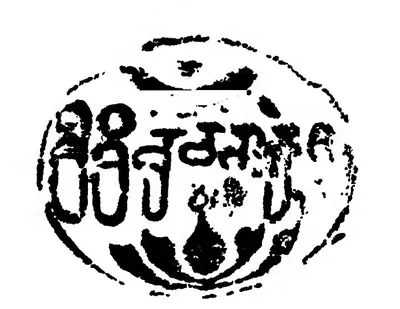
Its seal carries the legend Tribhuvanankusa.6 Fleet translated this family motto as “the glorious elephant-goad of the three worlds”.7 Until 1917 it was known only from the seals of his grandson, Vijayaditya II.6
Two more sets of plates were found in the West Godavari district about two years before 1930.8 R. Subba Rao published them in that year, and they were kept at the Telugu Academy in Kakinada (then Cocanada).8 Each set has three plates on a ring.8 Its seal shows a crescent, the legend Sri Tribhuvanankusa and an open lotus.8
Both sets give land to the same Brahmin, Madhavasarma of Vargiparu.9 The first gives a field of eight khandikas (a land measure) west of the village of Gommaluru in the Gudrahara district, at a lunar eclipse.910 The second gives a field of twelve khandikas east of Dinakadu, in the Guntur taluk, at a solar eclipse.910 Subba Rao thought the second grant was the later one, because the first says the donee could then recite only two Vedas.9
Subba Rao listed the king’s titles in these grants.9 They include Samastabhuvanasraya (“refuge of the whole world”), Chakravarti (emperor), Vijayasiddhi, Bhattaraka, Vikramarama and Tribhuvanankusa.9 He noted that both sets are written in the old Telugu-Kannada script.11 They show the earliest form of the letter called sakata repha, an old Telugu “r”.11
The Rashtrakutas
At the end of his father’s reign and the start of his own, the Rashtrakutas under Dantidurga took the western Deccan from the Chalukyas of Badami.3 According to The Early History of the Deccan (1960), a Rashtrakuta inscription of 769 tells how the crown prince Govinda II led an army against the Vengi country.3 The lord of Vengi submitted to him at his camp where the Musi river joins the Krishna.3 He gave up treasure, troops and land.312
Subba Rao told the same story from the Alas plates of Govinda II, but as a real defeat of Vijayaditya I.9 In his view the king had to give up his western districts and pay a heavy war fine.9 But he thought Vijayaditya still held his own, as his grants and his great titles show.9 The authors of The Early History of the Deccan, K. A. Nilakanta Sastri and N. Venkataramanayya, doubted that Vengi suffered much.12 They pointed out that the Rashtrakuta army did not enter Vengi, and there was no battle.12
Length of reign and family
Grants of his descendants Gunaga-Vijayaditya III and Chalukya-Bhima I, examined in 1912–14, give him nineteen years instead of eighteen.1314 His son and successor was Vishnuvardhana IV.7
Where the sources disagree
- Dates. Fleet gives 746–764.2 Subba Rao gives 751–769.11 The Early History of the Deccan gives 755–772.3
- Length of reign. Most grants say eighteen years.2 The grants of Gunaga-Vijayaditya III and Chalukya-Bhima I examined in 1912–14 say nineteen.1314
- Who was the lord of Vengi in the Alas plates? Subba Rao (1930) and The Early History of the Deccan (1960) place Govinda II’s march in Vijayaditya I’s reign.93 Robert Sewell dated the Alas plates to 770–71 and took them as a defeat of his son Vishnuvardhana IV.15 Sewell also noted Fleet’s doubts about whether the plates are genuine.15
- How serious it was. Subba Rao thought Vijayaditya lost his western districts and paid a war fine.9 Nilakanta Sastri and Venkataramanayya thought there was no fighting and little real loss.12
Footnotes
-
J. F. Fleet, “The Chronology of the Eastern Chalukya Kings”, Indian Antiquary XX (1891), p. 12, list of kings (archive.org (opens in a new tab)). ↩
-
Fleet, “Chronology of the Eastern Chalukya Kings” (1891), p. 99 and note 17 (archive.org (opens in a new tab)). ↩ ↩2 ↩3 ↩4 ↩5 ↩6 ↩7
-
K. A. Nilakanta Sastri and N. Venkataramanayya, “The Eastern Chalukyas”, in G. Yazdani (ed.), The Early History of the Deccan, Parts VII–XI (1960), p. 474 (archive.org (opens in a new tab)). Cite-only; paraphrased. ↩ ↩2 ↩3 ↩4 ↩5 ↩6 ↩7
-
F. Kielhorn, “Six Eastern Chalukya Copper-plate Inscriptions: A. Ederu Plates of Vijayaditya II”, Epigraphia Indica V (1898–99), p. 119 (archive.org (opens in a new tab)). ↩
-
A. C. Burnell, Elements of South-Indian Palaeography (2nd ed., 1878), p. 21, note 1 (archive.org (opens in a new tab)). ↩
-
Annual Report on Epigraphy, for 1916–17 (G.O. No. 1035, Home (Education), 10 August 1917), p. 116, paragraph 22 (archive.org (opens in a new tab)). ↩ ↩2 ↩3 ↩4 ↩5 ↩6
-
Fleet, “Chronology of the Eastern Chalukya Kings” (1891), p. 100 (archive.org (opens in a new tab)). ↩ ↩2
-
R. Subba Rao, “Two New Copper-plate Inscriptions of Vijayaditya I”, Journal of the Andhra Historical Research Society V, pt. 1 (1930), p. 51 (archive.org (opens in a new tab)). ↩ ↩2 ↩3 ↩4
-
Subba Rao, “Two New Copper-plate Inscriptions of Vijayaditya I” (1930), p. 53 (archive.org (opens in a new tab)). ↩ ↩2 ↩3 ↩4 ↩5 ↩6 ↩7 ↩8 ↩9 ↩10 ↩11
-
Subba Rao, “Two New Copper-plate Inscriptions of Vijayaditya I” (1930), p. 54 (archive.org (opens in a new tab)). ↩ ↩2
-
Subba Rao, “Two New Copper-plate Inscriptions of Vijayaditya I” (1930), p. 52 (archive.org (opens in a new tab)). ↩ ↩2 ↩3
-
Nilakanta Sastri and Venkataramanayya, in The Early History of the Deccan (1960), p. 475 (archive.org (opens in a new tab)). Cite-only; paraphrased. ↩ ↩2 ↩3 ↩4
-
Annual Report on Epigraphy, Southern Circle, for 1911–12 (G.O. No. 919, Public, 29 July 1912), p. 84, paragraph 62 (archive.org (opens in a new tab)). ↩ ↩2
-
Annual Report on Epigraphy, for 1913–14 (G.O. No. 920, Public, 4 August 1914), p. 84, paragraph 6 (archive.org (opens in a new tab)). ↩ ↩2
-
Robert Sewell and S. Krishnaswami Aiyangar, The Historical Inscriptions of Southern India (1932), p. 30 (archive.org (opens in a new tab)). ↩ ↩2
Photos
Related
Dynasties
References
Notes (0)
Sources (8)
Spotted an error on this page? Tell us
Last updated: