Vishnuvardhana III (Eastern Chalukya)
Eastern Chalukya king of Vengi (709–746), son of Mangi-yuvaraja. He took the throne by expelling his younger half-brother Kokkili and reigned for 37 years. His grants name two queens, and one of them, a renewal of an older gift to a Jain temple at Bezwada, is the earliest mention of Jains in the dynasty's records. A Pallava record claims that a general of Nandivarman II drove an enemy out of his kingdom.
Vishnuvardhana III was the eighth king of the Eastern Chalukya dynasty of Vengi. The later grants of the family agree that he reigned for 37 years. J. F. Fleet and Robert Sewell date the reign 709–746.12
Family and coming to the throne
Vishnuvardhana III was a son of Mangi-yuvaraja.34 Mangi-yuvaraja, the son of Vishnuvardhana II, reigned for 25 years. Sewell dates his reign 672–696.52
Jayasimha II was the eldest son of Mangi-yuvaraja.16 He reigned for thirteen years, 696–709 in Sewell’s dating.17 One grant of his is known, giving a field at Penukaparu in the Karmarashtra district. In it he calls himself Sakalalokasraya, “asylum of the whole world”, and its executor bore the title Prithivi-gamundi, which E. Hultzsch connected with gamunda, a village headman.6
Kokkili was the younger half-brother of Jayasimha II.1 He reigned for only six months.18 Vishnuvardhana III was the elder brother of Kokkili.1 The Pithapuram pillar inscription of 1202 says that Vishnuvardhana ruled for 37 years “having expelled him”.8 The grants do not say whether Vishnuvardhana was older or younger than Jayasimha II. Fleet followed Hultzsch in placing him between the two.1
Queens and grants
Four records of his time had been reported by 1917.
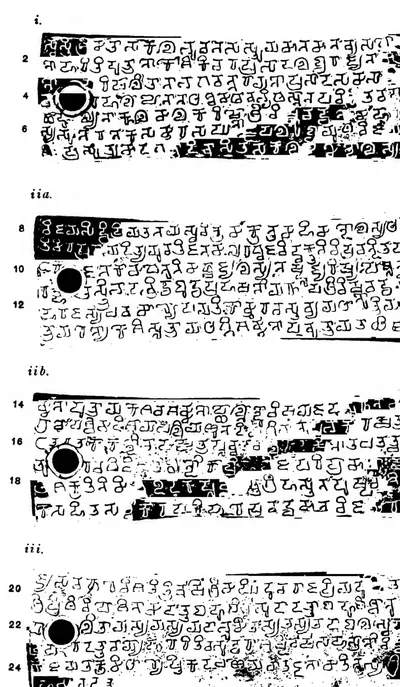
- Ipur plates. Found in the Krishna district and dated in the 23rd year of his reign. They record a grant of a field, a house-site and a flower-garden in the district of Plolnandu, near Pithapuram, to a Brahmin of Kommara. The seal bears his surname Vishamasiddhi. Hultzsch described the Sanskrit as “barbarous”.49
- Pasapubarru grant. It gave land in the Gudrahara district to a Brahmin of Parandur on the day of a solar eclipse. The epigraphist who examined it in 1914 noted that no inscription of Vishnuvardhana III had been published before.3
- Musinikonda grant. It gave a village to the Jain temple Nadumbi-vasati at Bijavada (Vijayawada, then Bezwada), through the Jain teacher Kalibhadracharya. The epigraphist of 1917 called this “so far, the earliest mention of Jainas and Jaina temples in Eastern Chalukya records”. Its executor was Ayyana-mahadevi, queen of Kubja Vishnuvardhana, and its seal bore the founder’s name. He therefore thought the charter renewed an old grant of the founder’s time. A word in the text that may be a date would correspond to Saka 684 (762–63; Saka is an Indian way of counting years), in the reign of Vishnuvardhana’s son.10
- Selapadu stone. A stone inscription at Selapadu in the Guntur taluk is dated in the 33rd year of a Sarvalokasraya Vishnuvardhana. Since only Vishnuvardhana III and Vishnuvardhana IV reigned so long, the epigraphist assigned it to one of the two.10
Vijaya-Mahadevi was the chief queen of Vishnuvardhana III. She was the executor of the Pasapubarru grant.3 The Ipur grant was made by Prithivipothi, daughter of Maghinduvaraja. Hultzsch thought that she seems to have been one of the queens of Vishnuvardhana III. He suggested, with hesitation, that her father was the Pallava king Mahendravarman III, and saw in the match a sign of close connection between the two dynasties.411
The Pallava claim
Pallava records claim a success against Vengi in his reign. The Udayendiram plates of the Pallava king Nandivarman II say that his general Udayachandra pursued the Nishada chief Prithivivyaghra, who was performing a horse sacrifice. He drove him out of the territory of Vishnuraja, which Fleet took to be the land of Vengi, the kingdom of Vishnuvardhana III, and “made subject to Nandivarman”.1213 The Godavari district gazetteer read the same record as a claim that Udayachandra had subdued Vishnuvardhana III himself. It thought this reconquest “by the ancient owners of the country seems to have been short-lived”.14
Vijayaditya I
Vijayaditya I was the son of Vishnuvardhana III.1 He reigned for eighteen years, 746–764 in Fleet’s and Sewell’s dating. Most later grants call him Vijayaditya-Bhattaraka, and one gives him the surnames Vikrama-Rama and Vijayasiddhi.12 A grant of his grandson Vijayaditya II calls its donor’s grandfather Vikramarama, which F. Kielhorn took to mean Vijayaditya I.15 A. C. Burnell also gave him the name Saktivarman. Fleet could find no authority for this.161 Grants of Gunaga-Vijayaditya III and Chalukya-Bhima I examined in 1912–14 give him nineteen years instead of eighteen.1718
His first known grant was examined in 1917. It names Mangi-yuvaraja, his son Vishnuvardhana and his son Vijayaditya, and gives the village of Sakharambu in Velanandu to a Brahmin of Karamchedu. Its seal bears the legend Tribhuvanankusa, until then known only from the seals of his grandson. The epigraphist suggested that its date might be the lunar eclipse of 25 December 763.10 His son was Vishnuvardhana IV.
Footnotes
-
Fleet, “Chronology of the Eastern Chalukya Kings” (1891), p. 99 and note 17 (archive.org (opens in a new tab)). ↩ ↩2 ↩3 ↩4 ↩5 ↩6 ↩7 ↩8 ↩9 ↩10
-
Sewell and Aiyangar, Historical Inscriptions of Southern India (1932), p. 336, table of the Eastern Chalukya dynasty (archive.org (opens in a new tab)). ↩ ↩2 ↩3
-
Annual Report on Epigraphy, for 1913–14 (1914), p. 85, paragraph 8 (archive.org (opens in a new tab)). ↩ ↩2 ↩3
-
E. Hultzsch, “Ipur Plates of Vishnuvardhana III”, Epigraphia Indica XVIII (1925–26), p. 58 (archive.org (opens in a new tab)). ↩ ↩2 ↩3
-
J. F. Fleet, “The Chronology of the Eastern Chalukya Kings”, Indian Antiquary XX (1891), p. 98 (archive.org (opens in a new tab)). ↩
-
E. Hultzsch, “Penukaparu Grant of Jayasimha II”, Epigraphia Indica XVIII (1925–26), p. 314 (archive.org (opens in a new tab)). ↩ ↩2
-
Robert Sewell and S. Krishnaswami Aiyangar, The Historical Inscriptions of Southern India (1932), p. 26 (archive.org (opens in a new tab)). ↩
-
E. Hultzsch, “Pithapuram Pillar Inscription of Mallapadeva”, Epigraphia Indica IV (1896–97), p. 239 (archive.org (opens in a new tab)). ↩ ↩2
-
Hultzsch, “Ipur Plates of Vishnuvardhana III” (1926), p. 60, abstract of contents (archive.org (opens in a new tab)). ↩
-
Annual Report on Epigraphy, for 1916–17 (G.O. No. 1035, Home (Education), 10 August 1917), p. 116, paragraphs 21–22 (archive.org (opens in a new tab)). ↩ ↩2 ↩3
-
Hultzsch, “Ipur Plates of Vishnuvardhana III” (1926), p. 59 (archive.org (opens in a new tab)). ↩
-
J. F. Fleet, “Dynasties of the Kanarese Districts”, in Gazetteer of the Bombay Presidency, Vol. I, Part II (1896), p. 326 (archive.org (opens in a new tab)). ↩
-
Fleet, “Dynasties of the Kanarese Districts” (1896), p. 327 (archive.org (opens in a new tab)). ↩
-
F. R. Hemingway, Madras District Gazetteers: Godavari (1907), p. 20 (archive.org (opens in a new tab)). ↩
-
F. Kielhorn, “Six Eastern Chalukya Copper-plate Inscriptions: A. Ederu Plates of Vijayaditya II”, Epigraphia Indica V (1898–99), p. 119 (archive.org (opens in a new tab)). ↩
-
A. C. Burnell, Elements of South-Indian Palaeography (2nd ed., 1878), p. 21, note 1 (archive.org (opens in a new tab)). ↩
-
Annual Report on Epigraphy, Southern Circle, for 1911–12 (G.O. No. 919, Public, 29 July 1912), p. 84, paragraph 62 (archive.org (opens in a new tab)). ↩
-
Annual Report on Epigraphy, for 1913–14 (G.O. No. 920, Public, 4 August 1914), p. 84, paragraph 6 (archive.org (opens in a new tab)). ↩
Photos
Related
Dynasties

References
Notes (0)
Sources (10)
Spotted an error on this page? Tell us
Last updated: