Vishnuvardhana II (Eastern Chalukya)
Eastern Chalukya king of Vengi (663–672), son of Indra-Bhattaraka and nephew of Jayasimha I, who may have adopted him. Two of his grants are the earliest Eastern Chalukya records whose dates can be worked out to the day. J. F. Fleet built the chronology of the whole dynasty on them. His son Mangi-yuvaraja followed him, and Mangi-yuvaraja's grant of 673 was found at Chendalur in the Ongole country.
Vishnuvardhana II was the fourth king of the Eastern Chalukya dynasty of Vengi. Robert Sewell’s table dates his reign 663–672.1 His reign matters to historians because two of his grants carry dates precise enough to be worked out exactly.2 J. F. Fleet used them, with the Chipurupalle grant of the founder, to fix the starting point of the whole dynasty.2
Family
Vishnuvardhana II was the son of Indra-Bhattaraka.3 Indra-Bhattaraka, a younger son of Kubja Vishnuvardhana, is said to have reigned for only seven days after his brother Jayasimha I.4
E. Hultzsch noted that the inscriptions knew of only one son of Indra-Bhattaraka, the one who succeeded as Vishnuvardhana II.5 The Kondanaguru grant, however, names Indra-Bhattaraka’s eldest son as another Indravarman.5
Two grants were found at Pamidimukkala, in the Nuzvid estate of the Krishna district.6 One makes Vishnuvardhana the son of Indra-Bhattaraka, and the other the son of Jayasimha-Vallabha.6 The epigraphist who examined them in 1917 concluded that Jayasimha I had treated Vishnuvardhana II as an adopted son.6 Sewell reported the same suggestion.7
Names and titles
His own grants call him Vishnuvardhana, and one later grant calls him Vishnuraja. The seals of his grants give him the surname Vishamasiddhi, as for his grandfather. One grant calls him a paramamaheshvara, a devout worshipper of Shiva.3
Another grant says that he had won the “five great sounds”, the right to be announced by five kinds of musical instruments.3 His title was Maharaja.3
The Pamidimukkala grants suggest that he had a further surname, Pralayaditya.6 Sewell’s table adds Rajanandana and Makaradhvaja.1 A. C. Burnell’s list of 1878 calls him Rajanandana-Vishnuvardhana II.8
The dated grants
Fleet knew two grants of the reign.
- A grant from somewhere in the Nellore district gave the village of Beyuru in the Karmarashtra district to Brahmins. It is dated in his second year, on a Wednesday, the tenth day of the bright half of Chaitra, under the Magha nakshatra (lunar mansion). Fleet worked this out as Wednesday, 13 March 664. Its writer was Vinayaka, son of Era.3
- A grant apparently from Mattewada in the Krishna (then Kistna) district was addressed to the village of Pallivada in the Gudrahara district. It was made in his fifth year, at an eclipse of the sun on the new-moon day of Phalguna. Fleet identified the eclipse as that of 17 February 668. Only its first two plates survive.3
From these two dates Fleet placed Vishnuvardhana’s accession between 14 February and 24 March 663.2 V. Rangacharya, working from the same two grants in 1928, narrowed it to between 17 February and 13 March 663.9
Hultzsch noticed that one grant of Vishnuvardhana II names many receivers of the gift, each called a Boya of some village.5 He took the word to mean simply “resident”.5
The Pamidimukkala grants gave land in a district called Vara-nandu to two Brahmins, and one of them is dated in the king’s third year.10 That third year had a lunar eclipse in Karttika, and Sewell placed it in 635.7 He argued that the year must be Jayasimha’s, since there was no such eclipse in Vishnuvardhana’s own third year.7
Mangi-yuvaraja
Mangi-yuvaraja was the son of Vishnuvardhana II.3 He reigned for twenty-five years, and Sewell’s table dates his reign 672–696.31 Fleet could find nothing to explain why the title yuvaraja, “heir-apparent”, was always attached to his name.311
He had the epithet sarvalokasraya, “asylum of all mankind”.311 The seal of his grant gives him the surname Vijayasiddhi, which the text of the grant explains as “the success of victory in controversies” about metaphysics and other sciences.311
That grant, now in the Madras Museum, gave fields in a village of the Karmarashtra district at the winter solstice in his twentieth year.1112 Sewell noted another grant of his, dated 6 May 673, found at Chendalur in the Ongole taluk, which showed him ruling that country.13
Hultzsch compared the alphabet of the Penukaparu grant of Mangi-yuvaraja’s son Jayasimha II with that of the Chendalur plates.14 See Vishnuvardhana III for Mangi-yuvaraja’s sons.
Footnotes
-
Sewell and Aiyangar, Historical Inscriptions of Southern India (1932), p. 336, table of the Eastern Chalukya dynasty (archive.org (opens in a new tab)). ↩ ↩2 ↩3
-
J. F. Fleet, “The Chronology of the Eastern Chalukya Kings”, Indian Antiquary XX (1891), p. 10 (archive.org (opens in a new tab)). ↩ ↩2 ↩3
-
Fleet, “Chronology of the Eastern Chalukya Kings” (1891), p. 98 (archive.org (opens in a new tab)). ↩ ↩2 ↩3 ↩4 ↩5 ↩6 ↩7 ↩8 ↩9 ↩10 ↩11
-
Fleet, “Chronology of the Eastern Chalukya Kings” (1891), p. 97 (archive.org (opens in a new tab)). ↩
-
E. Hultzsch, “Kondanaguru Grant of Indravarman”, Epigraphia Indica XVIII (1925–26), p. 2 (archive.org (opens in a new tab)). ↩ ↩2 ↩3 ↩4
-
Annual Report on Epigraphy, Southern Circle, for 1916–17 (G.O. No. 1035, Home (Education), 10 August 1917), p. 115, paragraph 20 (archive.org (opens in a new tab)). ↩ ↩2 ↩3 ↩4
-
Robert Sewell and S. Krishnaswami Aiyangar, The Historical Inscriptions of Southern India (1932), p. 23 (archive.org (opens in a new tab)). ↩ ↩2 ↩3
-
A. C. Burnell, Elements of South-Indian Palaeography (2nd ed., 1878), p. 21, note 1 (archive.org (opens in a new tab)). ↩
-
V. Rangacharya, “The Pulibumra Plates of the Eastern Chalukya King Jayasimha I”, Epigraphia Indica XIX (1927–28), p. 256 (archive.org (opens in a new tab)). ↩
-
Annual Report on Epigraphy, for 1916–17 (1917), p. 116, paragraph 20 (archive.org (opens in a new tab)). ↩
-
Fleet, “Chronology of the Eastern Chalukya Kings” (1891), p. 99 (archive.org (opens in a new tab)). ↩ ↩2 ↩3 ↩4
-
J. F. Fleet, “Madras Museum Copper-plate Grant of Mangi-Yuvaraja”, Indian Antiquary XX (1891), p. 104 (archive.org (opens in a new tab)). ↩
-
Sewell and Aiyangar, Historical Inscriptions of Southern India (1932), p. 26 (archive.org (opens in a new tab)). ↩
-
E. Hultzsch, “Penukaparu Grant of Jayasimha II”, Epigraphia Indica XVIII (1925–26), p. 314 (archive.org (opens in a new tab)). ↩
Photos
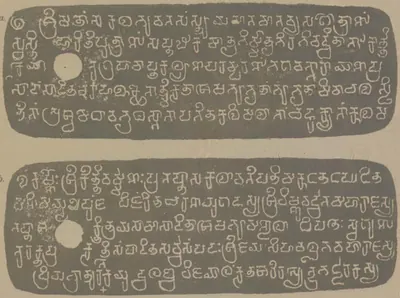 "Eastern Chalukya grant of the fifth year of Vishnuvardhana II.", plates i a and i b (Indian Antiquary VII, plate at p. 191 (PDF p. 248))Inscription rubbing · 1878
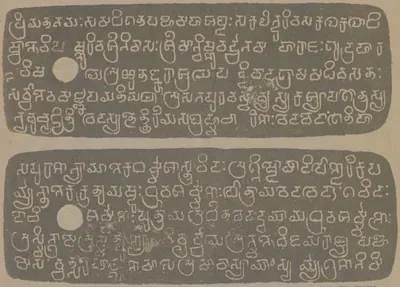 "Eastern Chalukya grant of the fifth year of Vishnuvardhana II.", plates ii a and ii b (Indian Antiquary VII, plate at p. 190 (PDF p. 247))Inscription rubbing · 1878
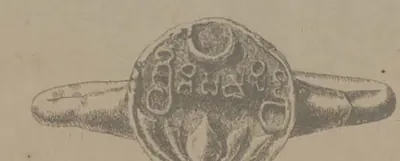 Seal of the "Eastern Chalukya grant of the fifth year of Vishnuvardhana II." (Indian Antiquary VII, plate at p. 190 (PDF p. 247))Drawing · 1878
Related
Dynasties

References
Notes (0)
Sources (6)
Spotted an error on this page? Tell us
Last updated: