Gurazala
Town in the Palnadu, west of Dachepalle. An inscription of 1129 calls it Madhavipattana; in it Beta Birudankarudra, a Haihaya feudatory (subordinate chief) of the Western Chalukyas, gave land to a temple there. In the ballad of the Palnadu heroes it is the capital of King Alugu Bhupati and of Nayakuralu, from which Brahma Nayudu broke away.
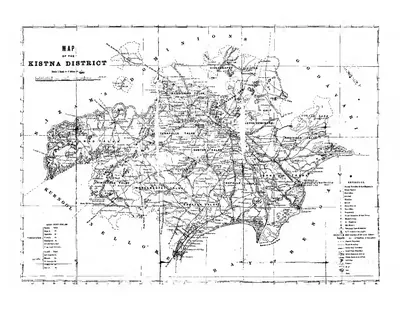
Gurazala lies in the Palnadu, about eight miles west of Dachepalle.1 Gordon Mackenzie (1883) called it “once the capital of the local chieftains known in verse as the Palnati Viralu”.1 He saw many old temples there whose inscriptions had not yet been properly read, and two Portuguese epitaphs of 1767 and 1769.1
In the inscriptions
A record on a pillar in the Virabhadresvara temple at Gurazala is dated in Saka 1051 (1129; Saka is an Indian way of counting years), in the reign of the Western Chalukya king Somesvara III.2 It mentions a place called Madhavipattana.2 It records a gift of land by “a Haihaya feudatory chief named Beta Birudankarudra” to a temple of the Hindu trinity founded there by a Brahman.2 V. Rangacharya identified Madhavipattana with Gurazala.2
The Annual Report on Epigraphy for 1932–33 identified this Beta with the Haihaya chief of the Macherla inscription.3 That chief was “a descendant of Kartaviryarjuna” of the Chagi race.3 Chilukuri Veerabhadra Rao (1912) also identified Madhavipattana with Gurijala.45 He took these Haihayas to be the kings whose story is the Palnati Viracharitra.45 See the Haihayas of Kona and Palnadu and the Western Chalukyas of Kalyani.
In the ballad
Robert Sewell summarised the ballad of the Palnadu heroes.6 In it, King Alugu Bhupati built the city on his return from his marriage at Chandavolu.6 He named it after the creepers that grew there and made it his chief town.6
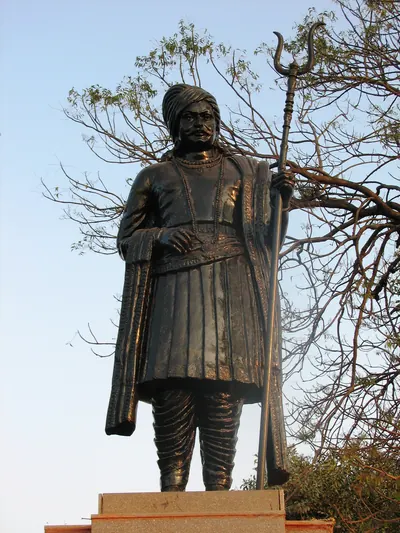
From Gurazala Brahma Nayudu led the young princes away to found Macherla.789 The fateful cock-fight was fought at Gurazala.789 Sewell explained the name as “Diamond city” and placed the town about six miles west of the Nagileru.6 See Brahma Nayudu and Macherla.
Footnotes
-
Gordon Mackenzie, A Manual of the Kistna District (1883), p. 157 (archive.org (opens in a new tab)). ↩ ↩2 ↩3
-
V. Rangacharya, A Topographical List of the Inscriptions of the Madras Presidency, Vol. II (1919), p. 808, No. 509 (archive.org (opens in a new tab)). ↩ ↩2 ↩3 ↩4
-
Annual Report on South-Indian Epigraphy for 1932–33 (1936), Part II, para. 12, p. 59 (archive.org (opens in a new tab)). ↩ ↩2
-
Chilukuri Veerabhadra Rao, Andhrula Charitramu, Part II (1912), p. 195 (archive.org (opens in a new tab)). In Telugu. ↩ ↩2
-
Veerabhadra Rao, Andhrula Charitramu, Part II (1912), p. 196 (archive.org (opens in a new tab)). In Telugu. ↩ ↩2
-
Robert Sewell, Lists of the Antiquarian Remains in the Presidency of Madras, Vol. I (1882), Appendix A, p. v and note 2 (archive.org (opens in a new tab)). ↩ ↩2 ↩3 ↩4
-
Sewell, Lists of Antiquarian Remains, Vol. I (1882), Appendix A, p. vi (archive.org (opens in a new tab)). ↩ ↩2
-
Sewell, Lists of Antiquarian Remains, Vol. I (1882), Appendix A, p. vii (archive.org (opens in a new tab)). ↩ ↩2
-
Sewell, Lists of Antiquarian Remains, Vol. I (1882), Appendix A, p. viii (archive.org (opens in a new tab)). ↩ ↩2
Photos
Related
People
References
Notes (0)
Sources (5)
Spotted an error on this page? Tell us
Last updated: