Kaulas
Fort of the Telugu country which the first Bahmani sultan took from the ruler of Warangal. Haig names this ruler Kanhayya Naik, and an epigraphy report of 1934–35 notes that he has been identified with the Musunuri chief Kapaya Nayaka. His attempt to win Kaulas back led to war with the Bahmani sultan Muhammad Shah I.
A frontier fort
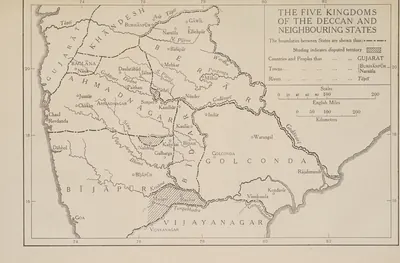
Ferishta says that the first Bahmani sultan, Ala-ud-din Hasan Bahman Shah, took Kaulas (Kowlas) from the Raja of Warangal.1 In his words, the sultan “wrested Kowlas, also, with its dependencies, from the Raja of Wurungole, with whom he formed a treaty of alliance”.1 Haig names the raja Kanhayya Naik.2 Elsewhere Haig calls him “Krishna or Kanhayya Naik”.3 The epigraphy report for 1934–35 says that the Musunuri chief Kapaya Nayaka “has been identified with Kanya-Nayaka or Krishna-Nayak of the Muhammadan historians”.4 He says that Bahman Shah’s general Sikandar Khan forced him to give up Kaulas and pay tribute.2
Bahman Shah divided his kingdom into four provinces.56 Kaulas then went to the governor of Bidar, with Bidar, Indur and the Bahmani districts of Telingana.56 Gribble describes it as “a fort which had been taken from the Rajah of Warangal, in whose territory it was situated”.7 See Kapaya Nayaka and the Bahmanis.
The war with Warangal
Ferishta says that early in the reign of Muhammad Shah I, the Raja of Telingana demanded the return of his lands.8 The Raja sent his son Vinaik Dew with an army to recover Kaulas, but the Bahmani general Bahadur Khan defeated it.8 Haig says that Kanhayya had demanded the retrocession (giving back) of Kaulas.9
After the raid on Velumputtun the wounded sultan halted at Kaulas, where his main army joined him.10 He later marched from Kaulas on his final campaign into Telingana.11 When peace was made, Bahadur Khan stayed at Kaulas to see the terms carried out.12 Haig, too, has the sultan’s pursuers checked at Kaulas.13 See Golconda.
Footnotes
-
Muhammad Qasim Ferishta, tr. John Briggs, History of the Rise of the Mahomedan Power in India, Vol. II (1829), p. 293 (archive.org (opens in a new tab)). ↩ ↩2
-
Wolseley Haig (ed.), The Cambridge History of India, Vol. III (1928), p. 373 (archive.org (opens in a new tab)). ↩ ↩2
-
Haig, Cambridge History of India, Vol. III (1928), p. 169 (archive.org (opens in a new tab)). ↩
-
Annual Report on South-Indian Epigraphy for 1934–35 (1938), p. 74 (archive.org (opens in a new tab)). Paraphrased except for the phrase quoted. ↩
-
Ferishta, tr. Briggs, Vol. II (1829), p. 296 (archive.org (opens in a new tab)). ↩ ↩2
-
Haig, Cambridge History of India, Vol. III (1928), p. 375 (archive.org (opens in a new tab)). ↩ ↩2
-
J. D. B. Gribble, A History of the Deccan, Vol. I (1896), p. 37 (archive.org (opens in a new tab)). ↩
-
Ferishta, tr. Briggs, Vol. II (1829), p. 301 (archive.org (opens in a new tab)). ↩ ↩2
-
Haig, Cambridge History of India, Vol. III (1928), p. 379 (archive.org (opens in a new tab)). ↩
-
Ferishta, tr. Briggs, Vol. II (1829), p. 304 (archive.org (opens in a new tab)). ↩
-
Ferishta, tr. Briggs, Vol. II (1829), p. 305 (archive.org (opens in a new tab)). ↩
-
Ferishta, tr. Briggs, Vol. II (1829), p. 306 (archive.org (opens in a new tab)). ↩
-
Haig, Cambridge History of India, Vol. III (1928), p. 380 (archive.org (opens in a new tab)). ↩
Photos
References
Notes (0)
Sources (4)
Spotted an error on this page? Tell us
Last updated: