Ala-ud-din Hasan Bahman Shah
Officer of the Delhi sultanate who led the Deccan revolt against Muhammad bin Tughluq, with help from the ruler of Warangal. In 1347 he founded the Bahmani sultanate at Gulbarga. He took Kaulas from Warangal and made western Telangana a province of his kingdom.
Ala-ud-din Hasan, known before his accession as Zafar Khan, founded the Bahmani sultanate, the first independent Muslim kingdom of the Deccan. He came to power in 1347 at the head of a revolt against the Delhi sultan Muhammad bin Tughluq.12 Troops sent by the Hindu ruler of Warangal helped him win it.12 His reign set the pattern of Bahmani relations with Telangana: tribute from Warangal, a frontier in the west of the region, and a province governed from Bidar.
Origins and name
The historian Ferishta admitted that accounts of Hasan’s early life differed.34 He gave only the one “most generally believed in the Deccan”.34 In it Hasan, a native of Delhi, was the servant of Gangu, a Brahman astrologer in favour with Prince Muhammad Tughluq.34 Hasan was ploughing a field his master had lent him when he found a pot of old gold coins, and he handed it over.34 His honesty was reported to the king, who gave him command of a hundred horsemen.34
Gangu, the story goes, read in Hasan’s horoscope that he would rise to power.34 He made Hasan promise to take the name Gangu and to make him his finance minister.34
Ferishta had seen a family tree in the royal library of Ahmadnagar that traced Hasan to Bahman, an ancient king of Persia.5 He thought flatterers had made it up after Hasan came to the throne.5 In his view the name Bahmani was a compliment to Gangu, commonly pronounced “Bahmun”.5 Hasan himself, he says, was an Afghan by birth.5
Later writers disagreed. T. W. Haig, writing in 1907, says that Hasan claimed descent from the Persian hero Bahman.67 In Haig’s account he reigned as Ala-ud-din Bahman Shah, not, “as is usually stated”, Ala-ud-din Hasan Gangu Bahmani.67 The Imperial Gazetteer likewise notes that an inscription of his own time calls him Ala-ud-din Bahman Shah.67
That inscription is on a broken stone outside a gate of Gulbarga fort.8910 It records the building of a mosque in AH 754 (1353; AH is the Islamic way of counting years) “in the reign of … ‘Ala’u-‘d-dunya wa’d-din Bahman Shah”.8910 Haig, who published it, said it removed “all doubt as to his correct style”.8910 In 1904 he argued that the dynasty’s name came from the Persian Bahman and had “no connection with the caste-name ‘Brahman’”.8910
G. Yazdani, then in charge of the Nizam’s Archaeological Department, disagreed in its report for 1919–20.11 He thought the courtiers chose the name because the Persian king’s name matched the Persianised form of “Brahman”.11 In this way the name honoured both the king’s claim and his debt to Gangu.11
The Deccan revolt
Hasan went to the Deccan with Qutlugh Khan, Muhammad bin Tughluq’s governor of Daulatabad, and was given an estate near Raybagh.4 Then the sultan ordered the Deccan officers to his camp in Gujarat.1213 They feared for their lives and revolted.1213 Some Hindu rajas joined them, and others helped them in secret.1213 They chose an Afghan officer, Ismail, as their king, and Hasan received the title Zafar Khan.1213
Muhammad bin Tughluq was called away by a revolt elsewhere.12 Meanwhile Zafar Khan marched against the sultan’s general Imad-ul-Mulk at Bidar.12 According to Ferishta he dared not attack until he was joined by “fifteen thousand infantry, sent by the Raja of Tulingana”, and by horsemen from Ismail.12 Imad-ul-Mulk was killed and his army routed.12
The Kistna District Manual names the Warangal ruler as Virabhadraya, a son of Prataparudra.14 Ismail then stepped down in Zafar Khan’s favour.2
Ferishta dates the coronation to Friday, 24 Rabi-ul-Akhir AH 748, which Briggs converts to 12 August 1347.2 Other writers give other days:15166
- Sewell’s table gives 3 August16
- his narrative, citing the Burhan-i Ma’asir, gives 3 December15
- Haig gives 4 August, and notes 4 December as another reading6
The new king made Gulbarga his capital and appointed Saif-ud-din Ghori his minister.1718 Ferishta says he kept his promise and made Gangu his treasurer.1718 It was generally believed, Ferishta adds, that Gangu was the first Brahman to serve a Muslim prince.1718 Briggs added a footnote calling this ignorant, since Brahmans had long kept the public accounts.1718
Warangal and western Telangana
Ferishta says Ala-ud-din took Kaulas and its lands from the Raja of Warangal and then made an alliance with him.19 Later the Raja stopped paying.2021 He was treated gently because of the help he had given, and he agreed to pay the tribute he had once sent to Delhi.2021
Haig names this ruler as Kanya or Kanhayya Naik (see Kapaya Nayaka).22 He adds that the sultan captured the rock fort of Bhongir, which became for a time the Bahmani frontier post.22 He suggests that Bhongir was later given back in exchange for Kaulas.22
The Burhan-i Ma’asir, the other main history of the dynasty, tells this part of the reign differently. It does not mention the Telugu troops at Bidar.2324 Instead it says that soon after the accession the general Sikandar Khan wrote to “Kanabayand, who was wali of Telingana”, asking for elephants.2324 Kanabayand sent a written promise of submission and met Sikandar Khan with rich offerings.2324 He sent two elephants and other presents to the king.2324
Late in the reign, it says, the king spent nearly a year in Telingana and took the district of Bhonagir.25 He overthrew its temples and built mosques and schools in their place.25 His kingdom then reached “from the east side of Daulatabad to Bhonagir and the river Godavari”.25
In his Cambridge History Haig combines the two accounts.2627 He writes that Sikandar Khan “compelled Kanhayya Naik of Warangal to cede the fortress of Kaulas and to pay tribute”.26 He adds that the king later took Bhongir and subdued the country between it and Kohir.27
Late in his reign Ala-ud-din divided the kingdom into four provinces.2829 One, made up of Bidar, Indur, Kaulas and the districts in Telingana, went to Azim-i-Humayun, son of the minister.2829 Haig calls Bidar the capital of western Telingana.22 He judges that the Bahmani border then ran a little east of Indur.22
Family
According to the Burhan-i Ma’asir, Bahman Shah had four sons, of whom it names Muhammad, the eldest, Mahmud and Ahmad.1030 Ferishta names three of his sons, Muhammad, the eldest, Daud and Mahmud, the youngest, and makes Daud the fourth king.2910 Haig concluded in 1904 that the four were Muhammad, Daud, Ahmad and Mahmud.31 But the order of Daud and Ahmad could not be settled.31
Muhammad succeeded his father as Muhammad Shah I.3132 The Burhan-i Ma’asir makes Ahmad the father of the later kings Firuz Shah and Ahmad Shah I.3132 It makes Mahmud the father of Muhammad Shah II.3132
Coins
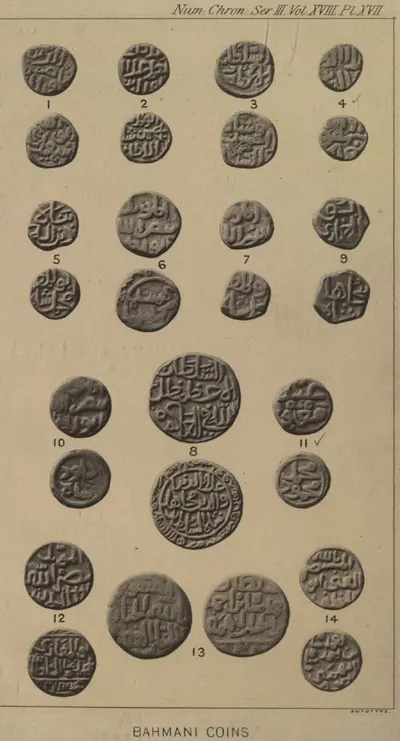
Codrington, in 1898, listed small silver coins of the king, one of them dated AH 758, and two kinds of copper.33 Haig says the king took the title “the Second Alexander” on his coins, copying Ala-ud-din Khalji.2734 He notes a coin of his dated AH 760, after his death, and says it might have been struck after he died.2734
Death and reputation
In AH 758 (1357) the sultan set out towards Gujarat, but he fell ill with fever and returned to Gulbarga.28295 In his last months he went on holding audience twice a day.28295 He set free all prisoners except those held for crimes punished by death.28295
He died on 1 Rabi-ul-Awwal AH 759, which Briggs gives as 10 February 1358.28295 He was sixty-seven, and had reigned eleven years, two months and seven days.28295 Sewell gives 2 February 1358.16
The Burhan-i Ma’asir gives the same length of reign.30 The Tazkirat-ul-Muluk, as King translates it, gives thirteen years, ten months and twenty-seven days, and a death in AH 781.35
Judgements of him differ. Ferishta praised his justice “tempered with mercy”.205 He quoted the king’s own explanation of his rise: kindness to friends, generosity to enemies, and courtesy to all.205 Sewell, writing in 1932, judged him a fierce and bigoted ruler who killed Hindus without mercy.15
Footnotes
-
Ferishta, tr. Briggs, Vol. II (1829), p. 289 (archive.org (opens in a new tab)); Gribble, History of the Deccan (1896), p. 21 (archive.org (opens in a new tab)). ↩ ↩2 ↩3 ↩4 ↩5 ↩6
-
Ferishta, tr. Briggs, Vol. II (1829), p. 290 (archive.org (opens in a new tab)). ↩ ↩2 ↩3 ↩4 ↩5 ↩6 ↩7 ↩8
-
Muhammad Qasim Ferishta, tr. John Briggs, History of the Rise of the Mahomedan Power in India, Vol. II (1829), p. 284 (archive.org (opens in a new tab)). ↩ ↩2 ↩3 ↩4 ↩5 ↩6 ↩7
-
Ferishta, tr. Briggs, Vol. II (1829), p. 285 (archive.org (opens in a new tab)); J. D. B. Gribble, A History of the Deccan, Vol. I (1896), p. 16 (archive.org (opens in a new tab)). ↩ ↩2 ↩3 ↩4 ↩5 ↩6 ↩7 ↩8
-
Ferishta, tr. Briggs, Vol. II (1829), p. 297 (archive.org (opens in a new tab)). ↩ ↩2 ↩3 ↩4 ↩5 ↩6 ↩7 ↩8 ↩9 ↩10 ↩11
-
T. W. Haig, Historic Landmarks of the Deccan (1907), p. 3 and notes (archive.org (opens in a new tab)). ↩ ↩2 ↩3 ↩4 ↩5
-
Imperial Gazetteer of India: Hyderabad State (1909), p. 11 (archive.org (opens in a new tab)). ↩ ↩2 ↩3
-
T. W. Haig, “Inscriptions in Gulbarga”, Epigraphia Indo-Moslemica 1907–08 (1909), p. 1 (archive.org (opens in a new tab)). ↩ ↩2 ↩3 ↩4
-
T. W. Haig, “Some Notes on the Bahmani Dynasty”, Journal of the Asiatic Society of Bengal LXXIII, Part I, extra number (1904), p. 2 (archive.org (opens in a new tab)). ↩ ↩2 ↩3 ↩4
-
Haig, “Some Notes on the Bahmani Dynasty” (1904), p. 4 (archive.org (opens in a new tab)). ↩ ↩2 ↩3 ↩4 ↩5 ↩6
-
Annual Report of the Archaeological Department of H.E.H. the Nizam’s Dominions, 1919–20 (1922), p. 2, note (archive.org (opens in a new tab)). ↩ ↩2 ↩3
-
Ferishta, tr. Briggs, Vol. II (1829), pp. 286–287 (archive.org (opens in a new tab)). ↩ ↩2 ↩3 ↩4
-
Ferishta, tr. Briggs, Vol. II (1829), p. 288 (archive.org (opens in a new tab)). ↩ ↩2 ↩3 ↩4
-
Gordon Mackenzie, A Manual of the Kistna District (1883), p. 16 (archive.org (opens in a new tab)). ↩
-
Robert Sewell, The Historical Inscriptions of Southern India (1932), p. 191 (archive.org (opens in a new tab)). ↩ ↩2 ↩3
-
Sewell, Historical Inscriptions (1932), p. 327 (archive.org (opens in a new tab)). ↩ ↩2 ↩3
-
Ferishta, tr. Briggs, Vol. II (1829), p. 291 (archive.org (opens in a new tab)). ↩ ↩2 ↩3 ↩4
-
Ferishta, tr. Briggs, Vol. II (1829), p. 292 and note (archive.org (opens in a new tab)). ↩ ↩2 ↩3 ↩4
-
Ferishta, tr. Briggs, Vol. II (1829), p. 293 (archive.org (opens in a new tab)). ↩
-
Ferishta, tr. Briggs, Vol. II (1829), p. 294 (archive.org (opens in a new tab)). ↩ ↩2 ↩3 ↩4
-
Gribble, History of the Deccan (1896), p. 30 (archive.org (opens in a new tab)). ↩ ↩2
-
Haig, Historic Landmarks of the Deccan (1907), p. 73 (archive.org (opens in a new tab)). ↩ ↩2 ↩3 ↩4 ↩5
-
J. S. King, The History of the Bahmani Dynasty, founded on the Burhan-i Ma’asir (1900), p. 9 and notes 15–17 (archive.org (opens in a new tab)). ↩ ↩2 ↩3 ↩4
-
King, History of the Bahmani Dynasty (1900), p. 10 (archive.org (opens in a new tab)). ↩ ↩2 ↩3 ↩4
-
King, History of the Bahmani Dynasty (1900), p. 21 (archive.org (opens in a new tab)). ↩ ↩2 ↩3
-
Wolseley Haig (ed.), The Cambridge History of India, Vol. III (1928), p. 373 (archive.org (opens in a new tab)). ↩ ↩2
-
Haig, Cambridge History of India, Vol. III (1928), p. 375 (archive.org (opens in a new tab)). ↩ ↩2 ↩3 ↩4
-
Ferishta, tr. Briggs, Vol. II (1829), p. 295 (archive.org (opens in a new tab)). ↩ ↩2 ↩3 ↩4 ↩5 ↩6 ↩7
-
Ferishta, tr. Briggs, Vol. II (1829), p. 296 (archive.org (opens in a new tab)). ↩ ↩2 ↩3 ↩4 ↩5 ↩6 ↩7 ↩8
-
King, History of the Bahmani Dynasty (1900), p. 22 (archive.org (opens in a new tab)). ↩ ↩2
-
Haig, “Some Notes on the Bahmani Dynasty” (1904), pp. 5–6 (archive.org (opens in a new tab)). ↩ ↩2 ↩3 ↩4 ↩5
-
Haig, “Some Notes on the Bahmani Dynasty” (1904), pp. 6, 8 (archive.org (opens in a new tab)). ↩ ↩2 ↩3
-
O. Codrington, “On the Coins of the Bahmani Dynasty”, Numismatic Chronicle, 3rd series, XVIII (1898), p. 263 (archive.org (opens in a new tab)). ↩
-
Haig, Cambridge History of India, Vol. III (1928), p. 376 and note 1 (archive.org (opens in a new tab)). ↩ ↩2
-
King, History of the Bahmani Dynasty (1900), p. 26 and note 31 (archive.org (opens in a new tab)). ↩
Photos
References
Notes (0)
Sources (12)
Spotted an error on this page? Tell us
Last updated: