Lepakshi
Village nine miles east of Hindupur in the Anantapur district. It is known for the Virabhadra temple on the low Kurmasaila hill and for the colossal stone bull near it. Virupanna of Penukonda built the temple in the reign of Achyuta Raya. The temple's inscriptions of 1533–1538 place Lepakshi in Rodda-nadu, a subdivision of the Penukonda province.
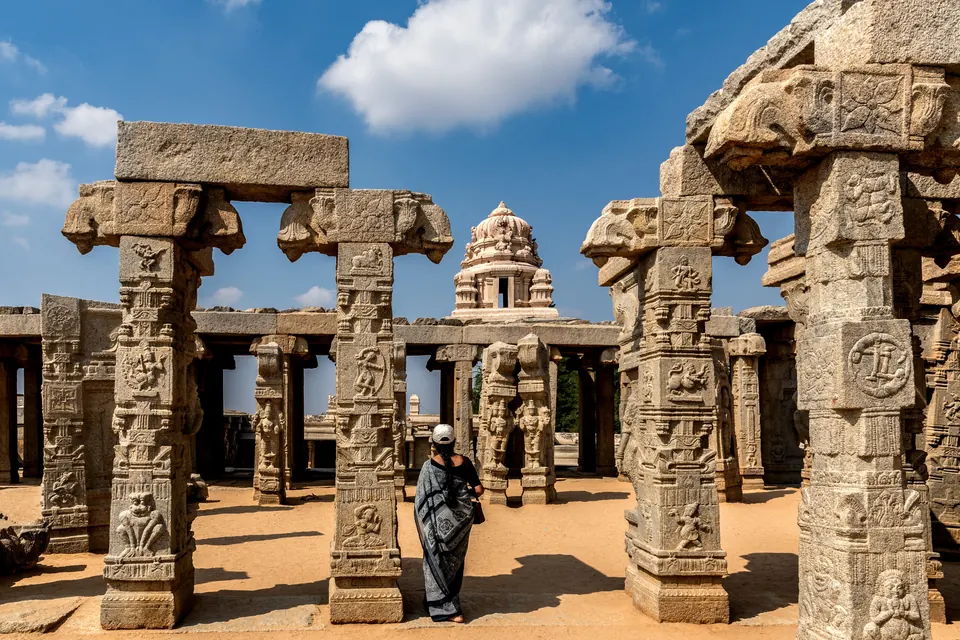
The Anantapur gazetteer of 1905 describes Lepakshi as “a small agricultural village with a population of 2,376, lying nine miles east of Hindupur”.1 It says that the village “is well-known for its temple to Virabhadra and the colossal stone bull which stands near this”.1 The temple “is built on a low rocky hill”, and the gazetteer calls it a notable building in the style of the best Vijayanagar architecture.1
The bull stands about two hundred yards to the east of the temple.2 The gazetteer says that it “is a remarkable piece of work”, about fifteen feet high and some twenty-seven feet long.2 It is “finished with great care”.2
V. Rangacharya wrote in 1919 about the Vishnu temple of the village.3 He said that a Telugu bard had honoured it in his Telugu dramatic poem Lepakshi-Ramayanamu.3 He understood that the poem “is largely sung on occasions of puppet shows”.3 See the Lepakshi temple.
Lepakshi in the inscriptions
The temple’s inscriptions were copied in 1912.34 They date from 1533 to 1538, in the reign of Achyuta Raya.34 They call the god “Viresvara on the Kurmasaila hill at Lepakshipura”.34 They describe Lepakshi as “a village in Sadali-vente which belonged to Rodda-nadu, a subdivision of Penugonde-rajya” (the Penukonda kingdom).34
The records name the temple’s builder as Virupanna or Virappannayya “of Penugonde”.34 They call him the son of Nandi-Lakiseti of Lepakshi.34 Viresvaradevarapura, a hamlet belonging to Lepakshi, held a market every Sunday.4 Its tolls were granted to the temple.4 See the Lepakshi inscriptions, Achyuta Raya and Penukonda.
Later records
Later records at old Lepakshi, near the village, include Telugu grants of 1680 and 1681 to the temple of Santa-Nanjundesvara.5 One of them was made for the merit of the Golconda king Abul Hasan.5 Another was made by merchants “of all countries” in the time of the Karvetinagar chief Saluva Makaraja Tirumalaraja.5
The gazetteer records that in 1786 Tipu Sultan camped at Lepakshi on his way to Adoni.1
Footnotes
-
W. Francis, Madras District Gazetteers: Anantapur (1905), p. 172 (archive.org (opens in a new tab)). ↩ ↩2 ↩3 ↩4
-
Francis, Anantapur Gazetteer (1905), p. 174 (archive.org (opens in a new tab)). ↩ ↩2 ↩3
-
V. Rangacharya, A Topographical List of the Inscriptions of the Madras Presidency, Vol. I (1919), p. 12, Anantapur district, Lepakshi (archive.org (opens in a new tab)). ↩ ↩2 ↩3 ↩4 ↩5 ↩6 ↩7 ↩8 ↩9
-
Rangacharya, Topographical List, Vol. I (1919), p. 13, Anantapur Nos. 76–78 (archive.org (opens in a new tab)). ↩ ↩2 ↩3 ↩4 ↩5 ↩6 ↩7 ↩8
-
Rangacharya, Topographical List, Vol. I (1919), p. 15, Anantapur Nos. 88–89 (archive.org (opens in a new tab)). ↩ ↩2 ↩3
Photos
Related
People
Monuments
Inscriptions
References
Notes (0)
Sources (2)
Spotted an error on this page? Tell us
Last updated: