Achyuta Raya
King of Vijayanagara from 1529 or 1530 to 1542, half-brother and successor of Krishnadeva Raya. He was crowned at Tirupati after years of confinement at Chandragiri. He lost Raichur and Mudkal to Bijapur, while Sultan Quli of Golconda attacked Kondavidu. His court poem credits him with a southern campaign and a victory at Raichur. Nuniz, who lived at his capital, called him a tyrant ruled by his two brothers-in-law, the Salakam Tirumalas, whose regency after his death led to civil war.
Achyuta Raya followed Krishnadeva Raya as king of Vijayanagara and reigned until 1542. The earliest date of his reign that Sewell knew was 15 August 1530.1 Sewell’s later work begins the reign in 1529.2 A record of 29 May 1542 shows him still alive.123 According to the list that Subramiah Pantulu quoted from H. H. Wilson, the grants of the reign run from 1530 to 1542.4 See Vijayanagara and Krishnadeva Raya.
Family
The Achyutarayabhyudayam of Rajanatha Dindima, written for his court, says that Narasa had three queens, Tippamba, Nagamamba and Obamamba, and that by Obamamba he had Achyuta.5 Tirumalamba’s Sanskrit Varadambikaparinayam calls Achyuta’s mother Obamamba, daughter of Rachiraja.6 It tells how he married Varadamba, younger sister of two of his ministers, both named Tirumalaraja.6 Their son Chinna Venkatadri was installed as heir to the throne.6
The Achyutarayabhyudayam adds that at Achyuta’s coronation Varadambika, “the daughter of Salaka Raju”, was anointed queen.7 It says his son Pinna Venkatadri was made crown prince.7 Sewell’s later pedigree gives Narasa and Obambika a second son, Ranga, whose son was Sadasiva.2
Not all sources make Achyuta Krishnadeva Raya’s brother. Nuniz calls him the late king’s brother, and the genealogy of the inscriptions makes him a half-brother.189 But two inscriptions noted by Sewell call him Krishnadeva Raya’s son.189 The Telugu Vasucharitramu makes him a son of the second Narasimha, and Couto calls him a nephew.189 Krishnaswami Aiyangar wrote that he was Krishna’s “surviving brother”.10
Coming to the throne
Nuniz says that Krishnadeva Raya had sent his three brothers and a nephew to the fortress of Chandragiri when he came to the throne.11 On his deathbed, Nuniz says, he chose Achyuta, “who now reigns”, because his own son was only eighteen months old.11 The minister Salvanay governed until Achyuta arrived from Chandragiri.11
The Achyutarayabhyudayam says that he was crowned first at Tirupati, where the god’s conch was used to bathe him.7 He was then crowned again at the capital, Vidyanagara.7 Krishnaswami Aiyangar wrote that Achyuta had himself anointed at Tirupati, “quite close to Chandragiri, where he was at the time”.10
Wars
The court poem makes Achyuta an energetic king. It tells how a governor named Chellappa revolted and fled to the king of Travancore.12713 In the poem, Achyuta then marched to Srirangam.12713 His brother-in-law Salaka Raju Tirumala went on, the poem says, defeated the Travancore king and restored the Pandya ruler.12713
Next the poem has Achyuta besiege Raichur and defeat the army sent to relieve it.14 In it the Sultan of Bijapur then submits to him on the banks of the Krishna.14 Krishnaswami Aiyangar found support for this in an inscription of 1534.15 It records a grant made by the king while camped on the Krishna.15
Krishnaswami Aiyangar wrote in 1928 that Achyuta sealed a treaty in the south “by his own marriage with a Pandya princess”.16 But his march to the Bijapur frontier, Aiyangar wrote, “effected nothing”.16
The Muslim and Portuguese sources tell of losses. Ferishta says that soon after Krishnadeva Raya’s death the Adil Shah took Raichur and Mudkal after a siege of three months.117 Sewell adds that Sultan Quli Qutb Shah of Golconda attacked Kondavidu about this time for holding back tribute.18 He took it and built a tower in the fort to mark the event.18 See Kondavidu, Sultan Quli and Raichur.
Nuniz and Ferishta
Nuniz, who was at the capital in his reign, wrote that Achyuta “gave himself over to vice and tyranny” and did only what his two brothers-in-law desired. The Adil Shah came within a league of the capital and razed the new city of Nagalapur.1119 Then, Nuniz says, the king made a peace for a hundred years, paid a great sum and gave up Raichur.1119 Afterwards he got the money back by ruthless demands on his captains.1119
Nuniz wrote: “He had destroyed the principal people of his kingdom and killed their sons and taken their goods”.1920 The captains held “that if this kingdom should ever be brought to destruction, it must take place in the lifetime of King Chitarao”.1920
Sewell set Ferishta’s account of these years beside Nuniz’s.21222324 Ferishta tells instead of a regent called “Hoje” Tirumala, who called the Bijapur army to the capital in 1535–36.21222324 In his account the regent killed himself when Rama Raya’s party broke in.21222324 Sewell thought it “hopeless to try and reconcile the conflicting stories of Nuniz, Barros, and Firishtah”.21222324
Krishnaswami Aiyangar thought that “Hoje” (Kannada hucchu, “mad”) Tirumala was the elder of Achyuta’s brothers-in-law.16
Court and religion
Sewell noted that many grants to temples were made in Achyuta’s reign.25 Among them was a grant of a village near Madras, made by the king in 1540 at the temple of Vitthalasvami at the capital.25 Sewell called the temple’s pavilions “an object of astonishment and admiration to all beholders”.25
The Telugu translation of Bhaskara’s arithmetic, the Lilavati, was made by Vallabhacharya.26 He made it at the request of Bommalata, a trusted servant of Krishnadeva Raya and of Achyuta.26 The court poet Rajanatha Dindima wrote for him the Achyutarayabhyudayam and a Bhagavata Champu.27
Death and succession
Achyuta died in 1542. Krishnaswami Aiyangar wrote in 1928 that his son Venkata was placed on the throne and killed by the mad Tirumala.16 He wrote that the three Aravidu brothers then crowned Sadasiva, son of Achyuta’s brother Ranga.16
Sewell’s later work notes that Sadasiva was on the throne by 27 June 1542.3 From this Sewell concluded that Venkata had been killed within a few weeks of his accession.3 The struggle that followed is told on the page of Aliya Rama Raya.
Footnotes
-
Robert Sewell, A Forgotten Empire (Vijayanagar) (1900), p. 165 and note (archive.org (opens in a new tab)). ↩ ↩2 ↩3 ↩4 ↩5 ↩6
-
Robert Sewell, ed. S. Krishnaswami Aiyangar, The Historical Inscriptions of Southern India (1932), p. 401 (archive.org (opens in a new tab)). ↩ ↩2 ↩3
-
Sewell, Historical Inscriptions (1932), p. 403, notes to the pedigrees (archive.org (opens in a new tab)). ↩ ↩2 ↩3
-
G. R. Subramiah Pantulu, “Discursive Remarks on the Augustan Age of Telugu Literature”, Indian Antiquary XXVII (1898), p. 300 (archive.org (opens in a new tab)). ↩
-
Krishnaswami Aiyangar, Sources of Vijayanagar History (1919), p. 108, extract 36, the Achyutarayabhyudayam (archive.org (opens in a new tab)). ↩
-
Krishnaswami Aiyangar, Sources of Vijayanagar History (1919), p. 172, extract 54, the Varadambikaparinayam of Tirumalamba (archive.org (opens in a new tab)). ↩ ↩2 ↩3
-
Krishnaswami Aiyangar, Sources of Vijayanagar History (1919), p. 158, extract 53, the Achyutarayabhyudayam (archive.org (opens in a new tab)). ↩ ↩2 ↩3 ↩4 ↩5 ↩6 ↩7
-
Sewell, A Forgotten Empire (1900), p. 180, pedigree (archive.org (opens in a new tab)). ↩ ↩2 ↩3
-
Sewell, A Forgotten Empire (1900), p. 181 (archive.org (opens in a new tab)). ↩ ↩2 ↩3
-
S. Krishnaswami Aiyangar (ed.), Sources of Vijayanagar History (1919), introduction, pp. 11–12 (archive.org (opens in a new tab)). ↩ ↩2
-
Fernao Nuniz, “Chronicle”, in Sewell, A Forgotten Empire (1900), p. 367 (archive.org (opens in a new tab)). ↩ ↩2 ↩3 ↩4 ↩5 ↩6
-
Krishnaswami Aiyangar, Sources of Vijayanagar History (1919), introduction, pp. 12–13 (archive.org (opens in a new tab)). ↩ ↩2 ↩3
-
Krishnaswami Aiyangar, Sources of Vijayanagar History (1919), p. 159, the Achyutarayabhyudayam (archive.org (opens in a new tab)). ↩ ↩2 ↩3
-
Krishnaswami Aiyangar, Sources of Vijayanagar History (1919), p. 160, the Achyutarayabhyudayam (archive.org (opens in a new tab)). ↩ ↩2
-
Krishnaswami Aiyangar, Sources of Vijayanagar History (1919), introduction, p. 14 (archive.org (opens in a new tab)). ↩ ↩2
-
S. Krishnaswami Aiyangar, “Hindu States in Southern India”, in Wolseley Haig (ed.), The Cambridge History of India, Vol. III (1928), p. 498 (archive.org (opens in a new tab)). ↩ ↩2 ↩3 ↩4 ↩5
-
Sewell, A Forgotten Empire (1900), p. 166, quoting Ferishta (archive.org (opens in a new tab)). ↩
-
Sewell, A Forgotten Empire (1900), p. 167 (archive.org (opens in a new tab)). ↩ ↩2
-
Nuniz, in Sewell, A Forgotten Empire (1900), p. 368 (archive.org (opens in a new tab)). ↩ ↩2 ↩3 ↩4 ↩5
-
Nuniz, in Sewell, A Forgotten Empire (1900), p. 369 (archive.org (opens in a new tab)). ↩ ↩2
-
Sewell, A Forgotten Empire (1900), pp. 168–169 (archive.org (opens in a new tab)). ↩ ↩2 ↩3 ↩4
-
Sewell, A Forgotten Empire (1900), p. 170, quoting Ferishta (archive.org (opens in a new tab)). ↩ ↩2 ↩3 ↩4
-
Sewell, A Forgotten Empire (1900), p. 171 (archive.org (opens in a new tab)). ↩ ↩2 ↩3 ↩4
-
Sewell, A Forgotten Empire (1900), pp. 176–177 (archive.org (opens in a new tab)). ↩ ↩2 ↩3 ↩4
-
Sewell, A Forgotten Empire (1900), p. 178 (archive.org (opens in a new tab)). ↩ ↩2 ↩3
-
Krishnaswami Aiyangar, Sources of Vijayanagar History (1919), p. 156, extract 52, the Lilavati of Vallabhacharya (archive.org (opens in a new tab)). ↩ ↩2
-
Krishnaswami Aiyangar, Sources of Vijayanagar History (1919), p. 176 and note, extract 55, the Bhagavata Champu of Rajanatha (archive.org (opens in a new tab)). ↩
Photos
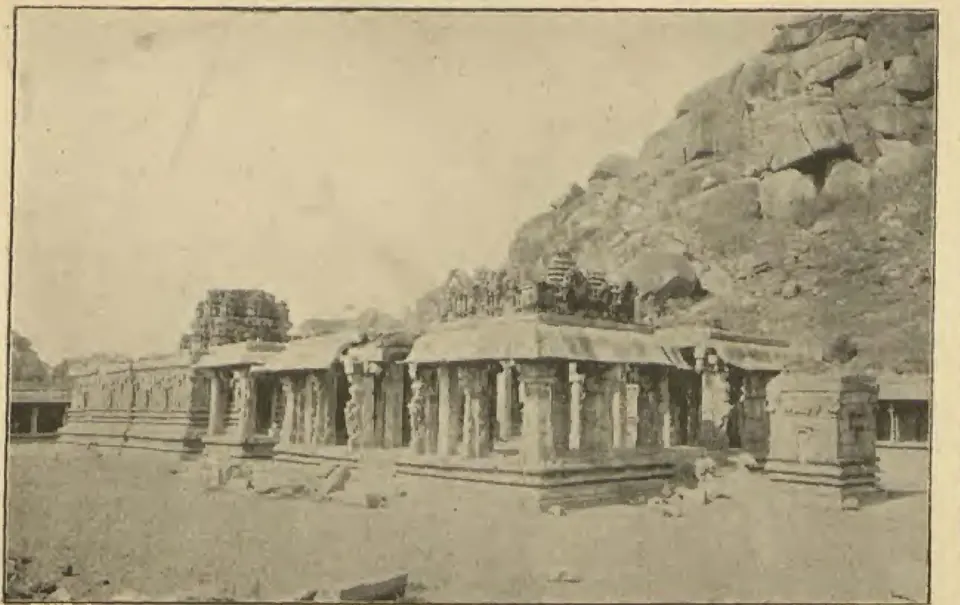
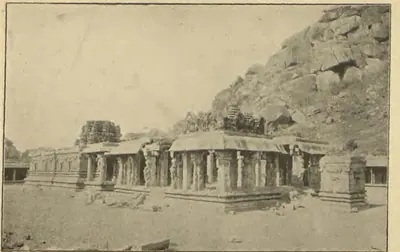 "Achyuta Raya's Temple" (Longhurst, Hampi Ruins, 3rd ed. 1933, fig. 49, p. 106 (PDF p. 120))Historic photograph · 1933
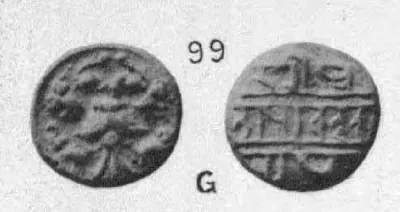 Gold coin No. 99: two-headed Gandabherunda bird holding elephants; legend Sri Pratapa Achyuta Raya (Elliot, Coins of Southern India, 1886, Plate III, No. 99 (PDF p. 191 of scan 00074712bsb))Coin · 1886
Related
Dynasties
References
Notes (0)
Sources (5)
Spotted an error on this page? Tell us
Last updated: