Mahendragiri
Mountain in the Eastern Ghats in southern Odisha. It is the Mahendra mountain of the Eastern Ganga grants, and on its summit the kings worshipped the god Gokarnasvamin. Old temples of large granite blocks stand on the top, and an inscription there records a Chola pillar of victory.
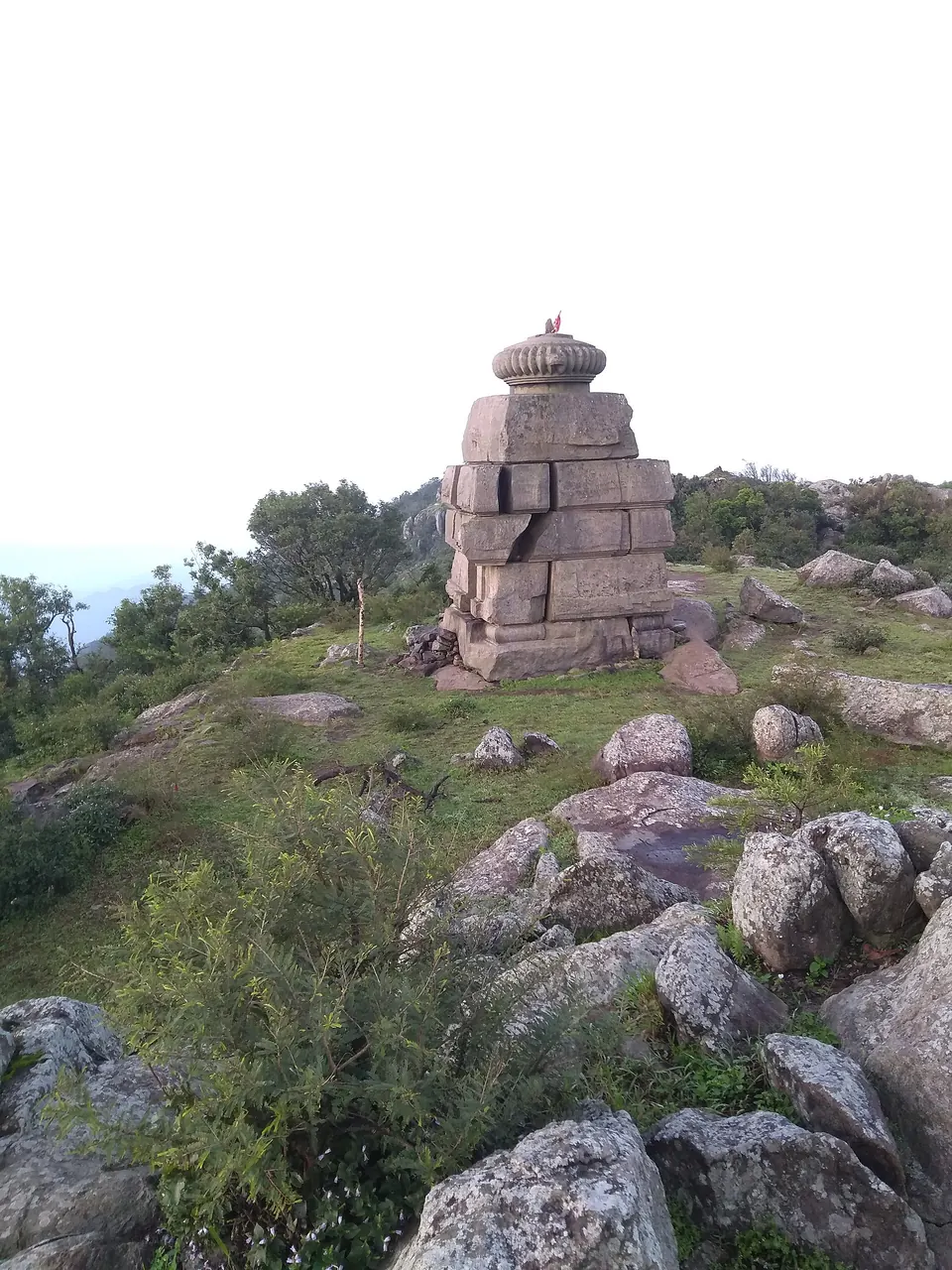
The Ganga kings of Kalinganagara issued copper-plate grants that describe the king as bowing to the god Gokarnasvamin.12 The grants say that the god “is established on the sinless peak of the Mahendra mountain”.12
The mountain and its temples
E. Hultzsch edited the Alamanda plates in 1895.1 He noted that Cunningham had identified the Mahendra mountain with the Mahendramala range, “which divides Ganjam from the valley of the Mahanadi”.1 Hultzsch concluded that this Gokarnasvamin must be distinct from the famous shrine of Gokarna in North Canara.1
Hultzsch quoted Robert Sewell’s Lists of Antiquities.1 It says that Mahendragiri lay in the Mandasa zamindari (landholder’s estate), and that its summit, 4,923 feet above the sea, bore four temples.1 The highest was built “of very large granite blocks and dedicated to Siva”.1 Sewell added: “This is perhaps the Gokarnasvamin of the Ganga grants.”1
In 1919 V. Rangacharya described the Gokarnesvara temple at the top of the hill as “sacred to the early Ganga kings of Kalinga”.3 He named two other temples there, of Yudhishthira and Bhima.3
The Nadagam plates of Vajrahasta trace the Ganga kings’ emblems to the favour of “the worshipful Gokarnasvamin, who is established on the top of the high mountain Mahendra”.4 These emblems were the bull crest and the insignia (symbols) of sovereignty.4 The Vizagapatam district gazetteer (1907) mentions “the ruins of cyclopean shrines” (shrines of huge stones) on Mahendragiri.5
The Chola pillar of victory
The sources differ over the Chola pillar of victory on the hill. The Vizagapatam gazetteer says that an inscription on Mahendragiri records a victory of the Chola king Rajaraja I.5 It says that he overthrew the Eastern Chalukya Vimaladitya in 999–1000 and set up a pillar of victory there.5
The Imperial Gazetteer (1908) gives two accounts. In one place it says that at the beginning of the eleventh century the Cholas overran Kalinga and set up a pillar of victory on Mahendragiri.6 In another it says that “the great king Rajendra Chola has left a record of his victories on Mahendragiri hill”.7 See the Eastern Gangas.
Footnotes
-
E. Hultzsch, “Alamanda Plates of Anantavarman”, Epigraphia Indica III (1894–95), p. 20, translation and note 5 (archive.org (opens in a new tab)). ↩ ↩2 ↩3 ↩4 ↩5 ↩6 ↩7 ↩8 ↩9
-
E. Hultzsch, “Chicacole Plates of Gunarnava’s Son Devendravarman; the Year 183”, Epigraphia Indica III (1894–95), p. 133, translation (archive.org (opens in a new tab)). ↩ ↩2
-
V. Rangacharya, A Topographical List of the Inscriptions of the Madras Presidency, Vol. I (1919), p. 709, Mahendragiri (archive.org (opens in a new tab)). ↩ ↩2
-
G. V. Ramamurti, “Nadagam Plates of Vajrahasta; Saka-Samvat 979”, Epigraphia Indica IV (1896–97), p. 192, translation, line 1 (archive.org (opens in a new tab)). ↩ ↩2
-
W. Francis, Madras District Gazetteers: Vizagapatam, Vol. I (1907), p. 26 (archive.org (opens in a new tab)). ↩ ↩2 ↩3
-
Imperial Gazetteer of India, Provincial Series: Madras, Vol. I (1908), p. 191 (archive.org (opens in a new tab)). ↩
-
Imperial Gazetteer: Madras, Vol. I (1908), p. 197 (archive.org (opens in a new tab)). ↩
Photos
References
Notes (0)
Sources (5)
Spotted an error on this page? Tell us
Last updated: