Samalkot and Chalukya-Bhimavaram
Town seven miles north of Kakinada (Cocanada). It takes in the old village of Bhimavaram, called Chalukya-Bhimavaram in its inscriptions after the Eastern Chalukya king Chalukya-Bhima. Its great Bhimesvara temple, one of the five Pancharama shrines of Shiva, is named in an inscription of 1202 as a foundation of that king. Samalkot was later the first seat of the Pithapuram zamindars and an English garrison town.
Samalkot lies seven miles north of Kakinada (then Cocanada).12 There the branch railway from Kakinada joined the main line of the Madras Railway, and a canal joins it to both Rajahmundry and Kakinada.12 The Godavari district gazetteer of 1907 gives its population in 1901 as 16,015.12 The town took in the villages of Bhimavaram and Jaggammagaripeta.12
Chalukya-Bhimavaram
By 1907 Bhimavaram had become part of Samalkot, but, the gazetteer says, “it has a character of its own”. Its inscriptions give its full name as Chalukya Bhimavaram.3
E. Hultzsch edited the Pithapuram pillar inscription of 1202.4 He found that verse 11 credits the Eastern Chalukya king Chalukya-Bhima with founding a temple of Shiva “called Chalukya-Bhimesvara after his own name”.4 “This temple still exists at Bhimavaram near Cocanada,” he wrote.4
Three of the temple’s inscriptions use the name Chalukya-Bhimesvara.4 Others call the place Chalukya-Bhimesvarapura, Chalukya-Bhimanagari and Chalukya-Bhimapura.4 Hultzsch concluded that “the name of Bhimavaram is derived from that of the temple”.4 Some of its inscriptions also call Bhimavaram Skandarama or Kumararama, “the garden of the War-god”.4 M. Rama Rao, writing in 1964, counts “Kumararama or modern Chalukyabhimavaram” among the five Pancharamas, the great Shiva shrines of the Andhra country.5 See Bhimesvara temple, Chalukya-Bhimavaram.
The two temples
The Bhimesvara temple, “built of black granite and sculptured”, is the larger of Bhimavaram’s two old temples. Robert Sewell noted in 1882 that it had “many inscriptions on pillars, too old to be easily read”.6 The gazetteer counted thirty inscriptions in the Bhimesvara and Narayanasvami temples copied by the Government Epigraphist (Nos. 460 to 489 of 1893).7 The oldest was dated 1087, and a few mention the Reddi kings.7
The second temple, of Vishnu, stands on the bank of the canal.8 Hultzsch read its ancient name as Rajanarayana-Vinnagara, “the Vishnu temple of Rajanarayana”.9 An inscription of Kulottunga I says that a merchant (Vaisya) named Mandaya founded it.9 Hultzsch thought it “was apparently called after the king himself, who had the surname Rajanarayana”.9 The Chellur plates of Vira-Choda do praise Kulottunga I as “Rajanarayana (i.e., a Vishnu among kings)”.10
M. Rama Rao, writing in 1964, called it the Mandavyanarayana temple.11128 He noted instead that the Eastern Chalukya king Danarnava (971–973 in his dating) had the title Rajanarayana.11128 He thought it likely that Danarnava built the shrine.11128
Samalkot
According to the gazetteer, the Pithapuram zamindari (landholder’s) family first lived at Samalkot.2 It was apparently their first capital, but they left it for Pithapuram for a time and made it their capital again in the 18th century.2 Some acts of hostility by the Pithapuram and Peddapuram zamindars (landholders) led the Company’s troops to seize the Samalkot fort in 1764.13
Barracks were built in 1786, when the town was “the principal garrison of the English in the Circar of Rajahmundry”.2 The fort was demolished in 1838, and the military station was given up in 1868.2 In 1899 a large sugar refinery and distillery was set up in the town.2
Footnotes
-
Hemingway, Godavari (1907), p. 213, s.v. Samalkot (archive.org (opens in a new tab)). ↩ ↩2 ↩3 ↩4
-
Hemingway, Godavari (1907), p. 214 (archive.org (opens in a new tab)). ↩ ↩2 ↩3 ↩4 ↩5 ↩6 ↩7 ↩8 ↩9
-
F. R. Hemingway, Madras District Gazetteers: Godavari (1907), p. 207, s.v. Bhimavaram (archive.org (opens in a new tab)). ↩
-
E. Hultzsch, “Pithapuram Pillar Inscription of Mallapadeva”, Epigraphia Indica IV (1896–97), p. 227 and notes 5–6 (archive.org (opens in a new tab)). ↩ ↩2 ↩3 ↩4 ↩5 ↩6 ↩7
-
Rama Rao, Eastern Calukyan Temples (1964), Preface (archive.org (opens in a new tab)). ↩
-
Robert Sewell, Lists of the Antiquarian Remains in the Presidency of Madras, Vol. I (1882), p. 24, s.v. Bhimavaram (archive.org (opens in a new tab)). ↩
-
Hemingway, Godavari (1907), p. 208 (archive.org (opens in a new tab)). ↩ ↩2
-
Rama Rao, Eastern Calukyan Temples (1964), p. 32 (archive.org (opens in a new tab)). ↩ ↩2 ↩3 ↩4
-
Hultzsch, “Pithapuram Pillar Inscription of Mallapadeva” (1897), p. 230 (archive.org (opens in a new tab)). ↩ ↩2 ↩3
-
E. Hultzsch, South-Indian Inscriptions, Vol. I (1890), No. 39, Chellur plates of Vira-Choda, p. 59, verse 12 (archive.org (opens in a new tab)). ↩
-
Rama Rao, Eastern Calukyan Temples (1964), p. 1 (archive.org (opens in a new tab)). ↩ ↩2 ↩3
-
M. Rama Rao, Eastern Calukyan Temples of Andhra Desa (1964), p. 2 (archive.org (opens in a new tab)). ↩ ↩2 ↩3
-
Imperial Gazetteer of India: Madras, Vol. I (1908), p. 289 (archive.org (opens in a new tab)). ↩
Photos
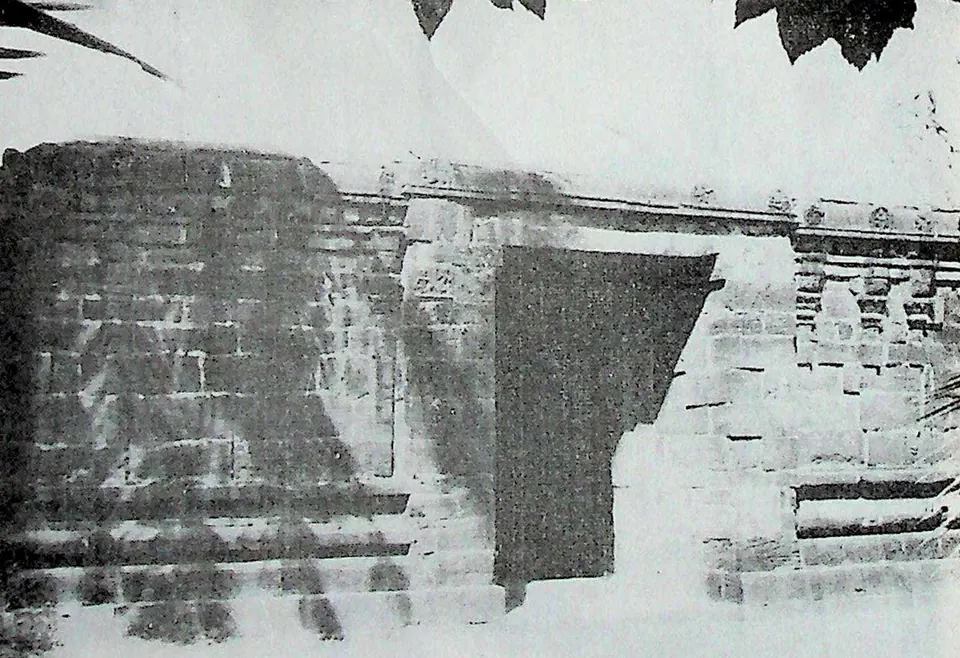
 "32. Northern Entrance to Outer Enclosure - Ch. Bhīmavaram, E. G. Dt." (M. Rama Rao, Eastern Calukyan Temples of Andhra Desa, 1964, Fig. 32 (PDF p. 95))Historic photograph · 1964
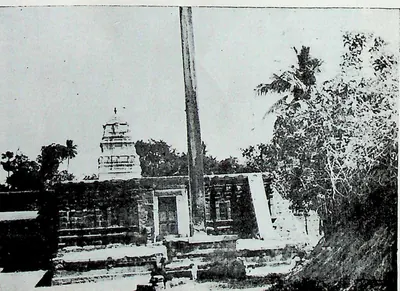 "33. Western Entrance to Outer Enclosure—Ch. Bhīmavaram, E. G. Dt." (M. Rama Rao, Eastern Calukyan Temples of Andhra Desa, 1964, Fig. 33 (PDF p. 97))Historic photograph · 1964
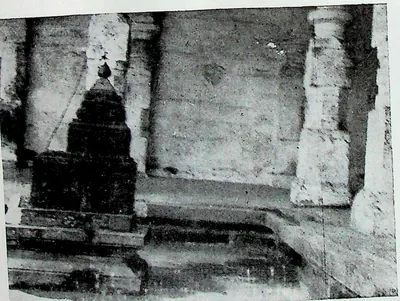 "34. Miniature Temple - Ch. Bhīmēśvaram, E. G. Dt." (M. Rama Rao, Eastern Calukyan Temples of Andhra Desa, 1964, Fig. 34 (PDF p. 99))Historic photograph · 1964
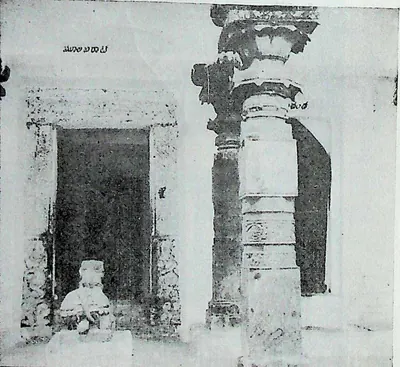 "35. Nandi Maṇṭapa - Ch Bhīmavaram, E. G. Dt." (M. Rama Rao, Eastern Calukyan Temples of Andhra Desa, 1964, Fig. 35 (PDF p. 101))Historic photograph · 1964
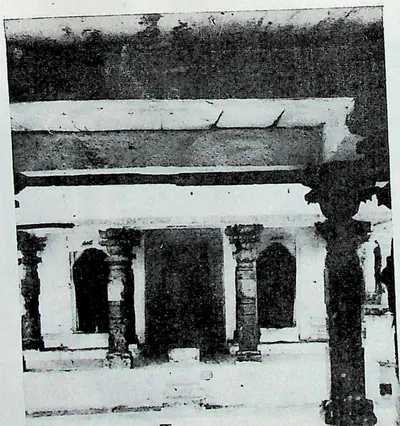 "36. Entrance to Groundfloor—Ch. Bhīmēśvara Temple—Ch. Bhīmavaram, E. G. Dt." (M. Rama Rao, Eastern Calukyan Temples of Andhra Desa, 1964, Fig. 36 (PDF p. 103))Historic photograph · 1964
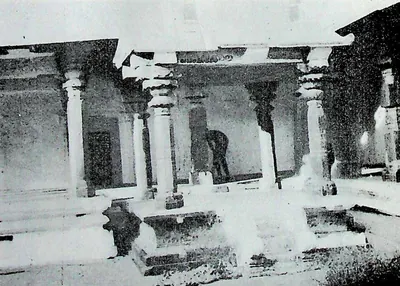 "37. Maṇṭapa in the North-east Corner—Ch. Bhīmavaram, E. G. Dt." (M. Rama Rao, Eastern Calukyan Temples of Andhra Desa, 1964, Fig. 37 (PDF p. 105))Historic photograph · 1964
Related
People
Monuments
Inscriptions
References
Notes (0)
Sources (6)
Spotted an error on this page? Tell us
Last updated: