Tadpatri
Town on the south bank of the Penner in the Anantapur district. It was founded under Vijayanagara by Ramalinga Nayudu, whose family built its two richly carved temples of Ramalingesvara and Chintala Venkataramana. It passed to Muslim governors after 1565, to Morari Rao of Gooty and then to Haidar Ali. A Mughal-style pagoda (gold coin) was struck there. By the treaty of 1792 Tipu Sultan ceded the taluks of Tadpatri and Tadimarri to the Nizam, who ceded them to the East India Company in 1800.
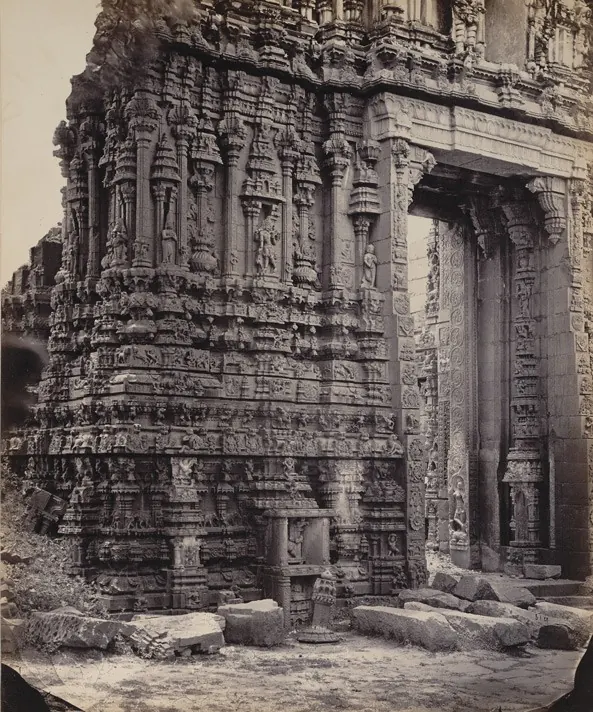
Tadpatri is a town on the south bank of the Penner, in the Anantapur district.1 It grew under the Vijayanagara kings, and it is known for two richly carved temples of that time.12
The town lies on low ground.1 Here the Penner runs “in a sandy bed about a mile wide”.1 The Anantapur gazetteer of 1905 describes sand dunes west of the town, some sixty feet high, blown up by the south-west monsoon.1 The Imperial Gazetteer calls Tadpatri “a considerable trading centre”, “noted for its silk and cotton cloths”.2 It also calls it “a place of much sanctity” (holiness).2 See Mysore under Haidar Ali and Tipu Sultan.
Founders and temples
The gazetteer found no local records.1 But a Mackenzie manuscript says that the first to improve the village was Ramalinga Nayudu.1 He was the local governor under the Vijayanagara kings in the reign of Krishnadeva Raya.1 He began the temple of Ramalinga, or Ramesvara, on the river bank, and dug channels from the Penner.1
His son Timma Nayudu “obtained the place as a jaghir” (land grant).1 Timma Nayudu dug more channels and began the temple of Chintala Tiruvenkatasvami.1 The Imperial Gazetteer says that the sculptures of these two shrines “are some of the finest work extant” (still surviving) “of the Vijayanagar period”.2 They are cut in “a close-grained green stone that lends itself to minute finish”, that is, to very fine detail.2 See Krishnadeva Raya.
Muslim governors, Morari Rao and Haidar
After the battle of Talikota, governors appointed by the Muslim victors ruled the place.1 Later, the manuscript says, Aurangzeb’s troops turned them out.1 The troops did “much wilful damage” to the mantapam (pillared hall) of the Chintala temple.1 They also built a fort on a sand dune near it.1
Then “Morári Rao of Gooty took the village and appointed amildars” (revenue officers) “to govern it”.1 His people repaired the mantapam.1 “Morári Rao was eventually defeated by Haidar Ali and Tadpatri again changed hands”, the manuscript goes on.3 The gazetteer says that the rest of the manuscript is a list of raids by poligars, Marathas and Musalmans.3 The raids fell on what was “apparently a defenceless sort of place”.3
The poligar (local chief) of Anantapur was among the raiders.4 He paid off Morari Rao in 1757.4 After that he sent out plundering expeditions that ravaged Tadpatri and other places.4
Henderson’s catalogue of Mysore coins (1921) notes that Mughal-style gold pagodas (coins) were struck at Tadpatri, Adoni and Gandikota, “originally in the reign of Farrukh-Siyar”.5 Haidar later copied pagodas like these at Gooty.5 See Gooty.
1792 and after
By the treaty of Srirangapatna (then Seringapatam) of 1792, the Nizam received a share of Tipu Sultan’s lands.6 It included “In Gooty 4 Talooks”.6 The first of these is “Tarputry”, valued at 19,055 Kanthiraya pagodas.6
The Anantapur gazetteer identifies the Anantapur part of this cession as “the then taluks of Tadpatri and Tádimarri”.7 These taluks “fell to the share of the Nizam”.7 They passed with the other Ceded Districts to the Company in 1800.7
Munro’s budget for Fasli (revenue year) 1216 set aside 5,398 star pagodas to repair the Chintala temple’s mantapam.3 Part of its roof had been “blown off and other damages done to it by an explosion of gunpowder during the disturbances under the former government”.3 A flood of the Penner in 1851 swept away three-quarters of the town.21
Footnotes
-
Francis, Anantapur Gazetteer (1905), p. 199 (archive.org (opens in a new tab)). ↩ ↩2 ↩3 ↩4 ↩5 ↩6 ↩7 ↩8 ↩9 ↩10 ↩11 ↩12 ↩13 ↩14 ↩15 ↩16 ↩17 ↩18
-
Imperial Gazetteer of India, Provincial Series: Madras, Vol. I (1908), p. 495 (archive.org (opens in a new tab)). ↩ ↩2 ↩3 ↩4 ↩5 ↩6
-
Francis, Anantapur Gazetteer (1905), p. 200 (archive.org (opens in a new tab)). ↩ ↩2 ↩3 ↩4 ↩5
-
Francis, Anantapur Gazetteer (1905), p. 146 (archive.org (opens in a new tab)). ↩ ↩2 ↩3
-
J. R. Henderson, The Coins of Haidar Ali and Tipu Sultan (Madras Government Museum, 1921), p. 1 (archive.org (opens in a new tab)). ↩ ↩2
-
C. U. Aitchison, A Collection of Treaties, Engagements and Sanads, Vol. IX (4th ed., 1909), p. 214, treaty of Seringapatam, districts ceded to the Nizam (archive.org (opens in a new tab)). ↩ ↩2 ↩3
-
W. Francis, Madras District Gazetteers: Anantapur (1905), p. 23 (archive.org (opens in a new tab)). ↩ ↩2 ↩3
Photos
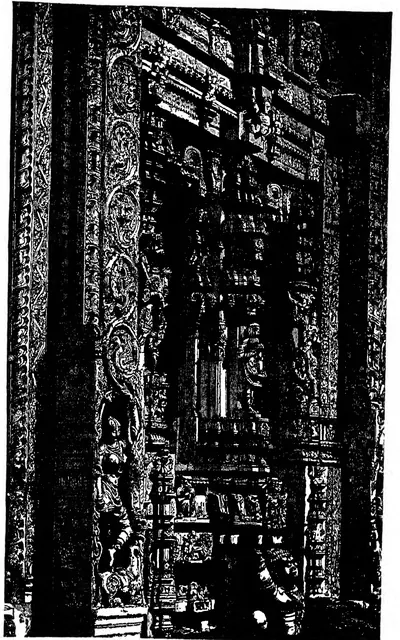 "Entrance through Gopuram at Tadpatri" (Fergusson, rev. 1910, Vol. I, woodcut 237, p. 405 (PDF p. 452))Drawing · 1910
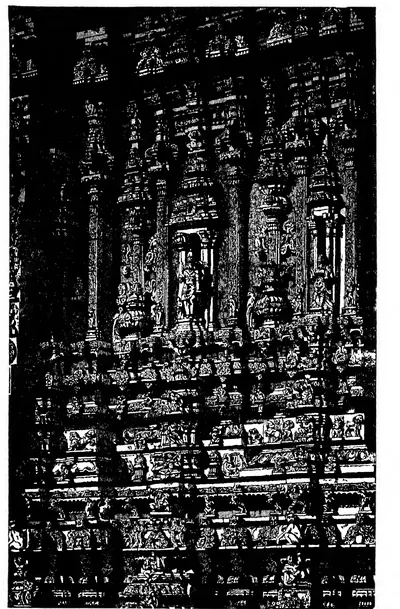 "Portion of Gopuram at Tadpatri" (Fergusson, rev. 1910, Vol. I, woodcut 238, p. 406 (PDF p. 453))Drawing · 1910
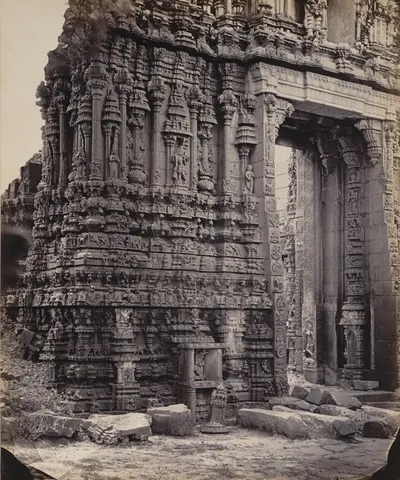 Sculptured base of the south gopura of the Ramalingesvara temple, Tadpatri, photographed by Edmund David Lyon about 1868Historic photograph · 1868
Related
People
Morari Rao Ghorpade
c. 1741–1776 CE
A Maratha soldier who fought for pay, of the Ghorpade family. He was lord of Gooty from the 1740s until Haidar Ali took the fortress in 1776. The Marathas left him as governor of Trichinopoly in 1741. He gave it up to the first Nizam in the mid-1740s and was accepted as chief of Gooty under the subahdar of the Deccan. His horsemen, whom Orme thought the best Indian soldiers of the day, fought in the Carnatic wars for Muhammad Ali and the English, for Mysore and for the French. Later they fought with the English against Haidar. He held Penukonda and Madakasira and took tribute from the Anantapur poligars. After a long siege of Gooty he surrendered to Haidar and died a prisoner at Kabbaldurga.
Tipu Sultan
1782–1799 CE
Son of Haidar Ali and ruler of Mysore from December 1782 until he was killed at the fall of Seringapatam on 4 May 1799. As a young commander he took Gurramkonda back from the Marathas in 1773–74. As Sultan he held Gooty, Gurramkonda, Cuddapah, Bellary and the Anantapur country. He gave Gooty and Gurramkonda the new names Faiz Hisar and Zafarabad and struck copper coins at both. He besieged Adoni in 1786 and seized the poligars of Rayadurg and Harpanahalli. By the treaty of 1792 he gave up Cuddapah, Gurramkonda, Bellary and Tadpatri to the Nizam. The rest of his Telugu districts went to the Nizam after his death and were ceded to the East India Company in 1800.
References
Notes (0)
Sources (4)
Spotted an error on this page? Tell us
Last updated: