Talikota
Small fortified town about 25 miles north of the Krishna, in the old Bijapur district, now in Karnataka. The allied armies of four Deccan sultans gathered here in December 1564, before the battle of January 1565 that broke the power of Vijayanagara. The battle is named after the town, though it was fought south of the Krishna. Sewell placed it near Bayapur on the road to Mudkal. H. Heras placed it near the villages of Raksasji and Tagdiji, and so called it the battle of Raksas-Tagdi.
The Deccan sultans had joined together against Vijayanagara, and their armies began their march south on 25 December 1564.1 Robert Sewell wrote that they “reached the neighbourhood of the Krishna near the small fortress and town of Talikota”.1 He called it “a name destined to be for ever celebrated in the annals of South India”.1 He added in a note: “Though, in fact, the battle did not take place there, but many miles to the south of the river.”1 “Talikota is twenty-five miles north of the Krishna.”1
Wolseley Haig, in the Cambridge History of India, says that the alliance of four kings assembled at Sholapur on 12 December.2 It says that the kings “on December 24 marched thence to Talikota … near the Krishna”.2 See Vijayanagara and Aliya Rama Raya.
Where the battle was fought
Sewell thought that the allies crossed the Krishna by the ford at the bend of the river at Ingaligi.3 He wrote that “the decisive battle seems to have been fought in the plains about the little village of Bayapur or Bhogapur”.3 This village lies “on the road leading directly from Ingaligi to Mudkal”.3
H. Heras, writing in 1927, said that after the crossing “the vanguards of both armies met some miles South of the Krishna”.4 They met “in the neighbourhood of the two villages of Raksasji and Tagdiji, the names of which combined give the word Raksas-Tagdi”.4 His chapter on it is headed “The Battle of Raksas-Tagdi”.4 The Anantapur gazetteer dates the battle to 23 January 1565.5
Haig judged that “Talikota was one of the decisive battles of India, and broke for ever the power of the great kingdom of Vijayanagar”.6 Rama Raja was captured and beheaded, and his brother Venkatadri was killed.57 Tirumala fled to Penukonda with the king Sadasiva and the treasure.57 See Tirumala, Penukonda and Hampi.
Where the sources disagree
- The start of the march. Sewell says that the four armies met on the plains of Bijapur and began their march south on Monday, 25 December 1564.1 Haig says that they assembled at Sholapur on 12 December and marched from there to Talikota on 24 December.2
Footnotes
-
Robert Sewell, A Forgotten Empire (Vijayanagar) (1900), p. 199 and note 2 (archive.org (opens in a new tab)). ↩ ↩2 ↩3 ↩4 ↩5 ↩6
-
Wolseley Haig, “The Five Kingdoms of the Deccan”, in Haig (ed.), The Cambridge History of India, Vol. III (1928), p. 448 (archive.org (opens in a new tab)). ↩ ↩2 ↩3
-
Sewell, A Forgotten Empire (1900), p. 200, note continued (archive.org (opens in a new tab)). ↩ ↩2 ↩3
-
H. Heras, The Aravidu Dynasty of Vijayanagara, Vol. I (1927), p. 203 and note (archive.org (opens in a new tab)). ↩ ↩2 ↩3
-
W. Francis, Madras District Gazetteers: Anantapur (1905), p. 19 (archive.org (opens in a new tab)). ↩ ↩2 ↩3
-
Haig, in Cambridge History of India, Vol. III (1928), p. 450 (archive.org (opens in a new tab)). ↩
-
Francis, Anantapur Gazetteer (1905), p. 20 (archive.org (opens in a new tab)). ↩ ↩2
Photos
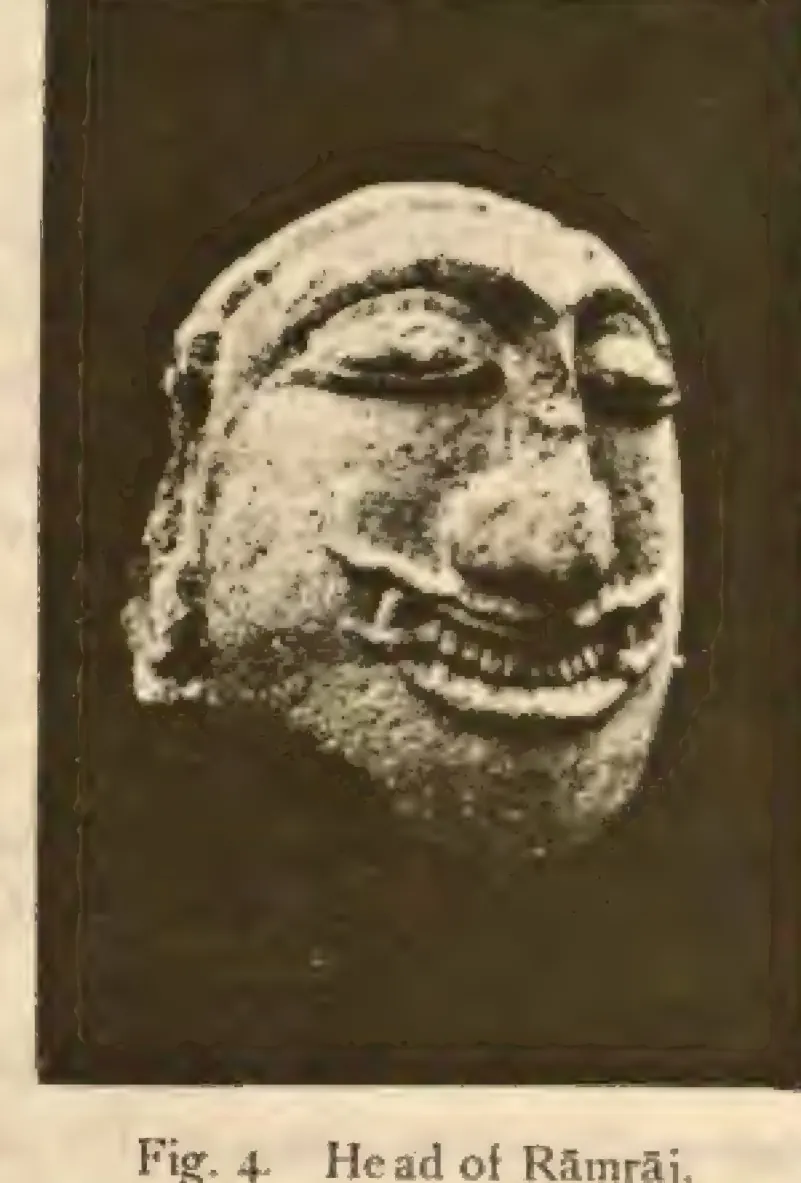
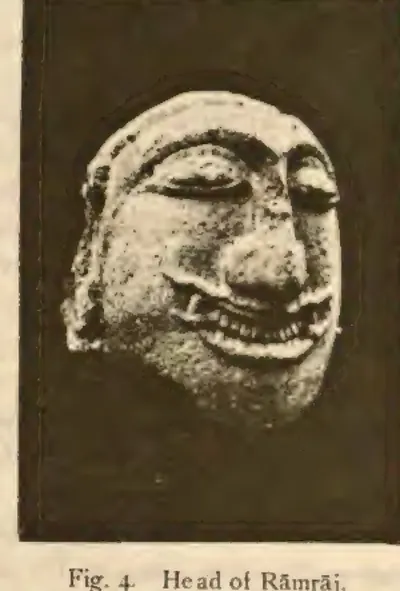 "Head of Ramraj": stone head found in the Taj Bauri at Bijapur, by tradition the effigy of Rama Raya set in the citadel wall (Cousens 1916, p. 9, fig. 4)Photograph · 1916
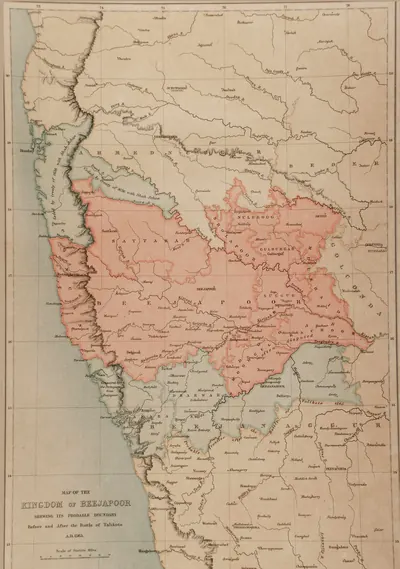 "Map of the Kingdom of Beejapoor, shewing its probable boundary before and after the Battle of Talikota, A.D. 1565" (Taylor and Fergusson, Architecture at Beejapoor, 1866, facing p. 1)Map · 1866
Related
People
Ibrahim Qutb Shah
1530–1580 CE
Fourth Qutb Shahi sultan of Golconda (1550–1580), a younger son of Sultan Quli. He spent seven years as an exile at Vijayanagara under Rama Raya. He came back to take the throne with the help of the Telugu foot soldiers who held the forts. He joined the alliance that destroyed Vijayanagara at Talikota in 1565, and he conquered Rajahmundry, the northern coast and Kondavidu. Telugu poets dedicated works to him and to his officers, and Telugu records call him Ibharama. A Sanskrit copper-plate grant from Nellore calls him Malikibharama.
Ali Adil Shah I
c. 1558–1580 CE
Fifth Adil Shahi sultan of Bijapur (r. 1558–1580). He was first an ally of Aliya Rama Raya, but then joined the league of Deccan sultans that defeated and killed Rama Raya in January 1565. Afterwards he won back Raichur and Mudgal, took Adoni in 1568 and turned south against the Aravidu kings, besieging Penukonda. The date and details of that siege are disputed. He was the husband of Chand Bibi.
References
Notes (0)
Sources (4)
Spotted an error on this page? Tell us
Last updated: