Udgir
Fort town in the Bidar district of the Nizam's Hyderabad State (now in Maharashtra), outside the Telugu country. In 1760 the Peshwa's army under Sadashiv Rao Bhau surrounded the Nizam Salabat Jang and his brother Nizam Ali here. The brothers were forced to cede forts and districts worth more than sixty-two lakhs of rupees a year, including the province of Bijapur and most of Aurangabad.
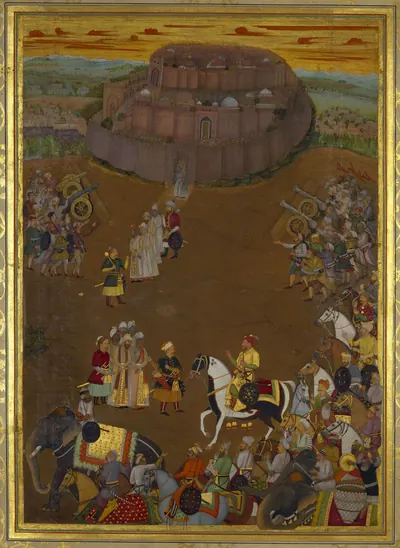
Udgir was the headquarters of a taluk of the Bidar district of Hyderabad State. The Imperial Gazetteer (1909) places it at 18°24′ N, 77°7′ E.1 It records that “the fort belonged to the Bijapur kings, and was besieged by Shah Jahan’s general in 1635, and surrendered to him”.12 It adds that the fort “was built about 1493, and has a ditch all round”, and that its palaces were in ruins.12
Udgir lies outside the Telugu country. But in 1760 “a great battle was fought here between the Nizam and the Marathas”, in which the Nizam was forced to accept the Marathas’ terms of peace.1 See the Marathas in the Telugu country and the Asaf Jahis.
The battle of 1760
The war began when the fort of Ahmadnagar was betrayed to the Marathas. Grant Duff says that Salabat Jang and his brother Nizam Ali Khan were ill prepared, and their army was in arrears and mutinous.345 Also, “an insurrection, caused by Soorya Rao, the Deshmookh of Neermul, had just been quelled”.345
Their main army moved by Bidar to Dharur.345 Meanwhile the two brothers took post at Udgir with seven or eight thousand men.345 There Sadashiv Rao Bhau surrounded them with forty thousand horse and with Ibrahim Khan Gardi’s trained infantry and artillery.345
After several days of fighting, Nizam Ali sent his seal of office to the Bhau.56 By the treaty the Nizam’s side:56
- gave up the forts of Daulatabad, Shivner, Asirgarh and Bijapur
- confirmed Ahmadnagar to the Marathas
- ceded the province of Bijapur, part of Bidar and the province of Aurangabad except the city and two parganas, with a revenue of more than sixty-two lakhs of rupees56
The Imperial Gazetteer says that the Nizam “and his brother occupied Udgir with 7,000 cavalry, but were surrounded by 60,000 Marathas”.1 “Desperate fighting continued for days, and the Nizam was forced to agree to the terms of peace imposed by the Marathas.”1 Gribble’s second volume places Udgir “about 150 miles from the western boundary at Ahmednagar”.7 See Aurangabad and Bijapur.
Where the sources disagree
- The size of the armies. Grant Duff says that the two brothers had “seven or eight thousand men”.4 He says that Sadashiv Rao Bhau brought up forty thousand horse, and that Ibrahim Khan Gardi’s infantry, five thousand strong, came to join him.5 The Imperial Gazetteer gives the brothers 7,000 cavalry and says that 60,000 Marathas surrounded them.1
Footnotes
-
Imperial Gazetteer: Hyderabad State (1909), p. 292 (archive.org (opens in a new tab)). ↩ ↩2 ↩3 ↩4 ↩5 ↩6 ↩7
-
Imperial Gazetteer of India, Provincial Series: Hyderabad State (1909), p. 289 (archive.org (opens in a new tab)). ↩ ↩2
-
James Grant Duff, A History of the Mahrattas, Vol. II (1826), pp. 122–123 (archive.org (opens in a new tab)). ↩ ↩2 ↩3 ↩4 ↩5
-
Grant Duff, History of the Mahrattas, Vol. II (1826), p. 123 (archive.org (opens in a new tab)). ↩ ↩2 ↩3 ↩4 ↩5 ↩6
-
Grant Duff, History of the Mahrattas, Vol. II (1826), p. 124 (archive.org (opens in a new tab)). ↩ ↩2 ↩3 ↩4 ↩5 ↩6 ↩7 ↩8 ↩9
-
Grant Duff, History of the Mahrattas, Vol. II (1826), p. 125 and note (archive.org (opens in a new tab)). ↩ ↩2 ↩3
-
J. D. B. Gribble and Mary Pendlebury, A History of the Deccan, Vol. II (1924), p. 82 (archive.org (opens in a new tab)). ↩
Photos
References
Notes (0)
Sources (3)
Spotted an error on this page? Tell us
Last updated: