Crafts & textiles
Kalamkari, ikat weaving, Nirmal paintings, Kondapalli and Etikoppaka toys and other crafts.
Of all the crafts of the Telugu country, weaving mattered most. In the Godavari district in 1907, it employed more hands than any other art or industry.1 A survey of Hyderabad State in the early 1930s found that it still gave work to more people than anything except farming.2 Around the loom grew the arts of dyeing and painting cloth, and beside it a range of smaller crafts in wood, lacquer, metal and ivory.
About the sources. Most of what is known about these crafts before 1900 was written by outsiders. They include a Greek sailing guide, a Venetian traveller, and European merchants who bought cloth for export. They also include British and Hyderabad officials, who judged the crafts at exhibitions or surveyed them for the state. Many of them wrote about decline, measured against what had once been exported. Where they blame the craftsmen themselves, this page says so.
Cloth for distant markets
The oldest written notice of Telugu cloth is in the first-century Periplus of the Erythraean Sea.3 It says that “a great quantity of muslins is made” in the coastal region of Masalia, the country around later Machilipatnam.3 At Amaravati, one of the donors recorded on the stupa is a goldsmith named Budhi. He gave with his mother, the wife of a merchant.4
By the 13th century the cloth had a name abroad. Marco Polo wrote that the kingdom he called Mutfili made “the best and most delicate buckrams, and those of highest price”.5 He added that there was “no King nor Queen in the world but might be glad to wear them”.5 His editor Henry Yule identified Mutfili as the Kakatiya kingdom, named after its port of Motupalli.6 Ganapatideva’s customs edict at Motupalli set a duty on silks by the bale and on silk thread.7
In the Kakatiya kingdom, weavers formed craft guilds, like oil-pressers, smiths, potters and goldsmiths.89 These guilds ran their own affairs and sold their goods at the local fair.89 Cloth merchants had their own place in the market of Warangal.89 Parabrahma Sastry also suggests that a workshop of sculptors at the capital, Orugallu, made carved pillars, door frames and Nandi bulls.10 Temple builders across the kingdom bought them.10
Golconda’s woven and painted cloth
The reports of Dutch and English merchants in the early 17th century give the first close view of the trade.11 W. H. Moreland edited them. He explains that weavers worked in their own houses, not in workshops.11 Most depended on advance payments from buyers, who could therefore dictate what was made.11
Cloth was sold either plain, as calico and muslin, or patterned.11 The finest muslins for export were made inland and carried the name of Warangal.11 The Golconda coast was the best place to buy plain cloth. It was dyed with local indigo for blue and chay-root for red.11
In these reports, a “painter” was a maker of patterned cloth.12 The Dutch merchant Antony Schorer found “many weavers” and painters around Narasapur.13 Another Dutch account lists the cloths of the Rajahmundry country, and the fine percalles (a kind of cotton cloth) of Narasapur and Kondapalli.14
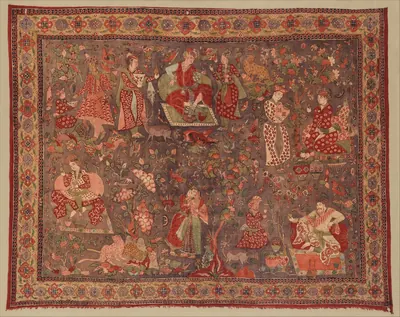
The French jeweller Tavernier described the chites (chintz) “called calmendar, that is to say, made with a brush”.15 It was made in the kingdom of Golconda, and especially around Machilipatnam (then Masulipatam).15 He noted that so little was made that even by hiring every worker one could hardly get three bales.15 Such cloths, he says, were used for bedcovers, tablecloths, pillowcases and handkerchiefs. Above all, they were used for waistcoats in Persia.16
The French physician Bernier described Shah Jahan’s court.17 He saw a great awning lined with “chittes, or cloth painted by a pencil of Masulipatam”.17 Its flowers were drawn so naturally that “one would have said it was a hanging parterre” (flower garden).17
How the painted cloth was made
George Watt wrote the catalogue of the Delhi exhibition of 1902–03.18 He explained that the word calmendar is kalamdar, “pen-like”.18 It is the name of the painter’s tool: a bundle of fine steel wires fixed to a stick, still in use in South India.1819
With this tool the artist drew the design in hot beeswax. The cloth had already been treated with a mordant (a substance that fixes dye).1819 When the cloth was dyed, the waxed parts resisted the colour. The wax was then boiled out, and the process repeated for each colour.1819 “The rapidity and accuracy of the operation has to be seen to be appreciated,” Watt wrote.1819
For the finer cloths, the outline was first pricked through a paper stencil and dusted with charcoal powder.1920 The rest was painted by hand.1920
Watt described two traditions.20 Cloths made for Hindu temples, as canopies over the deities, showed scenes from the Ramayana and Mahabharata.20 Cloths made for Muslim use, as prayer cloths, usually showed an arch around a Persian “tree of life”.20
The chief centres for temple canopies included Kalahasti, Palakollu and Machilipatnam.20 The Kalahasti cloths were “full of descriptions” of the scenes in the local language.20 Some Machilipatnam pieces were “virtually hand-painted pictures on cloth”.20
By 1903, in Watt’s view, Machilipatnam was the only remaining centre for fine painted prayer rugs, curtains and handkerchiefs.2122 The art had died out at Kakinada (then Cocanada).2122 Their typical design was a great central tree in deep red-brown with much blue.22
The Imperial Gazetteer of 1908 records the same decline.23 At Machilipatnam, old wooden printing blocks, many with Persian patterns, lay piled in corners “covered with the dust and cobwebs of years”.23 At Kalahasti, painted cloths were still made with scenes from the epics and the story written in Telugu.23 At Kakinada, cloths with the tree-of-life pattern were made.23
The Kistna manual of 1883 says Machilipatnam’s chintzes and coloured cloths were once sent to the Persian Gulf to the value of fifty lakhs of rupees a year.2425 Manchester goods had taken their place, leaving a trade of about half a lakh.2425
In the Godavari district in 1907, chintz stamping in red and dark blue was done at Gollapalaiyam, Kakinada and Samalkot.26 It was done by the same dyers who coloured men’s cloths, mostly Kapus and Tsakalas, using imported dyes.2627 Chay-root had recently been given up at Kakinada as too much trouble.27
Weavers and their cloth, 1800–1950
The loss of export markets fell hard on the weavers. In the Godavari district, the East India Company had bought some seven lakhs of rupees’ worth of cloth a year.28 After its trade ended, exports of cloth fell from over fourteen lakhs in 1825–26 to under two lakhs in 1842–43.28
Yet weaving survived for the home market.28 In 1907 almost every other village in the Godavari plains had weavers.28 The finest work, with yarn as fine as 200s count, was done at Kottapalli and Mulapeta.28 It was sold under the name of Uppada cloth as far south as Tanjore.28
Most weavers there were Devangas.29 Pattu Sales did the fine work at Kottapalli and Mulapeta. There were Padma Sales, Sales and Karnabattus in other places.29
In Visakhapatnam (then Vizagapatam) district, the weavers were Sales, Padma Sales, Pattu Sales and Devangas.30 Women of the Pattu Sale community spun a thread “as fine as imported 150s” for the delicate cloths of Siripuram and Ponduru.3031 Razam made coloured cloths sold as far as Calcutta.3031 The gazetteer found the industry declining. Some weavers were turning to tobacco-curing and money-lending.3031
In the Krishna (then Kistna) district, the weavers of the sand ridge villages west of Bapatla still spun their own thread.32 These villages included Chirala, Perala and Vetapalem. Their strong cloth held its own against imports.32 A record of 1679 already named Vetapalem as a weaving centre.32 Elsewhere, the manual says, Manchester goods had forced many weavers to “abandon their looms and take to the plough”.25
In 1921 the weavers of Chirala and Perala were at the centre of one of the best-remembered protests of the non-cooperation movement.33 See Duggirala Gopalakrishnayya and Reform, freedom & people’s movements.33
In Hyderabad State, the Imperial Gazetteer of 1909 found cotton weaving in almost every taluk.34 Coarse cloths called khadis were woven in every large village. People preferred them to mill cloth because they lasted longer.34
Silk saris were woven in Nalgonda, Mahbubnagar and Karimnagar districts.3435 The Salas of Nalgonda were improving their work.3435 The silk saris of Narayanpet, with gold borders, were sent to Poona, Bombay and Baroda.3435 In Warangal district, Koyas reared the tasar (wild silk) silkworm in the forest. They sold the silk to weavers at Hasanparti and other villages.36 The 1931 census counted 406,881 weavers and 111,998 handlooms in the Nizam’s Dominions.37
The 1933 survey of handloom weaving in Hyderabad State gives the first description of Telangana’s tie-dyed cloth.3839 The talia rumals and chutki saris were “mostly woven in Telengana and Carnatic districts”, and Warangal was noted for them.3839 They were made from yarn knotted to the pattern before dyeing, usually in black and red. The design appeared as the cloth was woven.3839 The survey says they had “a reputation of their own from a very long time”.3839
Block printing in red, chocolate and black was done in almost every weaving centre.40 It was used for saris, curtains, quilts, prayer mats, and the skirts and shawls of Lambada women.40
The survey’s authors blamed the weavers’ poverty partly on moneylenders who charged very high interest.41 They also blamed the weavers’ own “conservatism”. This second point is the officials’ judgement.41 The state set up a Cottage Industries Institute, travelling teams of weavers and dyers who gave demonstrations, and a government carpet factory at Warangal.42 Shortages continued after independence. In January 1951 about 2,000 weavers left Venkatagiri for Nellore because there was no yarn.43
Carpets
Warangal carpets were the surprise of the exhibition of 1851.44 George Birdwood, quoted by Watt, wrote of their “exceedingly fine count of the stitches, about 12,000 to the square inch”.44 He called them the only carpets in which silk had been used “with a perfect satisfactory effect”.44
In 1909 Hanamkonda, Mathwada, Karimabad and Warangal still made cotton, silk and woollen carpets for a large trade with Europe.3645 But the Imperial Gazetteer noted that aniline dyes, which faded, had harmed the trade.45
By the early 1930s, of 225 weaving families in Warangal, only 22 still made woollen carpets.4647 They worked 90 looms, and all of them were Muslims.4647 Exports to England had fallen from about a lakh of rupees a year to 36,000.4647
On the coast, Eluru and Machilipatnam were among the carpet-weaving centres of the Madras Presidency.48 Watt reported that the Eluru weavers were Muslims. They were too poor to buy materials or to live while a carpet was on the loom, so they worked on advances.49 By 1908 they wove mainly to English designs for export.48 Birdwood blamed English importers for the decline of the Machilipatnam carpets, once “the finest produced in India”. The importers had supplied the cheapest materials.50
Wood, lacquer and toys
Kondapalli, near Vijayawada (then Bezwada), was known for small figures and toys.2551 They were carved from a very light wood, ponuku, that grew on the Kondapalli hills.2551 In the early 1880s those hills were made a forest reserve, closed to cattle and goats.51 The Imperial Gazetteer of 1908 names Vellore and Kondapalli as the places where lacquered toys were made.52
In Visakhapatnam district in 1907, lacquer work was done at Nakkapalli, Chandanadu, Etikoppaka and other villages.5354 Wood was turned on a simple lathe. Coloured lac was held against it until the heat of the rubbing melted the lac onto the wood.5354 The pieces were polished with screw-pine leaves. The makers produced cots, children’s toys, and small boxes of tiny pots and plates.5354
Kurnool made lacquered gesso work: raised floral patterns in bright colours, with much gilding.55 It was said to be “perhaps the finest gesso-work produced anywhere in India”.55 At Nossam in the same district, leather mats were painted with deities and flowers.5552 Round playing cards and fans were lacquered and painted there.5552
About the sources. The summary of this theme names Nirmal paintings. The sources in the project’s library describe Nirmal only as a centre of steel-making (see below). They do not mention its painted wood or toys, and that history still needs a source.
Metal, ivory and lace
Telangana’s iron was famous for centuries. Valentine Ball, editing Tavernier, notes that the Ain-i-Akbari named Nirmal as producing excellent iron and steel.56 The steel cakes of Nirmal, Jagtial and Warangal were once exported far afield.5758 The steel of Konasamudram and Ibrahimpatnam was known for fine watered sword blades.5758 By 1909 the arms workshops of Hyderabad and the nearby towns were “dying out”.59
Karimnagar and Manakondur made silver filigree.5958 The Imperial Gazetteer called it work of “exceedingly delicate workmanship”.5958 Bidri ware is an alloy of zinc, copper, tin and lead, inlaid with silver.59 It took its name from Bidar, the town of Hyderabad State where it was made.59
In Watt’s words, Visakhapatnam was “the centre of the veneered ivory work of India”.6061 There, craftsmen made boxes and chessboards of sandalwood for European buyers.6061 They overlaid them with ivory, horn, tortoiseshell and porcupine quills, etched and filled with black lac.6061 The industry was said to have been brought in during the time of a Collector of 1859–62.6061
The same district made brass and bell-metal vessels.62 It also made heavy brass jewellery for the hill peoples by the lost-wax method.62
New crafts came with the missions. At Dummagudem on the Godavari, the wife of a missionary started a lace industry during the famine of 1896–97.63 It was taught to the young women of the mission school. Their work sold in India, England and Australia.63 Mission schools in Hyderabad State taught lace-making at Secunderabad, Karimnagar and Siddipet.64
Gaps
About the sources. The library is thin on several crafts named in the summary of this theme. It has nothing yet on Nirmal painting. It describes Telangana’s tie-dyed cloth only in the 1933 survey, without naming the weaving villages now linked with it. It has no sources on any of these crafts after about 1950.
Footnotes
-
F. R. Hemingway, Madras District Gazetteers: Godavari, Vol. I (1907), p. 102 (archive.org (opens in a new tab)). ↩
-
Report on the Survey of the Hand Loom Weaving and Dyeing Industries in H.E.H. the Nizam’s Dominions (1933), p. 8 (archive.org (opens in a new tab)). ↩
-
Wilfred H. Schoff (tr.), The Periplus of the Erythraean Sea (1912), § 62, p. 47 (archive.org (opens in a new tab)). ↩ ↩2
-
James Burgess, The Buddhist Stupas of Amaravati and Jaggayyapeta (1887), p. 82, inscription No. 28 (archive.org (opens in a new tab)). ↩
-
Henry Yule and Henri Cordier, The Book of Ser Marco Polo, Vol. II (1903), p. 361 (archive.org (opens in a new tab)). ↩ ↩2
-
Henry Yule and Henri Cordier, The Book of Ser Marco Polo, Vol. II (1903), p. 362, note 1 (archive.org (opens in a new tab)). ↩
-
E. Hultzsch, “Motupalli Pillar-Inscription of Ganapatideva”, Epigraphia Indica XII (1914), p. 197 (archive.org (opens in a new tab)). ↩
-
P. V. Parabrahma Sastry, The Kakatiyas of Warangal (1978), p. 243. ↩ ↩2 ↩3
-
Parabrahma Sastry, The Kakatiyas of Warangal (1978), p. 247. ↩ ↩2 ↩3
-
Parabrahma Sastry, The Kakatiyas of Warangal (1978), pp. 303–304. ↩ ↩2
-
W. H. Moreland (ed.), Relations of Golconda in the Early Seventeenth Century (1931), pp. xviii–xix (archive.org (opens in a new tab)). ↩ ↩2 ↩3 ↩4 ↩5 ↩6
-
Moreland’s note to Methwold’s Relation, in Relations of Golconda (1931), p. 19 (archive.org (opens in a new tab)). ↩
-
Schorer’s Relation, in Moreland, Relations of Golconda (1931), p. 63 (archive.org (opens in a new tab)). ↩
-
Anonymous Relation, in Moreland, Relations of Golconda (1931), p. 80 (archive.org (opens in a new tab)). ↩
-
Jean-Baptiste Tavernier, tr. V. Ball, Travels in India, Vol. II (1889), p. 4 (archive.org (opens in a new tab)). ↩ ↩2 ↩3
-
Tavernier, Travels in India, Vol. II (1889), p. 5 (archive.org (opens in a new tab)). ↩
-
Bernier, quoted in George Watt, Indian Art at Delhi, 1903 (1903), p. 260 (archive.org (opens in a new tab)). ↩ ↩2 ↩3
-
Watt, Indian Art at Delhi (1903), p. 260 (archive.org (opens in a new tab)). ↩ ↩2 ↩3 ↩4 ↩5 ↩6
-
Watt, Indian Art at Delhi (1903), p. 261 (archive.org (opens in a new tab)). ↩ ↩2 ↩3 ↩4 ↩5 ↩6
-
Watt, Indian Art at Delhi (1903), p. 262, quoting Colonel G. Bidie (archive.org (opens in a new tab)). ↩ ↩2 ↩3 ↩4 ↩5 ↩6 ↩7 ↩8
-
Watt, Indian Art at Delhi (1903), p. 263 (archive.org (opens in a new tab)). ↩ ↩2
-
Watt, Indian Art at Delhi (1903), p. 264 (archive.org (opens in a new tab)). ↩ ↩2 ↩3
-
Imperial Gazetteer of India: Madras, Vol. I (1908), p. 64 (archive.org (opens in a new tab)). ↩ ↩2 ↩3 ↩4
-
Gordon Mackenzie, A Manual of the Kistna District (1883), p. 118 (archive.org (opens in a new tab)). ↩ ↩2
-
Mackenzie, Kistna District (1883), p. 368 (archive.org (opens in a new tab)). ↩ ↩2 ↩3 ↩4 ↩5
-
Hemingway, Godavari (1907), p. 104 (archive.org (opens in a new tab)). ↩ ↩2
-
Hemingway, Godavari (1907), p. 105 (archive.org (opens in a new tab)). ↩ ↩2
-
Hemingway, Godavari (1907), p. 103 (archive.org (opens in a new tab)). ↩ ↩2 ↩3 ↩4 ↩5 ↩6
-
Hemingway, Godavari (1907), pp. 102, 104 (archive.org (opens in a new tab)). ↩ ↩2
-
W. Francis, Madras District Gazetteers: Vizagapatam, Vol. I (1907), p. 123 (archive.org (opens in a new tab)). ↩ ↩2 ↩3 ↩4
-
Francis, Vizagapatam (1907), p. 124 (archive.org (opens in a new tab)). ↩ ↩2 ↩3
-
Mackenzie, Kistna District (1883), pp. 205–206 (archive.org (opens in a new tab)). ↩ ↩2 ↩3
-
Sarojini Regani, Highlights of the Freedom Movement in Andhra Pradesh (1956), pp. 83–86 (archive.org (opens in a new tab)). ↩ ↩2
-
Imperial Gazetteer of India: Hyderabad State (1909), p. 41 (archive.org (opens in a new tab)). ↩ ↩2 ↩3 ↩4 ↩5
-
Imperial Gazetteer: Hyderabad (1909), pp. 145, 155 (archive.org (opens in a new tab)). ↩ ↩2 ↩3
-
Imperial Gazetteer: Hyderabad (1909), p. 167 (archive.org (opens in a new tab)). ↩ ↩2
-
Hand Loom Weaving and Dyeing Industries (1933), p. 8 (archive.org (opens in a new tab)). ↩
-
Hand Loom Weaving and Dyeing Industries (1933), p. 14 (archive.org (opens in a new tab)). ↩ ↩2 ↩3 ↩4
-
Hand Loom Weaving and Dyeing Industries (1933), pp. 34–35 (archive.org (opens in a new tab)). ↩ ↩2 ↩3 ↩4
-
Hand Loom Weaving and Dyeing Industries (1933), p. 50 (archive.org (opens in a new tab)). ↩ ↩2
-
Hand Loom Weaving and Dyeing Industries (1933), review by the Director of Commerce and Industries, pp. 1–2 (archive.org (opens in a new tab)). ↩ ↩2
-
Hand Loom Weaving and Dyeing Industries (1933), pp. 3–4 (archive.org (opens in a new tab)). ↩
-
Census of India, 1951, Vol. III: Madras and Coorg, Part I: Report (1953), p. 19 (archive.org (opens in a new tab)). ↩
-
Watt, Indian Art at Delhi (1903), p. 441 (archive.org (opens in a new tab)). ↩ ↩2 ↩3
-
Imperial Gazetteer: Hyderabad (1909), p. 41 (archive.org (opens in a new tab)). ↩ ↩2
-
Hand Loom Weaving and Dyeing Industries (1933), pp. 58–59 (archive.org (opens in a new tab)). ↩ ↩2 ↩3
-
Hand Loom Weaving and Dyeing Industries (1933), p. 60 (archive.org (opens in a new tab)). ↩ ↩2 ↩3
-
Imperial Gazetteer: Madras, Vol. I (1908), p. 65 (archive.org (opens in a new tab)). ↩ ↩2
-
Watt, Indian Art at Delhi (1903), p. 438 (archive.org (opens in a new tab)). ↩
-
Watt, Indian Art at Delhi (1903), p. 440, quoting Sir George Birdwood (archive.org (opens in a new tab)). ↩
-
Mackenzie, Kistna District (1883), p. 362 (archive.org (opens in a new tab)). ↩ ↩2 ↩3
-
Imperial Gazetteer: Madras, Vol. I (1908), p. 67 (archive.org (opens in a new tab)). ↩ ↩2 ↩3
-
Francis, Vizagapatam (1907), p. 128 (archive.org (opens in a new tab)). ↩ ↩2 ↩3
-
Francis, Vizagapatam (1907), p. 129 (archive.org (opens in a new tab)). ↩ ↩2 ↩3
-
Imperial Gazetteer: Madras, Vol. I (1908), p. 66 (archive.org (opens in a new tab)). ↩ ↩2 ↩3 ↩4
-
Ball’s note in Tavernier, Travels in India, Vol. I (1889), p. 157 (archive.org (opens in a new tab)). ↩
-
Imperial Gazetteer: Hyderabad (1909), p. 40 (archive.org (opens in a new tab)). ↩ ↩2
-
Imperial Gazetteer: Hyderabad (1909), p. 179 (archive.org (opens in a new tab)). ↩ ↩2 ↩3 ↩4
-
Imperial Gazetteer: Hyderabad (1909), p. 42 (archive.org (opens in a new tab)). ↩ ↩2 ↩3 ↩4 ↩5
-
Watt, Indian Art at Delhi (1903), p. 191 (archive.org (opens in a new tab)). ↩ ↩2 ↩3 ↩4
-
Francis, Vizagapatam (1907), p. 128 (archive.org (opens in a new tab)); Imperial Gazetteer: Madras, Vol. I (1908), p. 66 (archive.org (opens in a new tab)). ↩ ↩2 ↩3 ↩4
-
Francis, Vizagapatam (1907), p. 127 (archive.org (opens in a new tab)). ↩ ↩2
-
Hemingway, Godavari (1907), p. 112 (archive.org (opens in a new tab)). ↩ ↩2
-
Imperial Gazetteer: Hyderabad (1909), p. 25 (archive.org (opens in a new tab)). ↩
Photos
Related
Dynasties
Dutch East India Company
c. 1613–1825 CE
The Dutch East India Company (Vereenigde Oostindische Compagnie) traded on the Telugu coast from the early seventeenth century until 1825. Its factories at Masulipatam, Palakollu (from 1652), Draksharama, Jagannathapuram (Cocanada), Narasapur and Bimlipatam bought and dyed cotton cloth for its trade in the Indonesian islands. It coined money at Bimlipatam and Jagannathapuram. The Dutch seized Masulipatam from the King of Golconda for a time in 1686. But their settlements were trading stations held under farmans (royal orders) and the grants of the Raja of Vizianagaram, not territories. The English took them in 1781 and 1795 and handed them back in 1785 and 1818. They passed finally to the English East India Company on 1 June 1825.
East India Company
1759–1858 CE
The English East India Company in the Telugu country, from its first landing on the coast in 1611 to the Crown's take-over in 1858. For a century and a half it traded through factories at Masulipatam, Nizampatnam, Madapollam, Viravasaram, Vizagapatam, Injaram and Bendamurlanka, under farmans of the Golconda kings and the Mughals. Its fort at Madras stood on land granted in 1639 through the Nayaka Damarla Venkatadri. After Forde drove out the French it received the Masulipatam country (1759), the five Northern Circars by the emperor's grant of 1765 and the treaties with the Nizam of 1766 and 1768, Guntur (1788), the Ceded Districts of Rayalaseema (1800) and Nellore with the Carnatic (1801). It governed through Chiefs and Councils, then Collectors. It settled the coastal zamindars permanently in 1802–03, and the Rayalaseema cultivators under Thomas Munro's ryotwari system. It broke the power of the Vizianagaram raja at Padmanabham (1794) and of the poligars. After the Guntur famine of 1832–33 it built the Godavari and Krishna anicuts.
People
Places
Amarchinta
Town in the Mahbubnagar district of Telangana (in 1909 in the Raichur district of Hyderabad State). It gave its name to the Amarchinta or Atmakur samasthan, a tributary estate of 69 villages north of the Krishna, with its raja's fort at Atmakur. It paid the Nizam a tribute of Rs 6,363 and was noted for fine muslins with gold and silk borders.
Machilipatnam
Port near the mouth of the Krishna, known to Europeans as Masulipatam and locally as Bandar. It was the main sea outlet of the Golconda kingdom, where the English, Dutch and French traded from the 17th century. Later it was the chief town of the Northern Circars and of Kistna district.
Mahbubnagar
Town in south-western Telangana, formerly called Palmur, head of a district of the Nizam's Dominions formerly known as Nagar Karnul. The Imperial Gazetteer of 1909 describes a Telugu-speaking district on the Krishna, with the samasthans of Wanaparthy, Gopalpet and Jatprole, the silk weavers of Narayanpet, a revenue survey that doubled the recorded farm land, and the great famine of 1876–78.
Nirmal
Fortified town north of the Godavari, among hills of granite boulders crowned with forts, on the old Hyderabad–Nagpur road. Its raja was killed in 1752 fighting the Nizam Salabat Jang and Bussy; the main walls were built by French officers in the Nizam's service. The town was known for painted toys and playing cards, and in 1905 its taluk moved from Indur (Nizamabad) to the new Adilabad district.
Venkatagiri
Town in the old Nellore district, the seat of the Velugoti Rajas of Venkatagiri. Their estate was one of the great permanently settled zamindaris (landed estates) of the Madras Presidency, held under a sanad (grant) of 1802. In the 1930s it was the second town of the district, known for its fine lace-bordered saris. The Rajas built the Indra Mahal, a Town Hall and other public buildings there in the 1880s.
References
Notes (0)
Sources (17)
Spotted an error on this page? Tell us
Last updated: