Manchikallu inscription of Simhavarman
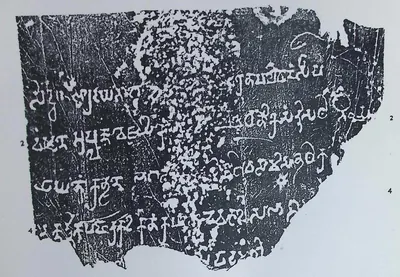
A broken Prakrit inscription on part of an eight-sided stone pillar from Manchikallu in the Palnad taluk. It records gifts by the Pallava king Simhavarman of the Bharadvaja gotra to the priests of the god Jivasivasvamin. D. C. Sircar, who edited it, took it for the earliest Pallava record. He dated it first to the end of the 3rd century and later to the middle of the 4th.
This short and broken inscription is the only record of the Pallava king Simhavarman of Manchikallu. D. C. Sircar called it the earliest inscription of the Pallava family.1
Discovery
P. Seshadri Sastri of Guntur published a first note on the inscription in 1944.2 He reported that it had been found at some distance from Rentachintala in the Palnad taluk.2 When Sircar went to look for it in 1957, he was told that it came from the village of Manchikallu.2 By then the stone had been taken to the taluk office at Gurazala.2 From there it went to the old bungalow of the Collector at Guntur, where he finally traced it.2 It is a fragment of an octagonal (eight-sided) pillar.2
Description and language
Five lines of writing survive, about seventeen inches long and nine high. The lower part of the inscription is broken away. The letters closely resemble those of the Ikshvaku inscriptions of Jaggayyapeta and Nagarjunakonda. Two Telugu-Kannada letters of about the 7th century, at the ends of two lines, belong to another record now almost lost.3 The language is Prakrit, but its spelling shows the influence of literary Prakrit and Sanskrit. Sircar compared its wording with that of the Mayidavolu plates of Sivaskandavarman.34
Content
As Sircar read it, the Pallava king Simhavarman of the Bharadvaja gotra (clan) had rites performed to please the gods.45 The rites were for his victory and the increase of his merit and power.45 After these, he gave woollen carpets and other gifts to the priests of the god Jivasivasvamin.45 The damaged last lines refer to a god worshipped in a temple and to a gift at his feet.45 Sircar took Jivasivasvamin to be probably a form of Siva.4
Date and significance
Sircar dated the letters to the second half of the 3rd century and the language to about its close.34 He suggested that Simhavarman extended Pallava power over the Krishna–Guntur region and took the place of the Ikshvakus.1 In his view Simhavarman destroyed their capital Vijayapuri at Nagarjunakonda, and was perhaps the father of Sivaskandavarman.1 After the dates of the last Ikshvaku kings were worked out, Sircar concluded that the Pallava occupation of the region took place about the middle of the 4th century. He then placed Simhavarman and Sivaskandavarman in about the fourth and fifth decades of that century.6
Footnotes
-
Sircar, “Two Inscriptions from Guntur District” (EI XXXII), p. 89 (archive.org (opens in a new tab)). ↩ ↩2 ↩3
-
D. C. Sircar, “Two Inscriptions from Guntur District”, Epigraphia Indica XXXII (1957–58), p. 82 (archive.org (opens in a new tab)). ↩ ↩2 ↩3 ↩4 ↩5 ↩6
-
Sircar, “Two Inscriptions from Guntur District” (EI XXXII), p. 87 (archive.org (opens in a new tab)). ↩ ↩2 ↩3
-
Sircar, “Two Inscriptions from Guntur District” (EI XXXII), p. 88 (archive.org (opens in a new tab)). ↩ ↩2 ↩3 ↩4 ↩5 ↩6 ↩7
-
Sircar, “Two Inscriptions from Guntur District” (EI XXXII), p. 90, translation (archive.org (opens in a new tab)). ↩ ↩2 ↩3 ↩4
-
D. C. Sircar, “More Inscriptions from Nagarjunikonda”, Epigraphia Indica XXXV (1963–64), p. 6 (archive.org (opens in a new tab)). ↩
Photos
References
Notes (0)
Sources (2)
Spotted an error on this page? Tell us
Last updated: