Gajapati inscriptions at Srikurmam (1452–1503)
Short Telugu records on the black stone pillars of the Srikurmam temple. They are dated in the reigns of the Gajapati kings Kapilendra (1452, 1455, 1460), Purushottama (1470–1495) and Prataparudra (1503), and record gifts of land, lamps, images and silver vessels. They were copied in 1896 and printed in South-Indian Inscriptions V (1925). Monmohan Chakravarti and R. D. Banerji used them to fix the regnal years of the kings, and V. Rangacharya used them to argue that the kings came to the throne earlier.
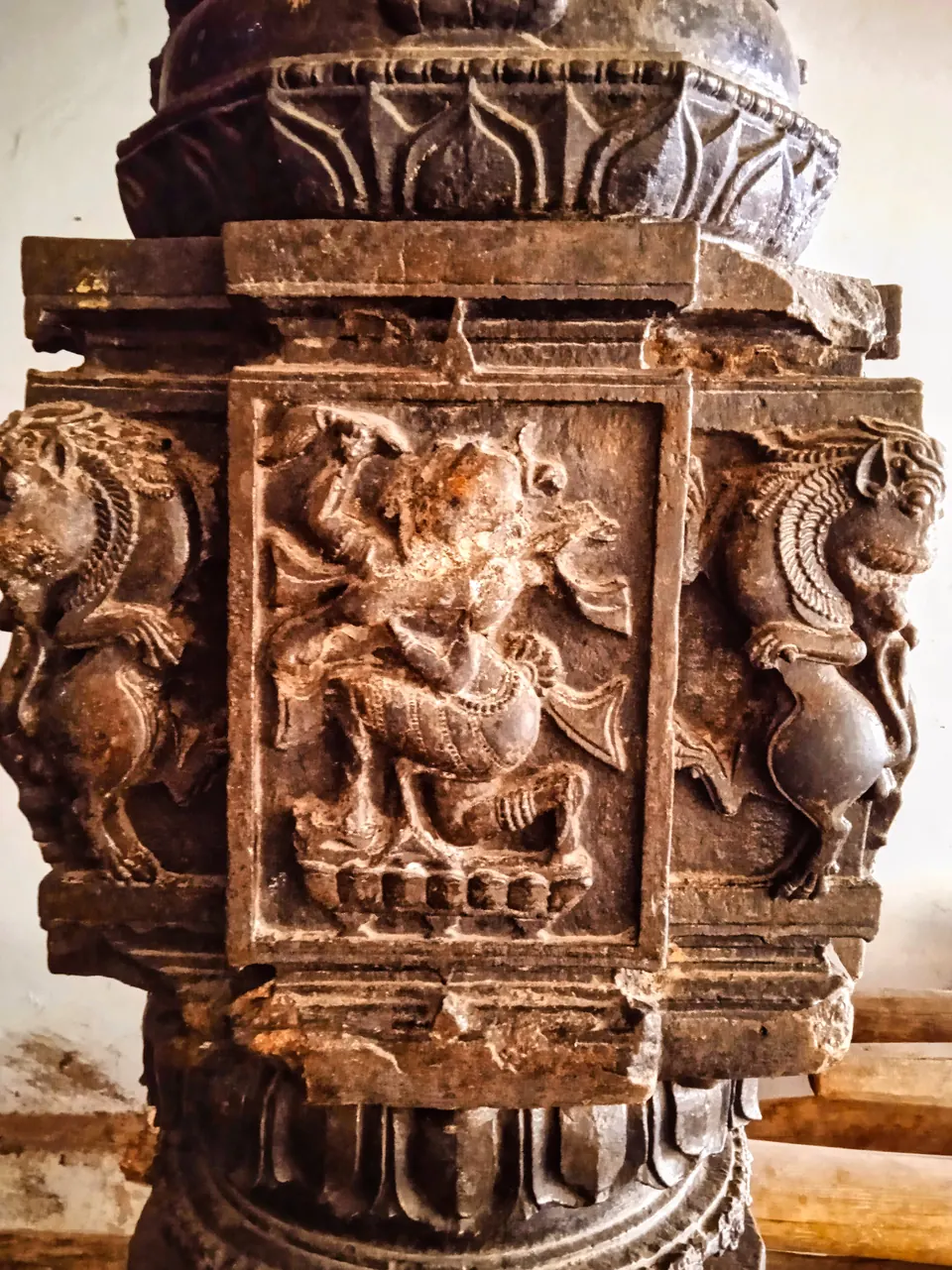
The records
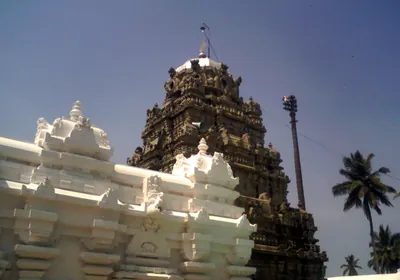
The Srikurmam temple near Srikakulam has more than a hundred inscriptions on the pillars of its verandas.12 Most of them are of the Eastern Ganga kings.12 They were copied for the Madras epigraphical survey in 1896, and printed in South-Indian Inscriptions V (1925).12
Among the latest are records dated in the reigns of the three great Gajapati kings of the Solar line.34 V. Rangacharya’s Topographical List (1919) summarises them.34 In 1900, Monmohan Chakravarti converted their dates to the Christian calendar.34 He worked from E. Hultzsch’s epigraphical report, ink impressions and his own copies.34 See the Srikurmam temple and Srikurmam.
Kapilendra
- Two records on the twentieth pillar of the veranda are of Saka 1373 (Saka is an Indian way of counting years), the year Prajapati.564 One is a gift of a lamp in the reign of Kapilendra, mentioning Kalinganagara, and the other is a gift of land (South-Indian Inscriptions V, Nos. 1198 and 1199).564 Chakravarti dated them to 27 January 1452.564
- A record on the eighteenth pillar, of “the Gajapati king, Pratapa-Kapilesvaradeva”, is of Saka 1377, his twenty-fifth year.578 It records a gift of land (No. 1194), and Chakravarti placed it in August 1455.578
- A record on the eighth pillar, of Pratapa-Kapilesvaradeva, is of Saka 1382, the year Vikrama, his thirty-second year.39 It records the gift of a brass image carrying a lamp, and of some land (No. 1165).39 Rangacharya concluded from it that Kapilesvara “was crowned about A.D. 1429-30. So the traditional version of 1452–1479 has to be given up.”3
Purushottama
- Records on the forty-ninth pillar, of Pratapavijaya-Purushottamadeva, are of Saka 1392 and of Saka 1393, the year Khara.1011 They record a gift of silver vessels and chamaras (fly-whisks) by an inhabitant of Palakonda, and a gift of land by the same man (Nos. 1247 and 1248).1011
- A record on the second pillar, of “the Gajapati king, Pratapavira-Purushottamadeva”, is of Saka 1393.12 It records a gift for offerings (No. 1153).12
- A record on the forty-first pillar, of Pratapa-Purushottamadeva, is of Saka 1417, the year Rakshasa, his thirty-second year.1213 It concerns a gift of land by a merchant from Rangolu (No. 1229).1213
Chakravarti counted the regnal years of these records in the anka reckoning of Orissa, which skips certain numbers.1415 He dated them to 25 September 1470, 31 March 1471 and 31 October 1495.1415 The last was in the thirty-third anka.1415 He added a record on the first pillar that had not been reported, of the twenty-fifth anka, 27 May 1490.1415
R. D. Banerji gave the same list as proof that Purushottama’s reign could be “thoroughly verified” from Srikurmam.16 Rangacharya’s summaries give the year of the Saka 1392 and 1393 records as the king’s seventh.110 He concluded that “the inscription settles the date of Purushottama’s accession to be A.D. 1464-5”.110
Prataparudra
- A record on the forty-first pillar is of Saka 1425, the year Rudhirodgarin, in the reign of the Gajapati king Pratapa-Rudradeva.121718 It records the gift of an image holding a lamp (No. 1228).121718 Rangacharya noted that this king “was the opponent of Krishnadeva Raya of Vijayanagar”, and Chakravarti dated the record to 3 November 1503.121718
After the Gajapatis
A record of Saka 1526 (1604) is on the third pillar of the second row of the Asthana-mantapa (audience hall).19 It is dated in the reign of Muhammad Quli Qutb Shah of Golconda.19 It records the gift of the village of Kurmam by a feudatory, Asvaraya, who had defeated Mukunda-Bahubalendra.19 Rangacharya called Mukunda-Bahubalendra “the famous Telugu usurper of the Gajapati sovereignty”.19 See the Gajapatis, Kapilendra, Purushottama and Prataparudra.
Footnotes
-
V. Rangacharya, A Topographical List of the Inscriptions of the Madras Presidency, Vol. I (1919), p. 686, Ganjam No. 152 (archive.org (opens in a new tab)). ↩ ↩2 ↩3 ↩4 ↩5 ↩6 ↩7
-
H. Krishna Sastri (ed.), South-Indian Inscriptions (Texts), Vol. V (1925), p. 420, No. 1153 (A.R. No. 274 of 1896) (archive.org (opens in a new tab)). ↩ ↩2 ↩3 ↩4 ↩5
-
Rangacharya, Topographical List, Vol. I (1919), p. 687, Ganjam No. 162 (archive.org (opens in a new tab)). ↩ ↩2 ↩3 ↩4 ↩5 ↩6 ↩7
-
Monmohan Chakravarti, “The last Hindu Kings of Orissa”, Journal of the Asiatic Society of Bengal, Vol. LXIX, Part I (1900), p. 180 (archive.org (opens in a new tab)). ↩ ↩2 ↩3 ↩4 ↩5 ↩6 ↩7
-
Rangacharya, Topographical List, Vol. I (1919), p. 689, Ganjam Nos. 191, 195 and 196 (archive.org (opens in a new tab)). ↩ ↩2 ↩3 ↩4 ↩5
-
South-Indian Inscriptions, Vol. V (1925), p. 437, Nos. 1198–1199 (A.R. Nos. 317–318 of 1896) (archive.org (opens in a new tab)). ↩ ↩2 ↩3
-
South-Indian Inscriptions, Vol. V (1925), p. 436, No. 1194 (A.R. No. 313 of 1896) (archive.org (opens in a new tab)). ↩ ↩2
-
Chakravarti, “The last Hindu Kings of Orissa”, JASB LXIX, Part I (1900), p. 181 (archive.org (opens in a new tab)). ↩ ↩2
-
South-Indian Inscriptions, Vol. V (1925), p. 424, No. 1165 (A.R. No. 284 of 1896) (archive.org (opens in a new tab)). ↩ ↩2
-
Rangacharya, Topographical List, Vol. I (1919), p. 693, Ganjam Nos. 243–244 (archive.org (opens in a new tab)). ↩ ↩2 ↩3 ↩4
-
South-Indian Inscriptions, Vol. V (1925), p. 458, Nos. 1247–1248 (A.R. Nos. 365–366 of 1896) (archive.org (opens in a new tab)). ↩ ↩2
-
Rangacharya, Topographical List, Vol. I (1919), p. 691, Ganjam Nos. 224–225 (archive.org (opens in a new tab)). ↩ ↩2 ↩3 ↩4 ↩5
-
South-Indian Inscriptions, Vol. V (1925), p. 451, No. 1229 (A.R. No. 347 of 1896) (archive.org (opens in a new tab)). ↩ ↩2
-
Chakravarti, “The last Hindu Kings of Orissa”, JASB LXIX, Part I (1900), p. 182 (archive.org (opens in a new tab)). ↩ ↩2 ↩3 ↩4
-
Chakravarti, “The last Hindu Kings of Orissa”, JASB LXIX, Part I (1900), p. 183 (archive.org (opens in a new tab)). ↩ ↩2 ↩3 ↩4
-
R. D. Banerji, History of Orissa from the Earliest Times to the British Period, Vol. I (1930), p. 318 (archive.org (opens in a new tab)). ↩
-
South-Indian Inscriptions, Vol. V (1925), p. 451, No. 1228 (A.R. No. 346 of 1896) (archive.org (opens in a new tab)). ↩ ↩2 ↩3
-
Chakravarti, “The last Hindu Kings of Orissa”, JASB LXIX, Part I (1900), p. 184 (archive.org (opens in a new tab)). ↩ ↩2 ↩3
-
Rangacharya, Topographical List, Vol. I (1919), p. 694, Ganjam No. 250 (archive.org (opens in a new tab)). ↩ ↩2 ↩3 ↩4
Photos
References
Notes (0)
Sources (4)
Spotted an error on this page? Tell us
Last updated: