Simhavarman (Pallava, Manchikallu inscription)
Pallava king of the Bharadvaja gotra, known only from a broken Prakrit pillar inscription found at Manchikallu in the Palnad taluk. D. C. Sircar took it for the earliest Pallava record. He suggested that this Simhavarman brought the Krishna–Guntur country under the Pallavas, pushing out the Ikshvakus, and was perhaps the father of Sivaskandavarman.
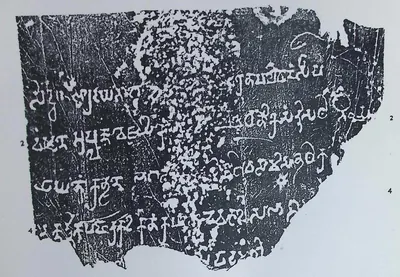
This Simhavarman is known from a single broken inscription in Prakrit.12 It is on a fragment of an eight-sided pillar from Manchikallu in the old Palnad taluk of the Guntur district.12 D. C. Sircar, who edited it, called it the earliest inscription of the Pallava family.12 See the Manchikallu inscription; for the later Simhavarman of the Sanskrit charters of the Nellore and Guntur country, see Simhavarman II.
The inscription
The record says that Simhavarman, of the Pallava family and the Bharadvaja gotra (family line), gave woollen carpets and other gifts to the priests of the god Jivasivasvamin.34 He did this after propitiatory rites (rites to win the gods’ favour) had been performed for his victory and for the increase of his merit and power.34 Sircar read the god’s name as that of a form of Siva.32 He took the bull on the seals of later Pallava grants as another sign of their Saiva leanings (devotion to Siva).32
Family
The inscription names no relatives. Sircar suggested that Simhavarman was the father and immediate predecessor of Sivaskandavarman. He based this on the closeness in date that he saw between this inscription and the Prakrit charters of Sivaskandavarman.2 He called it a conjecture (a guess).2 Sivaskandavarman’s own grants do not name his father, and the Hirahadagalli plates speak only of “the lord Bappa”.2
The end of the Ikshvakus
Sircar dated the inscription to the second half of the 3rd century from its script.53 From its language he placed it about the close of that century.53 The letters closely resemble those of the Ikshvaku inscriptions of Jaggayyapeta and Nagarjunakonda.2 A Pallava king was also present very near the Ikshvaku capital.2
From this Sircar suggested that Simhavarman replaced the Ikshvakus in the Krishna–Guntur region.2 He thought Simhavarman destroyed their city of Vijayapuri with its Buddhist buildings.2 Later Sircar dated the last Ikshvaku records.6 He then concluded that the Ikshvakus were overthrown not much earlier than the middle of the 4th century.6 So he placed both Simhavarman and Sivaskandavarman in about the fourth and fifth decades of that century.6
Footnotes
-
D. C. Sircar, “Two Inscriptions from Guntur District”, Epigraphia Indica XXXII (1957–58), p. 82 (archive.org (opens in a new tab)). ↩ ↩2 ↩3
-
Sircar, “Two Inscriptions from Guntur District” (EI XXXII), p. 89 (archive.org (opens in a new tab)). ↩ ↩2 ↩3 ↩4 ↩5 ↩6 ↩7 ↩8 ↩9 ↩10 ↩11 ↩12
-
Sircar, “Two Inscriptions from Guntur District” (EI XXXII), p. 88 (archive.org (opens in a new tab)). ↩ ↩2 ↩3 ↩4 ↩5 ↩6
-
Sircar, “Two Inscriptions from Guntur District” (EI XXXII), p. 90, translation (archive.org (opens in a new tab)). ↩ ↩2
-
Sircar, “Two Inscriptions from Guntur District” (EI XXXII), p. 87 (archive.org (opens in a new tab)). ↩ ↩2
-
D. C. Sircar, “More Inscriptions from Nagarjunikonda”, Epigraphia Indica XXXV (1963–64), p. 6 (archive.org (opens in a new tab)). ↩ ↩2 ↩3
Photos
Related
Dynasties

References
Notes (0)
Sources (2)
Spotted an error on this page? Tell us
Last updated: