Simhachalam inscriptions of Krishnadeva Raya (1516–1519)
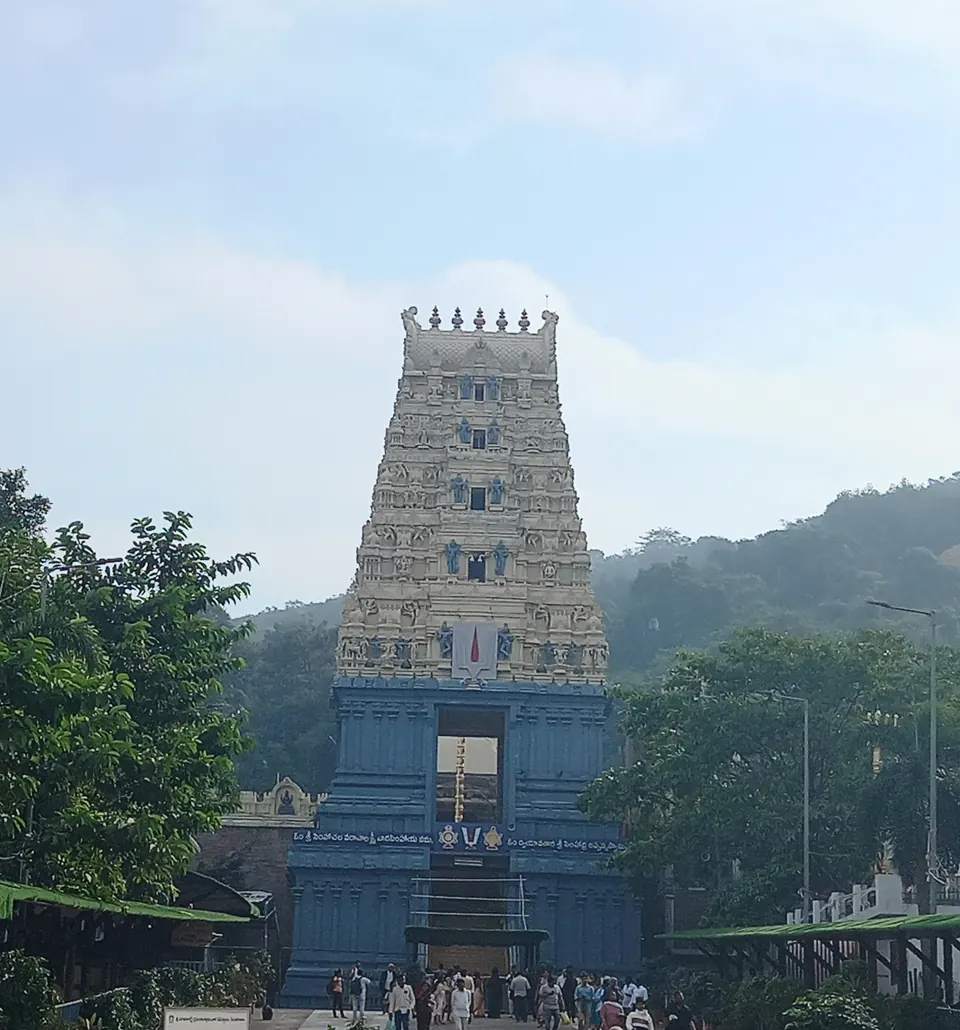
Three Telugu inscriptions of Krishnadeva Raya in the Varaha-Narasimha temple at Simhachalam near Visakhapatnam. They are on the base of the asthana-mandapa (audience hall) and on a round pillar of the verandah round the central shrine. They are dated Saka 1438 (1516) and 1441 (1519). They record that the king, after subduing Udayagiri, Kondavidu, Kondapalli and Rajahmundry on his 'first campaign', came to Simhadri. For the merit of his parents he gave the god a necklace of 991 pearls and other jewels. His queens Chinnadevi and Tirumaladevi also made gifts, and later the king gave several villages.
The records
V. Rangacharya’s list of 1919 gives three Telugu records of “the Vijayanagara king Krishnaraya” in the Simhachalam temple.1 The Government Epigraphist copied them in 1899.1 They are:1
- No. 243 of 1899, “on the base of the asthanamantapa in the first enclosure”, which records in Saka 1438 (Saka is an Indian way of counting years), Dhatri, “the presentation of a number of jewels to the temple”1
- No. 244, on the base of the same hall, which records in Saka 1441, Pramathin, a “gift of several villages”1
- No. 245, “on a round pillar on the verandah running round the garbhagriha” (the central shrine), which records in Saka 1438 “gifts of jewels by himself and by his two queens Chinnadevamma and Tirumaladevamma”1
Saka 1438 is 1516–17, and Saka 1441 is 1519–20.1 The Telugu texts were printed without translation in 1928, in the sixth volume of South-Indian Inscriptions, as Nos. 694 to 696.23 See Simhachalam and the Simhachalam temple.
The king’s first campaign
In 1898 G. R. Subramiah Pantulu printed a translation of the pillar inscription in the Indian Antiquary.4 It was “culled from the local records, of the District of Vizagapatam”.4 In it, the king is “reigning at Vijayanagara”.4 He is described as “having come on his first campaign and subdued the fortresses of Udayagiri, Kondavidu, Kondapalli, Rajamahendri, etc.”.4 Then he “came to Simhadri and visited the place in S. S. 1438 on the twelfth day of the black fortnight of the month of Chaitra of the Dhatu year”.4
There he made gifts “for the salvation of his mother Nagadevamma and his father Narasaraya”.4 He “gave to God one necklace of 991 pearls, a pair of diamond bangles”, and a gold plate of 2,000 pagodas’ weight (pagodas were gold coins).4 He also gave gold padakas (pendants) through his two wives.4 The record says “through his wife Chinnadevamma, a gold padaka of 500 pagoda weight and one of a similar weight through his other wife Tirumaladevamma”.4
Subramiah Pantulu used the record to show that the king had two wives.4 He placed three years of literary discussion at court between this campaign and the king’s second campaign.4 See Krishnadeva Raya.
The Vizagapatam gazetteer of 1907 summarised the campaign.56 In 1515, it says, Krishnadeva “seized Udayagiri in Nellore, Kondavidu (taking prisoner Pratapa Rudra’s son), Kondapalli in Kistna, Rajahmundry and other fortresses”.56 He then “halted at Simhadri (Simhachalam) and set up the pillar of victory at Potnuru”.56 The gazetteer adds that “The Simhachalam temple still contains inscriptions recounting his successes”.56 They tell “how he and his queens presented the god with a necklace of 991 pearls and other costly gifts.”56 See Potnuru.
Nuniz’s story of an insulting inscription
The Portuguese chronicler Nuniz tells a story about the temple at “Symamdary”.6 Krishnadeva was angry that the Gajapati refused to fight.6 So, Nuniz says, he had an inscription cut there, daring the king of Orissa to erase it, at the price of his wife.6
The gazetteer doubted the story.6 “If this insulting threat was really ever inscribed,” it wrote, “it is not likely to have been allowed to remain on record a moment after it could be safely deleted”.6 It added that “it is not now to be found at Simhachalam.”6 Robert Sewell had taken Nuniz’s Symamdary for Rajahmundry.6 The gazetteer thought that Nuniz’s distance of “a hundred leagues” from Kondapalli suits Simhachalam better.6 The question is discussed on the Gajapatis page.
Footnotes
-
V. Rangacharya, A Topographical List of the Inscriptions of the Madras Presidency, Vol. III (1919), p. 1675, Vizagapatam Nos. 71–73 (archive.org (opens in a new tab)). ↩ ↩2 ↩3 ↩4 ↩5 ↩6 ↩7
-
South-Indian Inscriptions (Texts), Vol. VI (1928), p. 260, No. 694 (archive.org (opens in a new tab)). ↩
-
South-Indian Inscriptions (Texts), Vol. VI (1928), p. 261, Nos. 695 and 696 (archive.org (opens in a new tab)). ↩
-
G. R. Subramiah Pantulu, “Discursive Remarks on the Augustan Age of Telugu Literature”, Indian Antiquary XXVII (1898), p. 296 (archive.org (opens in a new tab)). ↩ ↩2 ↩3 ↩4 ↩5 ↩6 ↩7 ↩8 ↩9 ↩10 ↩11
-
W. Francis, Madras District Gazetteers: Vizagapatam, Vol. I (1907), p. 28 (archive.org (opens in a new tab)). ↩ ↩2 ↩3 ↩4 ↩5
-
Francis, Vizagapatam Gazetteer, Vol. I (1907), p. 29 (archive.org (opens in a new tab)). ↩ ↩2 ↩3 ↩4 ↩5 ↩6 ↩7 ↩8 ↩9 ↩10 ↩11 ↩12 ↩13
Photos
References
Notes (0)
Sources (4)
Spotted an error on this page? Tell us
Last updated: