Amaravati inscription of Krishnadeva Raya (1515)
A Sanskrit verse inscription in Telugu letters on a slab in the Amaresvara temple at Amaravati, edited by H. Luders in 1903. It praises Krishnadeva Raya as the conqueror of Sivanasamudram, Udayagiri, Vinukonda and Bellamkonda, who took Kondavidu after capturing the Gajapati's son Virabhadra alive. It records that in Saka 1437 (1515) the king performed the tulapurusha gift (giving away his weight in gold) and gave agraharas (Brahmin villages) before the god Amaresa on the bank of the Krishna. It was the first inscription found to describe his eastern campaign.
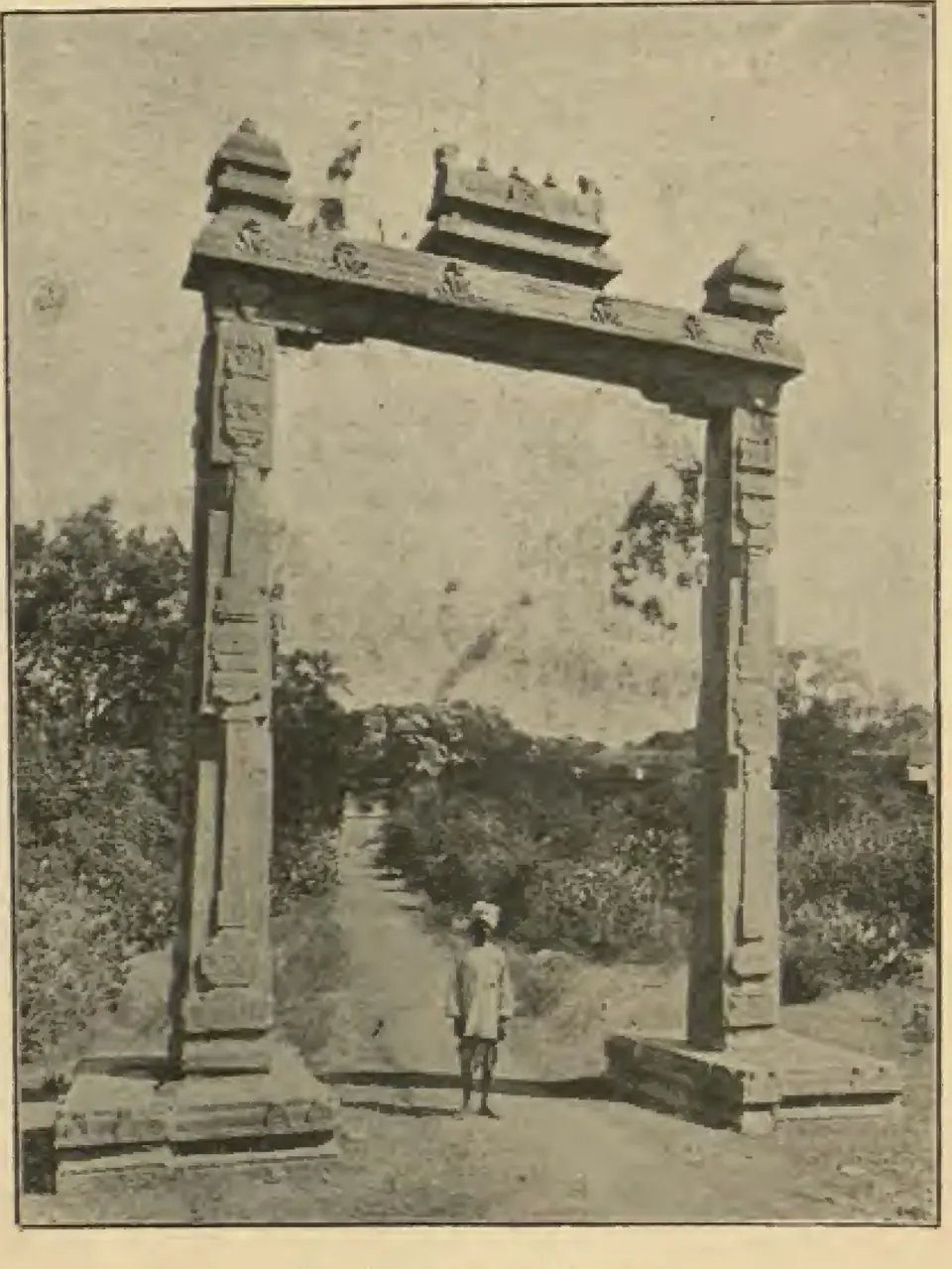
The slab
H. Luders edited the inscription in 1903 “from inked estampages supplied by Dr. Hultzsch”.12 He wrote that it “is engraved on a slab in the Samnyasin’s room in the Amaresvara temple at Amaravati in the Kistna district.”12 It “contains 53 lines of writing.”12 The alphabet is Telugu of the same type as the Mangalagiri pillar inscription.12 The language is Sanskrit verse, apart from the opening and closing words.12 See Amaravati.
The king and his conquests
Luders wrote: “The greater portion of it consists of verses already known to us from other records. New are only the verses 7, 9, 10 and 12.”2 Verse 7 says that from king Narasa “was born by Nagamamba king Krishnaraya”.2
Luders found verse 9 “of greater interest”.2 It praises Krishnaraya as the king “who, having taken by a forcible attack Sivanasamudra, Udayadri, Vinikonda and Bellakonda”, then took Kondavidu.2 Before that, he had “captured alive on the battle-field Virabhadra, the son of the Gajapati king”.2
Luders called this account, “although rather meagre, … of considerable importance”.2 He said so because it was “the first epigraphical record of Krishnaraya’s warlike exploits up to the conquest of Kondavidu”.2 He thought that the events were listed in their order.2 See Krishnadeva Raya.
Sivanasamudram, on an island in the Kaveri, belonged to the Ummattur chiefs.23 The king put down their revolt first.23 Luders connected the revolt with a letter of 1510 in the Commentaries of Albuquerque.23 The letter reported that the king of Narsinga was preparing an attack on a rebel vassal who had seized the city of “Pergunda”.23
Luders accepted Robert Sewell’s identification of Pergunda with Penukonda.23 He suggested that the war “would thus appear to have arisen from a dispute about this hill-fort”.23 An inscription of 1504 had already given the lord of Ummattur the title “Penugonda-chakresvara”.23 See Penukonda.
Udayagiri, Vinukonda, Bellamkonda and Kondavidu belonged to the campaign against the Gajapati of Orissa.3 Luders noted that Nuniz describes the eighteen-month siege of Udayagiri, but not the taking of Vinukonda and Bellamkonda.3 He thought this was “probably because these places were only of secondary importance”.3 He also noted that, by the inscriptions at Mangalagiri, Kaza and Kondavidu, the fortress of Kondavidu surrendered on 23 June 1515.3 See Udayagiri, Kondavidu and the Mangalagiri pillar inscription.
Virabhadra and the date
Both Portuguese chroniclers tell of the capture of Virabhadra, the Gajapati’s son.34 In Nuniz’s longer account, the prince was taken at Kondapalli, more than three months after Kondavidu fell.34 He later killed himself at Vijayanagara, rather than fight a low-born swordsman.34
Luders wrote: “The only discrepancy between the chronicle and the inscription is with respect to the date when the prince was taken captive”.34 The inscription places the capture before the fall of Kondavidu.34
Verse 10 gives the date in a word-code, where each word stands for a number.4 The date is “in the Saka year marked by the Munis (7), the towns (3), the oceans (4), and the moon (1)”.4 It is “in the year Yuvan, on the twelfth day in the month Ashadha”.4
On that day, it says, the king “duly performed the gift called tulapurusha”.4 He also “gave away many incomparable agraharas in the presence of the god Sulapani, who is renowned in the world as Amaresa, on the bank of the Krishnaveni”.4
Luders took this to be the very day of the fall of Kondavidu, and he left the conflict open.4 The text may have been composed months after the event.4 But he added that “it is equally possible that Nunes has made a slight mistake, and that Virabhadra was taken captive on an earlier occasion”.4 The inscription ends with a verse asking the blessing of Amaresa on Krishnaraya.4
In his edition of the Mangalagiri pillar, Luders had already noted the Kondavidu story of the Portuguese chronicle.5 There he dated the fall of the fort to Saturday, 23 June 1515.5 See the Gajapatis and Prataparudra.
Footnotes
-
H. Luders, “Amaravati Inscription of Krishnaraya of Vijayanagara; Saka-Samvat 1437”, Epigraphia Indica VII (1902–03), p. 17 (archive.org (opens in a new tab)). ↩ ↩2 ↩3 ↩4 ↩5
-
Luders, “Amaravati Inscription of Krishnaraya”, Epigraphia Indica VII (1902–03), p. 18 (archive.org (opens in a new tab)). ↩ ↩2 ↩3 ↩4 ↩5 ↩6 ↩7 ↩8 ↩9 ↩10 ↩11 ↩12 ↩13 ↩14 ↩15 ↩16 ↩17 ↩18 ↩19 ↩20
-
Luders, “Amaravati Inscription of Krishnaraya”, Epigraphia Indica VII (1902–03), p. 19 (archive.org (opens in a new tab)). ↩ ↩2 ↩3 ↩4 ↩5 ↩6 ↩7 ↩8 ↩9 ↩10 ↩11 ↩12 ↩13 ↩14 ↩15 ↩16
-
Luders, “Amaravati Inscription of Krishnaraya”, Epigraphia Indica VII (1902–03), p. 20 (archive.org (opens in a new tab)). ↩ ↩2 ↩3 ↩4 ↩5 ↩6 ↩7 ↩8 ↩9 ↩10 ↩11 ↩12 ↩13 ↩14
-
H. Luders, “Two Pillar Inscriptions of the time of Krishnaraya of Vijayanagara”, Epigraphia Indica VI (1900–01), p. 111 (archive.org (opens in a new tab)). ↩ ↩2
Photos
References
Notes (0)
Sources (2)
Spotted an error on this page? Tell us
Last updated: