Shitab Khan (Sitapati) of Warangal
A Telugu chief of humble birth who held Warangal, Khammam and Bellamkonda in the early sixteenth century. Hirananda Sastri identified him with an officer who had fled the Bahmani Sultan Humayun Shah about 1461, and with the Sitapati of the Golconda chronicle. His pillar inscription in Warangal fort records that he took the fort from the Muslims on 21 January 1504. He put back the images of Krishna and of the Kakatiya family goddess. He supported Telugu poets and called himself king of the Bhogi family. Sultan Quli Qutb Shah of Golconda defeated him. He took shelter with the Gajapati prince at Kondapalli and fought on the losing side at Palanchinur. The Kistna manual thought he was a vassal of Orissa.
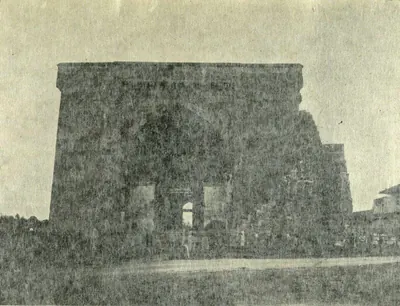
Shitab Khan held Warangal in the early sixteenth century.12 The Golconda chronicle, as Briggs translated it, calls him Sitapati, and his own inscription calls him Chittapa Khan.12 We know him from a few lines of Persian history, a Sanskrit and Telugu record at Warangal, two Telugu poems and some local traditions that contradict each other.12 Hirananda Sastri edited the inscription for the Nizam’s government in 1932.12 He called Shitab Khan “indeed a man of destiny”.12 See Shitab Khan of Warangal, Warangal and his inscription.
Origins
The Burhan-i Ma’asir is a Persian history, translated by J. S. King (1900). It says that “Shitab Khan, one of the Sultan’s amirs, having fled for his life”, Humayun Shah had the women of his household tortured in public.324 Sastri took this amir (noble) of about 1461 to be the same man.324
Sastri thought that he was born about 1440 “in some ordinary Boya family”.5 He rose to be governor of Warangal under the Bahmanis.5 Later he “succeeded in carving out for himself a small principality”.5 See Humayun Shah.
A Telugu local history, the Kimmuru kaifiyat (village record), tells a different story.678 It calls him Sitadu, a Boya cowherd raised by a Niyogi Brahmin, Avasarala Peddiraju.678 Sitadu became a soldier and “was given the title of Chittapa Khana”, and he made Peddiraju his diwan (minister).678 Sastri warned that the kaifiyats mixed him up with a later Shitab Khan of the 1570s.678
Sastri also wrote about the name.9 He thought that “his real name was Sitapati”, shortened to Sitadu.9 He thought “Shitab Khan” may have referred to “his quick rise (shitab) in life”.9 In his words, “Khan is only a title meaning powerful lord”.9 His inscription “indubitably shows that both he and his son were staunch followers of Brahmanism”.9
The Golconda chronicle calls him an infidel, and one kaifiyat makes him an enemy of Hindu temples.109 The book Glimpses of the Nizam’s Dominions says he “was the first Mahomedan conqueror of Warangal”, but Sastri found no authority for this.109
Family
His inscription says that Shitab Khan was the son of Mana, or Manaya, a famous archer, and of his wife Gauramba.51112 He was the grandson of Naga, a leader of the Bhoga family.51112
By his senior wife, Devambika, he had two sons, Avadhuta Khan and Purantaka.1314 By a second wife, Anumamba, he had three sons, Amara, Bhogi and Rama, and Amara was killed in battle.1314 Sastri noted that “the son of Shitab Khan, though a Hindu, went by the name of Avadhuta Khana”.9
Warangal, 1504
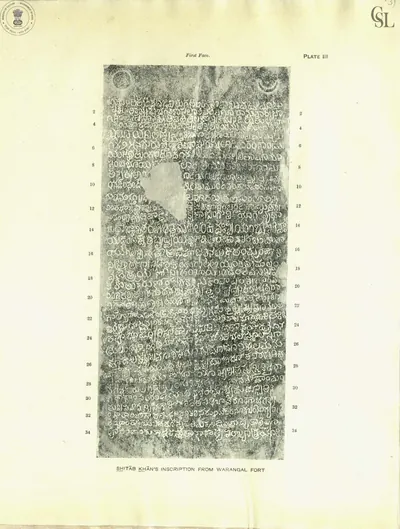
The inscription praises “Bhoge-Chittapa-khana, the ornament of the kings of the earth, who was equal to Vikramaditya”.1311 It records that he “captured the beautiful capital called Ekopala, (i.e., Warangal) which had been taken by the Yavanas”.1311 (Yavanas here means the Muslims.) He did this on Sunday, the fifth day of the bright fortnight of Magha in Saka 1425 (Saka is an Indian way of counting years).1311 Sastri worked this out as 21 January 1504.1311
The inscription says that he “took possession of the important and impregnable hill forts of Rajadri and others”.1516 Two sacred images had been removed by “the wicked Turushkas” (Turks).1516 He put back on its throne the image of Krishna as Panchalaraya.1516 He also set up again the goddess who “was the Lakshmi of the throne of the Kakati kingdom”.1516 See Rachakonda and the Kakatiyas.
Patron of poets
Sastri found him in Telugu literature.17 The Chitra-Bharatamu of Charigonda Dharmanna is dedicated to his minister Inumulapalli Peddanna.17 It praises “king Chitapa Khana, the son of Mana” for building lakes “like Sagara”, “Pakala and other lakes which can be compared with oceans”.17 It also praises his gifts of land and cows to Brahmins.17
The poem says that the minister’s brother built a palace with a golden top in the court of the god Panchalesvara.17 This is the image that the inscription says Shitab Khan restored.17 A tradition recorded in Glimpses of the Nizam’s Dominions says that he repaired the breaks in the dam of the Pakhal lake.17 He used treasure that was shown to him in a dream.17 See Pakhal.
Sultan Quli and the Gajapatis
Briggs translated the History of Sultan Quli Qutb Shah.18 It says that “Seetaputty, the Raja of Cummamett, had presumed to lay hands on some of the Kootb Shahy districts”.18 He “possessed the strong forts of Cummamett, Belumconda, Wurungole, and others, and had in his service twelve thousand infantry, noted as good marksmen”.18
According to this history, Sultan Quli took Bellamkonda by climbing its walls with ladders, and he beat Sitapati in the field.18192021 He broke up the league of rajas that Sitapati formed at Khammam, and stormed Khammam itself.18192021
Sitapati fled to “Raja Ramchundur, the son of Gujputty, who held his court at Condapilly”.18192021 He fought on the Hindu left with Hari Chandra at the great defeat near “Palunchinoor”.18192021 The Kistna district manual (1883) says that he “seems to have been a vassal of Orissa”.22 See Sultan Quli, Kondapalli, Khammam and the Gajapatis.
Sastri also cites the Telugu poem Krishnaraya-vijayamu and the prose Raya-vachakamu.23 They tell how Krishnadeva Raya invaded the Gajapati country.23 Then “Chitapa-Khana (Shitab Khan), with sixty thousand archers” stopped his foot-soldiers in the passes.23 At last Krishnadeva Raya’s Karnata troops climbed the hills above them and drove them off.23 Sastri dated this to Krishnadeva Raya’s invasion of Orissa in 1516.23
His end
No source records his death.5 Sastri thought that Sultan Quli took Warangal back after defeating Ala-ud-din Imad Shah in 1512.5 So Shitab Khan “could not have enjoyed the conquest for more than six or seven years”.5
Other writers give other dates:24252226
- The Hyderabad Archaeological Department’s report for 1925–26 says that Sultan Quli “took possession of Warangal between 1513 and 1516”.24252226
- The Kistna manual places the war after a peace of 1516 between Krishnadeva Raya and the Gajapati.24252226
- Bilgrami’s Landmarks of the Deccan (1927) says that between 1519 and 1525 Sultan Quli “was engaged in defeating Shitab Khan, a Zemindar of Warangal”.24252226
In another place Bilgrami makes “Shitab Khan one of the officers of Ibrahim” Qutb Shah.274 There Shitab Khan “conquered Warangal and annexed it to Golconda” after Talikota.274 This confuses him with the later Shitab Khan of the 1570s.274 See Ibrahim Qutb Shah.
Footnotes
-
Hirananda Sastri, Shitab Khan of Warangal (Hyderabad Archaeological Series No. 9, 1932), preface (archive.org (opens in a new tab)). ↩ ↩2 ↩3 ↩4 ↩5
-
Sastri, Shitab Khan of Warangal (1932), p. 3 (archive.org (opens in a new tab)). ↩ ↩2 ↩3 ↩4 ↩5 ↩6 ↩7
-
J. S. King, The History of the Bahmani Dynasty, founded on the Burhan-i Ma’asir (1900), p. 88 (archive.org (opens in a new tab)). ↩ ↩2
-
Sastri, Shitab Khan of Warangal (1932), p. 9 (archive.org (opens in a new tab)). ↩ ↩2 ↩3 ↩4 ↩5
-
Sastri, Shitab Khan of Warangal (1932), p. 15 (archive.org (opens in a new tab)). ↩ ↩2 ↩3 ↩4 ↩5 ↩6 ↩7 ↩8
-
Sastri, Shitab Khan of Warangal (1932), p. 5 (archive.org (opens in a new tab)). ↩ ↩2 ↩3 ↩4
-
Sastri, Shitab Khan of Warangal (1932), p. 6 (archive.org (opens in a new tab)). ↩ ↩2 ↩3 ↩4
-
Sastri, Shitab Khan of Warangal (1932), p. 7 (archive.org (opens in a new tab)). ↩ ↩2 ↩3 ↩4
-
Sastri, Shitab Khan of Warangal (1932), p. 14 (archive.org (opens in a new tab)). ↩ ↩2 ↩3 ↩4 ↩5 ↩6 ↩7 ↩8
-
Sastri, Shitab Khan of Warangal (1932), p. 10 (archive.org (opens in a new tab)). ↩ ↩2
-
Sastri, Shitab Khan of Warangal (1932), p. 20, translation of verse 1 and lines 5–6 (archive.org (opens in a new tab)). ↩ ↩2 ↩3 ↩4 ↩5 ↩6
-
Sastri, Shitab Khan of Warangal (1932), p. 21, translation of verses 5–8 (archive.org (opens in a new tab)). ↩ ↩2
-
Sastri, Shitab Khan of Warangal (1932), p. 13 (archive.org (opens in a new tab)). ↩ ↩2 ↩3 ↩4 ↩5 ↩6
-
Sastri, Shitab Khan of Warangal (1932), p. 23, translation of verses 23–27 (archive.org (opens in a new tab)). ↩ ↩2
-
Sastri, Shitab Khan of Warangal (1932), p. 22, translation of verse 19 (archive.org (opens in a new tab)). ↩ ↩2 ↩3 ↩4
-
Sastri, Shitab Khan of Warangal (1932), p. 24, translation of verses 33–34 (archive.org (opens in a new tab)). ↩ ↩2 ↩3 ↩4
-
Sastri, Shitab Khan of Warangal (1932), p. 11 (archive.org (opens in a new tab)). ↩ ↩2 ↩3 ↩4 ↩5 ↩6 ↩7 ↩8
-
John Briggs (tr.), History of the Rise of the Mahomedan Power in India, Vol. III (1829), p. 360, “History of the Kootb Shahy Dynasty” (archive.org (opens in a new tab)). ↩ ↩2 ↩3 ↩4 ↩5 ↩6 ↩7
-
Briggs, Rise of the Mahomedan Power, Vol. III (1829), p. 361 (archive.org (opens in a new tab)). ↩ ↩2 ↩3 ↩4
-
Briggs, Rise of the Mahomedan Power, Vol. III (1829), p. 362 (archive.org (opens in a new tab)). ↩ ↩2 ↩3 ↩4
-
Briggs, Rise of the Mahomedan Power, Vol. III (1829), p. 363 (archive.org (opens in a new tab)). ↩ ↩2 ↩3 ↩4
-
Gordon Mackenzie, A Manual of the Kistna District (1883), p. 25 (archive.org (opens in a new tab)). ↩ ↩2 ↩3 ↩4 ↩5
-
Sastri, Shitab Khan of Warangal (1932), p. 12 (archive.org (opens in a new tab)). ↩ ↩2 ↩3 ↩4 ↩5
-
Annual Report of the Archaeological Department of H.E.H. the Nizam’s Dominions, 1925–26 (1928), p. 12 (archive.org (opens in a new tab)). ↩ ↩2 ↩3 ↩4
-
Mackenzie, Kistna District (1883), p. 24 (archive.org (opens in a new tab)). ↩ ↩2 ↩3 ↩4
-
Syed Ali Asgar Bilgrami, Landmarks of the Deccan (1927), p. 195 (archive.org (opens in a new tab)). ↩ ↩2 ↩3 ↩4
-
Bilgrami, Landmarks of the Deccan (1927), p. 125 (archive.org (opens in a new tab)). ↩ ↩2 ↩3
Photos
Related
Dynasties
References
Notes (0)
Sources (6)
Spotted an error on this page? Tell us
Last updated: