Vijayaditya II Narendra-mrigaraja
Eastern Chalukya king of Vengi (799–843 in Fleet's chronology), the first of the dynasty to use the full imperial titles. His family's records say he fought 108 battles against the Gangas and the Rashtrakutas over twelve years and founded 108 temples of Shiva. Rashtrakuta records say that Govinda III made the king of Vengi build the walls of his city. The later grants give his reign as 40, 41, 44 or 48 years.
Vijayaditya II, known in the later records of his family as Narendra-mrigaraja, was the eleventh king of the Eastern Chalukya dynasty of Vengi. J. F. Fleet and Robert Sewell date his reign 799–843.12 His reign is remembered for the long war with the Rashtrakutas of Malkhed and for the temples of Shiva he is said to have built.34
Family
Vijayaditya II was the son of Vishnuvardhana IV.56 One of his grants calls his grandfather Vikramarama, and F. Kielhorn took this grandfather to be Vijayaditya I.6 See Vishnuvardhana IV.
Nripa-Rudra was a brother of Vijayaditya II, according to the Korraparru grant, of which he was the executor.37 The same grant calls him a descendant of the Haihaya race.37 Fleet concluded that he was a half-brother, the son of a Haihaya wife of Vishnuvardhana IV.37
Bhima-Salukki was a younger brother of Vijayaditya II. He is known only from a grant of Gunaga-Vijayaditya III found at Guntur and examined in 1912. It says that Vijayaditya II defeated him and took the Vengi country from him. The epigraphist who reported it thought that Bhima-Salukki was probably a full brother.8 In his view Bhima-Salukki had seized Vengi while Vijayaditya was fighting the Rashtrakutas.8
Names and titles
His own grants call him simply Vijayaditya. Later records call him Narendra-mrigaraja, or both names together, and one calls him simply Narendra. He had the epithet samastabhuvanasraya, “asylum of the universe”, and the surname Chalukyarjuna.5
The seals of his grants bear the legend Sri-Tribhuvanankusa, “the glorious elephant-goad of the three worlds”.5 Fleet took it to be a family motto rather than a personal title.5 In his own grants he uses the full imperial titles Maharajadhiraja, Paramesvara and Bhattaraka, the earliest use of them in the dynasty. The Korraparru grant calls him a paramamahesvara, a devout worshipper of Shiva.5
The executor of his Tandivada grant bore the title Niravadyesa-Vatsala.9 The epigraphist who examined the grant in 1917 inferred from this that the king himself had the surname Niravadya.9 The Western Chalukya king Vijayaditya had borne the same surname.9
Grants
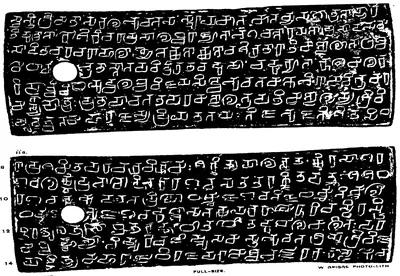
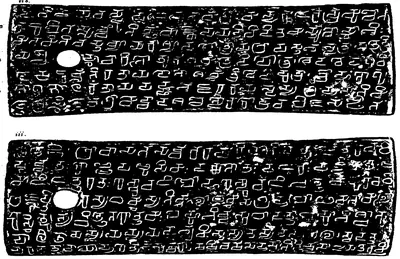
Three grants of his own had been published or reported by 1917.
- Korraparru. E. Hultzsch published this grant from Sir Walter Elliot’s collection in 1890. It gave the village of Korraparru, free of all taxes, to twenty-four Brahmins on the occasion of a lunar eclipse. Its writer was Aksharalalitacharya, who lived at Vijayavada (Vijayawada, then Bezwada).10113
- Ederu. This grant was found at Ederu in the Nuzvid estate of the Krishna district, about twenty-five years before Kielhorn re-edited it in 1899. It gave a field and a house-site in the village of Vandrupiteyu in the Kanderuvadi district to a Brahmin named Palla-bhattaraka, on the occasion of a solar eclipse. Its executor was Bolama.12613 One of its epithets says that he washed away the poverty of the needy with gold and silver placed on the balance. Kielhorn explained this as a gift of his own weight in precious metal.14
- Tandivada. It gave the village of Tandivada in the Koniru-nandu district to two Brahmins on the occasion of a solar eclipse. The writer was Aksharalikhitacharya.9
The war with the Rashtrakutas
A grant of the later king Amma I says that for twelve years, by day and by night, he fought a hundred and eight battles with the armies of the Gangas and the Rattas.315 It adds that he built the same number of temples of Shiva.315
The Pithapuram pillar inscription of 1202 puts it in verse:16
“The wise Narendra, having fought one hundred and eight battles (and) having founded, it is said, as many temples (and) tanks with gardens on (those) battle-fields, ruled (this) excellent country for forty-eight years.”16
Fleet identified the Rattas with the Rashtrakutas of Malkhed.3 He thought the Gangas might be either the Ganga feudatories (subordinate rulers) of the Rashtrakutas or the early Eastern Gangas of Kalinga.3 Hultzsch, following Fleet, took them to be Ganga feudatories of the Rashtrakutas, whose inscriptions are found in the Belgaum and Dharwar districts.15 A grant of Chalukya-Bhima I describes him as the destroyer of the party of the Southern Ganga.17
The Rashtrakuta records tell a different story. Govinda III issued his Radhanpur grant in 807–808.3 In it he claims to have summoned the lord of Vengi and made him help build, or fortify, a city.3
Fleet, writing in 1896, placed the order just before the rains of 807.18 He identified the city with Manyakheta (Malkhed), which became the Rashtrakuta capital.18 In 1901 he noted that the wording of the grant placed the walled site on or near the Tungabhadra. He wrote that it might have been only a large camp there, but he still thought it very likely that Malkhed was meant.19
Fleet also thought that Govinda III took the emblems of the Ganga and the Yamuna rivers in his wars with Vijayaditya II.18 Sewell cited a record of 802 from Mysore, which also says that the king of Vengi built the walls of a fortress for Govinda.20 He concluded that the Radhanpur episode must have happened before 802.20 Sewell also recorded that the next Rashtrakuta king, Amoghavarsha I, was at war with the Eastern Chalukyas throughout his long reign.21
Fleet concluded that “success was not entirely with the Eastern Chalukyas”.3 Hultzsch thought that each party claimed the victory over the other.22 The Godavari district gazetteer found the result unclear.4
Temples
The later records say that he founded 108 temples of Shiva called Narendresvara, after his own surname.3228 A copper-plate grant of Amma II of 958 gave villages to a temple of Umamahesvara at Vijayawada.23 The grant says that Vijayaditya Narendra-mrigaraja had built this temple.23
Another grant of Amma II, examined in 1915, names a temple at Vijayawada called Samastabhuvanasraya after his epithet.24 It also names a line of Kalamukha Shaiva teachers.24 No surviving building has been identified in these sources as one of his Narendresvara temples.
How long did he reign?
The later grants give four different lengths for his reign.
| Length | Records |
|---|---|
| 48 years | Most of the grants Fleet knew, the Pithapuram pillar inscription, and a grant of Amma II from the Nandigama taluk.5169 |
| 44 years | A grant of Amma I, published by Hultzsch.515 |
| 41 years | The Uruvuturu grant of Gunaga-Vijayaditya III.25 |
| 40 years | Two grants known to Fleet, the Guntur plates of Gunaga-Vijayaditya III and a grant of Chalukya-Bhima I.5817 |
Fleet found that 48 years could not be fitted into his chronology. It also seemed too long after three generations of long reigns. He adopted 44, suggesting that Vijayaditya had first ruled for four years as yuvaraja (crown prince). On this view, some scribes added those four years to his reign, and others wrongly subtracted them.263
In his alternative list, which counted regnal years from the beginning of the lunar year, he allowed 48.27 Hultzsch had noted in 1890 that the reign must have ended in Saka 764 (Saka is an Indian way of counting years).15 So 48, 44 or 40 years put his accession in Saka 716, 720 or 724.15
Kali-Vishnuvardhana V
Kali-Vishnuvardhana V was the son of Vijayaditya II.28 The records agree that he reigned for a year and a half, and Fleet dated the reign 843–844.28 His only grant then known, from “Ahadanakaram”, is partly in Telugu. He calls himself a paramamahesvara, and one later grant calls him “the lord of Vengi”.28
Silamahadevi was the queen of Kali-Vishnuvardhana V and the mother of Gunaga-Vijayaditya III.8 The Guntur plates call her a Rashtrakuta queen.8 See Gunaga Vijayaditya III.
Footnotes
-
Fleet, “Chronology of the Eastern Chalukya Kings” (1891), p. 12, list of the kings (archive.org (opens in a new tab)). ↩
-
Sewell and Aiyangar, Historical Inscriptions of Southern India (1932), pp. 336–337, table of the Eastern Chalukya dynasty (archive.org (opens in a new tab)). ↩
-
Fleet, “Chronology of the Eastern Chalukya Kings” (1891), p. 101 (archive.org (opens in a new tab)). ↩ ↩2 ↩3 ↩4 ↩5 ↩6 ↩7 ↩8 ↩9 ↩10 ↩11 ↩12 ↩13 ↩14
-
F. R. Hemingway, Madras District Gazetteers: Godavari (1907), p. 20 (archive.org (opens in a new tab)). ↩ ↩2
-
Fleet, “Chronology of the Eastern Chalukya Kings” (1891), p. 100 (archive.org (opens in a new tab)). ↩ ↩2 ↩3 ↩4 ↩5 ↩6 ↩7 ↩8
-
Kielhorn, “Ederu Plates of Vijayaditya II” (1899), p. 119 (archive.org (opens in a new tab)). ↩ ↩2 ↩3
-
Hultzsch, South-Indian Inscriptions, Vol. I (1890), p. 33 (archive.org (opens in a new tab)). ↩ ↩2 ↩3
-
Annual Report on Epigraphy, Southern Circle, for 1911–12 (G.O. No. 919, Public, 29 July 1912), p. 84, paragraph 62 (archive.org (opens in a new tab)). ↩ ↩2 ↩3 ↩4 ↩5 ↩6
-
Annual Report on Epigraphy, for 1916–17 (G.O. No. 1035, Home (Education), 10 August 1917), p. 117, paragraphs 23–24 (archive.org (opens in a new tab)). ↩ ↩2 ↩3 ↩4 ↩5
-
E. Hultzsch, South-Indian Inscriptions, Vol. I (1890), p. 31 (archive.org (opens in a new tab)). ↩
-
Hultzsch, South-Indian Inscriptions, Vol. I (1890), p. 35, translation (archive.org (opens in a new tab)). ↩
-
F. Kielhorn, “Six Eastern Chalukya Copper-plate Inscriptions: A. Ederu Plates of Vijayaditya II”, Epigraphia Indica V (1898–99), p. 118 (archive.org (opens in a new tab)). ↩
-
Kielhorn, “Ederu Plates of Vijayaditya II” (1899), p. 121, abstract of contents (archive.org (opens in a new tab)). ↩
-
Kielhorn, “Ederu Plates of Vijayaditya II” (1899), p. 120, text and notes (archive.org (opens in a new tab)). ↩
-
Hultzsch, South-Indian Inscriptions, Vol. I (1890), p. 37 (archive.org (opens in a new tab)). ↩ ↩2 ↩3 ↩4 ↩5 ↩6
-
E. Hultzsch, “Pithapuram Pillar Inscription of Mallapadeva”, Epigraphia Indica IV (1896–97), p. 239 (archive.org (opens in a new tab)). ↩ ↩2 ↩3
-
Annual Report on Epigraphy, for 1913–14 (G.O. No. 920, Public, 4 August 1914), p. 84, paragraph 6 (archive.org (opens in a new tab)). ↩ ↩2
-
J. F. Fleet, “Dynasties of the Kanarese Districts”, in Gazetteer of the Bombay Presidency, Vol. I, Part II (1896), p. 396 (archive.org (opens in a new tab)). ↩ ↩2 ↩3
-
J. F. Fleet, “Three Records in the Bangalore Museum”, Epigraphia Indica VI (1900–01), p. 64, note (archive.org (opens in a new tab)). ↩
-
Robert Sewell and S. Krishnaswami Aiyangar, The Historical Inscriptions of Southern India (1932), p. 33 (archive.org (opens in a new tab)). ↩ ↩2
-
Sewell and Aiyangar, Historical Inscriptions of Southern India (1932), p. 34 (archive.org (opens in a new tab)). ↩
-
Hultzsch, South-Indian Inscriptions, Vol. I (1890), p. 38 (archive.org (opens in a new tab)). ↩ ↩2
-
Sewell and Aiyangar, Historical Inscriptions of Southern India (1932), p. 49 (archive.org (opens in a new tab)). ↩ ↩2
-
Annual Report on Epigraphy, for 1914–15 (G.O. No. 1260, Public, 25 August 1915), p. 91 (archive.org (opens in a new tab)). ↩ ↩2
-
Annual Report on Epigraphy, for 1912–13 (G.O. No. 961, Public, 2 August 1913), p. 125, paragraph 64 (archive.org (opens in a new tab)). ↩
-
J. F. Fleet, “The Chronology of the Eastern Chalukya Kings”, Indian Antiquary XX (1891), p. 11 (archive.org (opens in a new tab)). ↩
-
Fleet, “Chronology of the Eastern Chalukya Kings” (1891), p. 14 (archive.org (opens in a new tab)). ↩
-
Fleet, “Chronology of the Eastern Chalukya Kings” (1891), p. 102 (archive.org (opens in a new tab)). ↩ ↩2 ↩3
Photos
Related
Dynasties

References
Notes (0)
Sources (10)
Spotted an error on this page? Tell us
Last updated: