Narasimha I (Eastern Ganga)
Eastern Ganga king of Kalinga and Orissa in the mid-13th century, son of Anangabhima. The Vizagapatam gazetteer credits him with building the central shrine, the halls and the enclosing verandah of the Simhachalam temple in black stone in 1267–68. His feudatories and ministers left records at Srikurmam. The Orissa temple chronicle remembers him as Languliya Narsinh, builder of the Sun temple at Konarak. His dates differ widely between the sources.
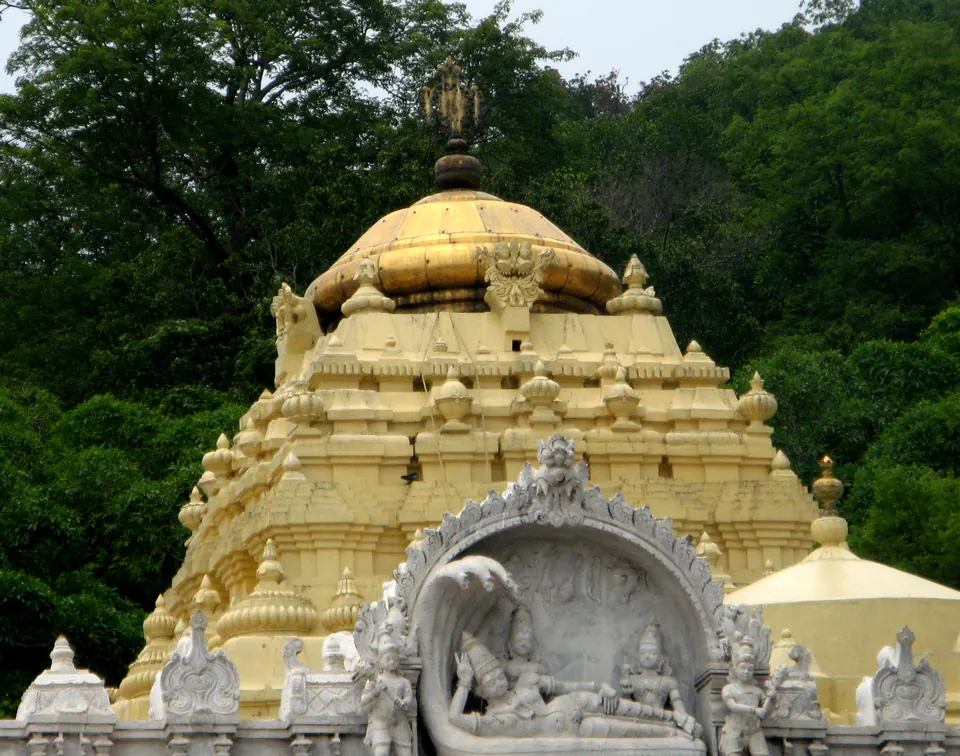
Narasimha I was an Eastern Ganga king who was reigning by Saka 1172 (1250–51; Saka is an Indian way of counting years).1 The Vizagapatam gazetteer credits him with building much of the Simhachalam temple in black stone in 1267–68.2 The temple chronicle of Puri remembers him as Languliya Narsinh, builder of the Sun temple at Konarak.3
Family
Narasimha I was the son of the Ganga king Anangabhima. A Srikurmam inscription of Saka 1172 (1250–51) records a gift of land by one of his feudatories.1 It names the king as Pratapavira-Narasimhadeva, “the son of Anangabhima of the Ganga family”.1 E. Hultzsch, summarising the Srikurmam records in 1896, wrote that “the first Narasimha was the son of Anangabhima”.4
An inscription of 1271–72 at Boni, in the Visakhapatnam (then Vizagapatam) district, is dated in the reign of his son Bhanudeva.5 It names Bhanudeva’s father as Vira-Narasimha and his grandfather as Bhima.5 Hultzsch identified the king Viranrisimha of another Srikurmam record with Narasimha I, the grandfather of Narasimha II.6
His son Bhanudeva I was the father of Narasimha II.67 Bhanudeva married Jakalladevi, “of the Chalukya race”, according to a genealogy that Hultzsch cited from the Journal of the Asiatic Society of Bengal.6 V. Rangacharya also took Narasimha II to be the son of Bhanudeva I.7
Robert Sewell’s genealogy gives Narasimha’s queen, with a query, as Sitadevi.8 It gives his daughter Chandrika as the wife of a Haihaya prince, Paramardi.8
Dates
The sources do not agree on his reign:
- Sewell’s table of 1932 dates it 1253–1256, followed by his son Bhanudeva I to 1275.8
- The Vizagapatam gazetteer of 1907 has him building at Simhachalam in 1267–68.2
- The palm-leaf chronicle of the Jagannatha temple, as W. W. Hunter printed it in 1872, gives Languliya Narsinh a reign of forty-five years, 1237–1282.3
- The inscriptions summarised by V. Rangacharya show him as king by Saka 1172 (1250–51) at Srikurmam.1
The years given for him on this site, 1250 to 1268, run only from that record to the Simhachalam building date of the gazetteer.12 See the Eastern Gangas for the general problem of the dynasty’s chronology.
Simhachalam
The gazetteer says that the Simhachalam temple contains inscriptions of several of the later Ganga kings, “but few details regarding them survive”.2 It continues, naming the mukhamandapam (front hall) and natyamandapam (dance hall): “In 1267-68 one of them, Narasimha I, built the central shrine, mukhamandapam, natyamandapam and enclosing arcade of that temple … in black stone.”2
The gazetteer describes the central enclosure as made “of dark granite richly and delicately carved with conventional and floral ornament and scenes from the Vaishnavite puranas”.9 It took this to be “doubtless the work of the Narasimha I referred to above”.9 It also gave him the hall of ninety-six black pillars on the north side of the temple.9
A Sanskrit prasasti (praise-poem) at Simhachalam of Saka 1184 (1262–63), composed by Chitsukharya, belongs to the reign of an Eastern Ganga king Narasimha.10 Rangacharya wondered whether he was Narasimha II.10 See the Simhachalam temple.
Srikurmam
At Srikurmam the Eastern Chalukya chief Vijayaditya II gave twenty-five cows for a lamp in 1273.61112 He traced his descent from Vimaladitya and Rajaraja Narendra.61112 His inscription calls his father Rajaraja “the minister of Viranrisimha”.61112 Hultzsch identified that king with the Ganga Narasimha I.61112 See the Srikurmam inscriptions of the Chalukya chiefs and the Srikurmam temple.
Wars
The gazetteer says that “Narasimha I and two of his successors are mentioned as having had to resist attacks from the Muhammadans of Bengal and Delhi”.2 In the Telugu country his reign falls in the time of the Kakatiya king Ganapatideva and his daughter Rudramadevi. P. V. Parabrahma Sastry used the Nandaluru inscription of 1257 of the Telugu Choda king Manumasiddhi II.1314
In his account, it says that Manumasiddhi crossed the Godavari and chased the king of Kalinga back into his own country.1314 He took this to refer to a Kakatiya defence against an invasion by Narasimha.1314
He identified the Narasimha named in a Draksharama record of 1262 with Narasimha I.1314 He described a gap of about sixteen years in the Kakatiya records of the Godavari region.1314 In his account, the gap ended only when Rudramadevi’s generals pushed back the Kalinga armies of Narasimha’s son Bhanudeva.1314
He also argued that a southern commander, Kopperunjinga, advanced as far as Draksharama to make contact with the king of Kalinga against Ganapati.15 See Rudramadevi and the Kakatiyas.
Konarak
Hunter’s chronicle says that Languliya Narsinh “built the great Sun Temple at Kanárak on the Sea (the Black Pagoda)”.3 The temple lies in Orissa, outside the Telugu country.
Footnotes
-
Rangacharya, Topographical List, Vol. I (1919), p. 688, Ganjam No. 185 (archive.org (opens in a new tab)). ↩ ↩2 ↩3 ↩4 ↩5
-
W. Francis, Madras District Gazetteers: Vizagapatam, Vol. I (1907), p. 28 (archive.org (opens in a new tab)). ↩ ↩2 ↩3 ↩4 ↩5 ↩6
-
W. W. Hunter, Orissa, Vol. II (1872), Appendix VII, p. 188 (archive.org (opens in a new tab)). ↩ ↩2 ↩3
-
V. Rangacharya, A Topographical List of the Inscriptions of the Madras Presidency, Vol. I (1919), p. 685, introduction to Srikurmam, quoting the Madras epigraphical report for 1896 (archive.org (opens in a new tab)). ↩
-
Rangacharya, Topographical List, Vol. III (1919), p. 1666, Vizagapatam No. 5 (archive.org (opens in a new tab)). ↩ ↩2
-
E. Hultzsch, “Four Pillar Inscriptions of Eastern Chalukya Chiefs at Srikurmam”, Epigraphia Indica V (1898–99), p. 32 (archive.org (opens in a new tab)). ↩ ↩2 ↩3 ↩4 ↩5 ↩6 ↩7
-
Rangacharya, Topographical List, Vol. III (1919), p. 1685, Vizagapatam No. 185 (archive.org (opens in a new tab)). ↩ ↩2
-
Robert Sewell, The Historical Inscriptions of Southern India (1932), p. 358, genealogical table of the Eastern Gangas (archive.org (opens in a new tab)). Paraphrased. ↩ ↩2 ↩3
-
Francis, Vizagapatam (1907), p. 325 (archive.org (opens in a new tab)). ↩ ↩2 ↩3
-
Rangacharya, Topographical List, Vol. III (1919), p. 1675, Vizagapatam No. 70 (archive.org (opens in a new tab)). ↩ ↩2
-
Hultzsch, “Four Pillar Inscriptions at Srikurmam” (1899), p. 34, translation of A, verses 7–9 (archive.org (opens in a new tab)). ↩ ↩2 ↩3 ↩4
-
Rangacharya, Topographical List, Vol. I (1919), p. 689, Ganjam No. 230 (archive.org (opens in a new tab)). ↩ ↩2 ↩3 ↩4
-
P. V. Parabrahma Sastry, The Kakatiyas of Warangal (1978), p. 112. ↩ ↩2 ↩3 ↩4 ↩5 ↩6
-
Parabrahma Sastry, The Kakatiyas of Warangal (1978), p. 120. ↩ ↩2 ↩3 ↩4 ↩5 ↩6
-
Parabrahma Sastry, The Kakatiyas of Warangal (1978), p. 115. ↩
Photos
Related
Dynasties
References
Notes (0)
Sources (7)
Spotted an error on this page? Tell us
Last updated: