Tandikonda grant of Amma II
Four surviving Sanskrit copper plates of the Eastern Chalukya king Amma II, dug up near Oruvakallu in Sattenapalle taluk about 1914–15. The finder melted down the fifth plate and the seal. The king gives Tandikonda (Tadikonda, near Guntur) and three other villages to the temple of Uma-Mahesvara at Bezwada, built by Vijayaditya II. The king's preceptor Vidyesvara composed the grant, and it sets out his spiritual line in the Kalamukha school of Pasupata Saivas. Its editor dated it to Saka 880 (958), but the journal's editor doubted his reasoning.
This is a grant by Amma II, the Eastern Chalukya king of Vengi (945–970), to a temple of Shiva at Vijayawada (then Bezwada).12 It is known mainly for its second part.12 This part traces the spiritual descent of the king’s Saiva preceptor (religious teacher), a teacher of the Kalamukha school.12
Discovery
B. V. Krishna Rao of Rajahmundry edited the plates in 1936.3 He told the story of their discovery from the letters of the missionary Isaac Cannaday.3
In the cold season of 1914–15, Cannaday was touring in the Sattenapalle taluk of Guntur district.3 At Oruvakallu he heard that a man digging for earth to build house walls had found a set of copper plates.3 The fifth plate, and perhaps the seal and ring, had been melted down.3
Cannaday got the remaining four plates and sent them early in 1916 to the Assistant Archaeological Superintendent for Epigraphy at Madras.3 There they were registered as copper plate No. 11 of 1914–15.3
Krishna Rao placed the findspot near a granite rock, nearly 260 feet high, to the west of the village.3 He added that a cave in the rock held a goddess called Ganga.3 Ruins and mounds round the rock, he wrote, suggested that a large village had stood there at one time.3
Description and language
Each plate measures about 11 by 6 inches.314 The first is inscribed on the inner side only, and the others on both sides.314 There are sixty-nine lines in all, well preserved and carefully engraved.314 The text breaks off in mid-sentence, so the writing must have continued on the lost fifth plate.314
Krishna Rao described the characters as Telugu of the 10th century, of the later cursive type.1 He noted that older forms are kept for some initial vowels.1 The language is Sanskrit, with nineteen verses besides the usual closing verses.1 The names of places in the boundaries are in Telugu.1
The grant
The grant opens with an invocation to Shiva and gives the usual family tree of the Eastern Chalukyas.1 Krishna Rao found that it matched the genealogies in Amma II’s Elavarru (Yelavarru), Padamkaluru and Maliyapundi grants.1 He found that it added nothing new about the dynasty.1
It then records that Vijayaditya Narendramrigaraja had built a temple at Vijayavatika (Vijayawada).2 J. F. Fleet’s list of the dynasty gives Narendramrigaraja as the title of Vijayaditya II.5 The temple was called Samastabhuvanasraya, and he set up in it an image of Uma-Mahesvara.2
At the winter solstice, Amma II gave this god the village of Tandikonda, in the Gudla-Kanderuvadi district.2 With it he gave three other villages: Ammalapundi, Gollapundi and Asuvulaparru.2 The four villages were made temple land (devabhoga), free of taxes.2 The income was to pay for repairs, for offerings and music, and for a feeding house (sattra).2
The boundaries are given by a stream, tanks, a tree and a heap of boulders.2 The grant names the king as donor, his preceptor Vidyesvara as composer and the Katakanayaka as executor (ajnapti).4 Robert Sewell listed the same gift under the year 958.6
The Kalamukha teachers
The second part praises the Kalamukha ascetics, a branch of the Pasupata Saivas.24 They followed the Vedas and belonged to the Simha-parishad.24 They lived at old Shiva temples such as that of Amaravatesvara at Amaravati.24
The text traces a line of teachers from Lakulisa-Pasupati, through Prabhutarasi, Bhuvanarasi, Vidyesvara and others, to Vidyesvara II and his pupil Prabhutarasi III.24 In the presence of his teacher, Prabhutarasi III built a temple and a three-storeyed monastery decorated with paintings.24 He obtained from Amma II three villages and a thousand goats for them.24
N. Lakshminarayan Rao questioned Krishna Rao’s pedigree of these teachers in a note.4 He thought that the title Kalamukhendra belonged to Prabhutarasi II and not to Pasupati II.4
Krishna Rao went on to suggest that two teachers, Vidyarasi and Taporasi, were the same as Vidyesvara and Prabhutarasi of this grant.7 Vidyarasi and Taporasi are mentioned in an inscription of the 10th-century prince Vikramakesari at Kodumbalur in the Tamil country.7 The journal’s editor called the suggestion far-fetched, since the names were not similar enough.7
Date
The grant gives no date of its own.1 Krishna Rao noticed that the other grants of Amma II give the coronation year as Saka 867 (Saka is an Indian way of counting years), in word-numerals (numbers written as words).1 This one, he noticed, seems to give Saka 880.1 He thought the scribe had confused the coronation date with the year of the grant.1 In his view the grant was made at the winter solstice of Saka 880.1
He linked this with the Mangallu grant.12 By that grant, Amma II left for Kalinga after eleven years of rule because of the Rashtrakuta Krishna III.12 Krishna Rao suggested that Krishna III had tried to put his protégé Badapa on the throne, and that Amma’s campaign ended in a great victory.12 In his reading, the Tandikonda grant asks for long life, health and prosperity for the king’s people.12 He suggested that it was made on Amma’s return.12
The article gives the Christian equivalent of Saka 880 as A.D. 968–69.2 But it also places the grant in the thirteenth year of the reign.2 Saka 880 corresponds to 958–59.2
The journal’s editor disagreed with part of this.1 In a note, he translated the phrase about the king’s people more literally.1 In his translation it is a wish for the increase of the country, progeny, life, health and prosperity.1 He concluded that it did not refer to any war and could not help to date the grant.1 See Mangallu grant and Arumbaka plates of Badapa.
The places
Krishna Rao wrote that only three of the places named could be identified: Tandikonda, Lamu and Gollapundi.7 Tandikonda was the modern Tadikonda in the Guntur taluk, about eight miles north of Guntur.7 The tanks called Chayita and Bhimasamudra, on its boundaries, still existed.7 Bhimasamudra had on its bank a large mound with extensive ruins of a Shiva temple.7 Lamu, on the southern boundary, lay two miles south of Tadikonda.7
He identified Gollapundi with a Gollapudi on the north bank of the Krishna near Vijayawada.7 He suggested that Ammalapundi might be Anamarlapudi, twelve miles south-east of Tadikonda.7
He explained Gudla-Kanderuvadi as meaning Kanderuvadi of the temples, the part of the Kanderuvadi district round Amaravati.7 He took the district Kanderuvadi to be named after an old township, Kanderu, the modern Kanteru in the Guntur taluk.7 See Tadikonda.
Footnotes
-
Krishna Rao, “Tandikonda Grant of Ammaraja II” (1936), p. 162 and note 4 by the editor (archive.org (opens in a new tab)). ↩ ↩2 ↩3 ↩4 ↩5 ↩6 ↩7 ↩8 ↩9 ↩10 ↩11 ↩12 ↩13 ↩14 ↩15 ↩16 ↩17 ↩18 ↩19 ↩20 ↩21 ↩22 ↩23 ↩24 ↩25 ↩26 ↩27 ↩28
-
Krishna Rao, “Tandikonda Grant of Ammaraja II” (1936), p. 163 (archive.org (opens in a new tab)). ↩ ↩2 ↩3 ↩4 ↩5 ↩6 ↩7 ↩8 ↩9 ↩10 ↩11 ↩12 ↩13 ↩14 ↩15 ↩16 ↩17 ↩18 ↩19 ↩20 ↩21 ↩22 ↩23 ↩24
-
B. V. Krishna Rao, “Tandikonda Grant of Ammaraja II”, Epigraphia Indica XXIII (1935–36), p. 161 and note 2 (archive.org (opens in a new tab)). ↩ ↩2 ↩3 ↩4 ↩5 ↩6 ↩7 ↩8 ↩9 ↩10 ↩11 ↩12 ↩13 ↩14
-
Krishna Rao, “Tandikonda Grant of Ammaraja II” (1936), p. 164 and note 2 by N. Lakshminarayan Rao (archive.org (opens in a new tab)). ↩ ↩2 ↩3 ↩4 ↩5 ↩6 ↩7 ↩8 ↩9 ↩10 ↩11 ↩12 ↩13
-
J. F. Fleet, “The Chronology of the Eastern Chalukya Kings”, Indian Antiquary XX (1891), p. 11 (archive.org (opens in a new tab)). ↩
-
Robert Sewell and S. Krishnaswami Aiyangar, The Historical Inscriptions of Southern India (1932), p. 49 (archive.org (opens in a new tab)). ↩
-
Krishna Rao, “Tandikonda Grant of Ammaraja II” (1936), pp. 165–166 and p. 165, note 5 by the editor (archive.org (opens in a new tab)). ↩ ↩2 ↩3 ↩4 ↩5 ↩6 ↩7 ↩8 ↩9 ↩10 ↩11 ↩12
Photos
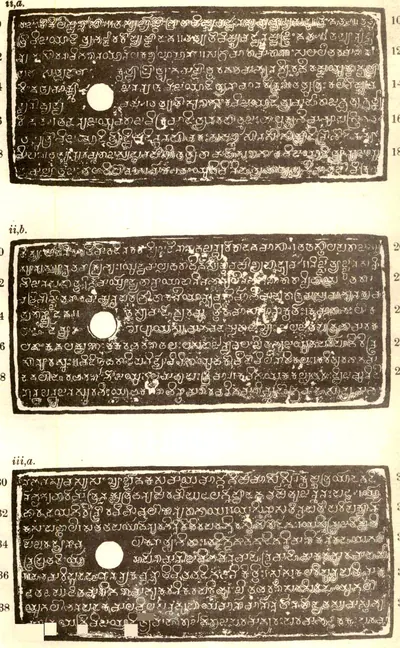 "Tandikonda Grant of Ammaraja II.", plates ii a, ii b and iii a (Epigraphia Indica XXIII, plate between pp. 168 and 169 (PDF p. 218))Inscription rubbing · 1936
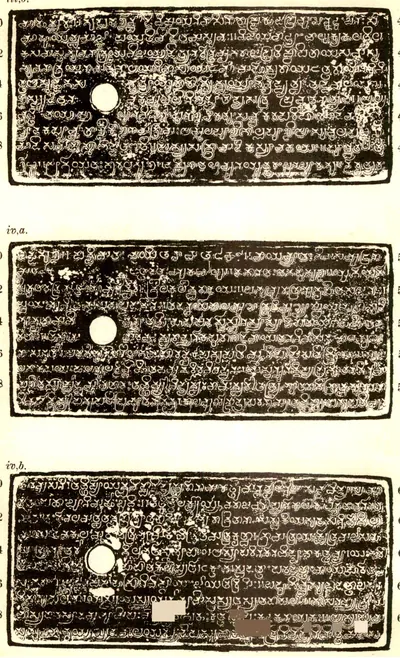 "Tandikonda Grant of Ammaraja II.", plates iii b, iv a and iv b (Epigraphia Indica XXIII, plate between pp. 168 and 169 (PDF p. 219))Inscription rubbing · 1936
References
Notes (0)
Sources (3)
Spotted an error on this page? Tell us
Last updated: