Mangallu grant of Amma II
Five Sanskrit copper plates issued in the name of the Eastern Chalukya king Amma II, dug up in the Nandigama taluk and noticed in 1917. The grant says that after eleven years of rule Amma II went to Kalinga because of the Rashtrakuta Krishna III, and that his half-brother Danarnava then ruled. At the request of Kakatya Gundyana, it gives the village of Mangallu (probably Magallu, near Nandigama) to a Brahmin. Later historians took Gundyana for an early Kakatiya. V. Rangacharya edited the grant in 1960 and disputed the 1917 reading of the key passage.
This grant is issued in the name of Amma II, the Eastern Chalukya king crowned in 945.12 It was made while his half-brother Danarnava held the kingdom.12
It is one of the main sources for the troubles of Amma II’s reign, and for the earlier civil war of 925–934.34 Historians of the Kakatiyas have also taken it as the first mention of that family.34
Discovery and description
The epigraphy report for 1916–17 records that the plates were received from the Sub-Collector of Bezwada, who had treated them as treasure trove.1 They “were dug up in the Nandigama taluk”.1 They were registered as No. 1 of Appendix A of that year.1 V. Rangacharya edited them in 1960 from ink impressions supplied by the Government Epigraphist.5
There are five plates with high rims, measuring 9⅓ by 4⅙ inches, on a ring that had not been cut.1 The 1917 report describes the seal.1 Its ring is set in an ornamental base, and its rim is shaped like a lotus creeper ending in a full-blown lotus.1
Beside the lotus is an elephant-goad.1 Above them is the legend Sri-Tribhuvanankusa in Chalukyan characters.1 Above the legend is the running boar facing left, flanked by the sun and moon and two fly-whisks.1
Rangacharya found the script to be of the usual Vengi type of the 10th century.5 The 67 lines are on the whole well preserved.5 But some passages are hard to read, because of defects in the plates, the engraver’s mistakes and erasures, and the corrupt language.5
Language and genealogy
The language is Sanskrit, in prose with a few verses, except for the boundaries, which are in Telugu.15 The 1917 report called the language “very corrupt”.15
After an opening verse to Vishnu and the usual praise of the family, the grant lists twenty-one kings from Kubja-Vishnuvardhana to Yuddhamalla II.5 Some of its lengths of reign differ from other records.5
The 1917 report noted that it gives Vijayaditya II Narendra 48 years.1 It gives Vikramaditya II, son of Chalukya-Bhima I, one year instead of eleven months.1 It also spells Gunaga as Gunakenalla, and Beta-Vijayaditya as “Beka-Vijayaditya”.1
The civil war of 925–934
The grant adds to what other records tell of the wars between the senior line and the junior line of Yuddhamalla II.1 The 1917 report summarised lines 19–21.1 After Vikramaditya II, the report says, “the feudatory Sabara chiefs, the commanders of the Vallabha (i.e., the Rashtrakuta) forces and others” took over.1 They “apportioned among themselves the (Chalukyan) territory for seven years”.1
King Bhima, the son of Vijayaditya, then ousted the usurpers.1 He did so “treating with insult Mallaparaja who had put on the crown at this juncture”, and reigned for twelve years.1 The report took this as support for a suggestion by Hultzsch.1 Hultzsch had suggested that Yuddhamalla II is left out of some grants because his conqueror, Chalukya-Bhima II, ignored him.1
Rangacharya read the same passage as saying that Mallapa, Yuddhamalla II, set himself up as king in the midst of this chaos.6 He identified the Vallabha with the Rashtrakuta Govinda IV.6
He also tried to reconcile the accounts of Beta-Vijayaditya V, the son of Amma I.36 Some records say that Beta was deposed as a child, and others that he was imprisoned.36 Yet he founded a line of later chiefs.36 Rangacharya suggested that he was made king as a child, deposed and kept a prisoner.36 In Rangacharya’s view, Beta probably died in the first twelve years of Amma II’s reign.36
Amma II and Danarnava
The next verses deal with Amma II.12 In the 1917 report’s summary, Amma II reigned for eleven years.12 He then went to the Kalinga country “in wrath against Krishna” (Krishna-kopat).12 The kingdom was then ruled “to the great joy of the people” by Danarnava.12 He was “the son of Bhima … and Ankidevi” and ruled “with the consent of his step-brother”.12
The report thought the grant was probably made in Danarnava’s reign.12 But the order was issued in the name of Vijayaditya, that is, Amma II.12
Rangacharya disagreed on three points:
- He translated Krishna-kopat as because of Krishna’s anger, not in wrath against Krishna.67 He thought that Amma was at that moment more the victim than the avenger of Krishna III’s anger, and might even have been taken prisoner.67
- He read the passage on Danarnava’s rule as saying that Danarnava obtained the country from the Vallabha, that is, Krishna III.37 In his view the 1917 report’s “with the consent of his step-brother” rested on a misreading.37 The plates say that Danarnava ruled according to the precepts of Manu.37
- He concluded that Danarnava was not a rival.7 In his view, Danarnava governed as regent for his brother and made the grant in his brother’s name.7 He did so perhaps because Krishna III held Amma captive and allowed this, for diplomacy or under pressure of arms.7
He also thought that Danarnava, though the elder, had been passed over for the boy Amma.67 His reason was that Danarnava’s mother Ankidevi was of lower rank than Amma’s mother.67 He noted that all the later records give Amma a reign of twenty-five years, ending in 970.67
Other readings of the same events are set out on the Amma II and Danarnava pages. The 1921 epigraphy report used the newly found Arumbaka plates of Badapa.8 It concluded that Krishna III had invaded at the instance of Badapa.8 It held that Danarnava held the west in Amma’s name, while Badapa held the east.8
B. V. Krishna Rao, in 1936, thought that Amma II had marched against a coalition led by Krishna III and returned victorious.9 Rangacharya noted that the same writer had earlier claimed that Krishna III died during the invasion of Vengi in 956.7 He called this a misreading of the events.7 P. V. Parabrahma Sastry argued in 1978 that Krishna III had made Danarnava king after Amma fled.10
The grant and Kakatya Gundyana
The grant gives the village of Mangallu to a Brahmin named Dommana, at the request of a feudatory chief called Kakatya Gundyana.3 It is addressed to the householders headed by the Rashtrakutas of the Natavadi district.3 It is also addressed to the councillor, priest, general and the other members of the eighteen tirthas, the officers of state.3
According to the grant, Gundyana belonged to the family of Samanta Voddi.32 His grandfather, Gundiya-rashtrakuta, a descendant of Samanta Voddi, had done great service to a Chalukya king.32 Gundiya’s son Erija-rashtrakuta was a skilled horseman.32 Gundyana was Erija’s son by Vandyanamba.32
Dommana, of the Kutsa gotra (clan), was the grandson of Chiddamayya of the village of Velaparru, and the son of Sridhara and Machemamba.32 He had kept the karpati vow, of early bathing, continence, truthfulness and other observances, for Gundyana’s merit and favour.32 In return he received the village as a tax-free agrahara (village granted to Brahmins).32
The 1917 report gives the occasion as the summer solstice.2 Rangacharya gives it as the uttarayana of an unspecified year.3 Hultzsch translated this term in the Vemalurpadu plates as the winter solstice.11
The report names the executor (ajnapti) as Katakaraja and the composer as Potana-bhatta.2 Parabrahma Sastry took Kakatya Gundyana to be the earliest member of the Kakatiya family to appear in the records.4 He dated the grant to about 956.4
The village
The 1917 report identified Mangallu with one of two villages in the Nandigama taluk of the Krishna (then Kistna) district, Mangollu or Magallu.2 Rangacharya repeated this, and identified Konduru, the northern boundary, with the village of that name in the same taluk.7 He described the Nandigama area as the heart of the Natavadi country, through which the road from the coast to Hyderabad passed.7
The journal’s editor added a note.7 In his view, the river Munna, said to lie south-west of the village granted, must be the Munneru.7 So the village was Magallu, which lies close to the river on its east, and not Mangollu, about ten miles west of it.7 See Magallu.
Numbering of the kings
Rangacharya numbered some kings differently from J. F. Fleet and E. Hultzsch, whose numbering this site follows.53 He calls Amma II also Vijayaditya VI.53 The Bhima who reigned for eight months in 926–927 is Bhima III here, but Bhima II in his edition.53 The Chalukya-Bhima who reigned 934–945 is Chalukya-Bhima II here, but Chalukya-Bhima III in his edition.53
Footnotes
-
Annual Report on Epigraphy, Madras, for 1916–17 (G.O. No. 1035, Home (Education), 10 August 1917), Part II, para. 24, p. 117 (archive.org (opens in a new tab)). ↩ ↩2 ↩3 ↩4 ↩5 ↩6 ↩7 ↩8 ↩9 ↩10 ↩11 ↩12 ↩13 ↩14 ↩15 ↩16 ↩17 ↩18 ↩19 ↩20 ↩21 ↩22 ↩23 ↩24 ↩25 ↩26 ↩27 ↩28 ↩29 ↩30 ↩31
-
Annual Report on Epigraphy, Madras, for 1916–17 (1917), Part II, para. 24, p. 118 (archive.org (opens in a new tab)). ↩ ↩2 ↩3 ↩4 ↩5 ↩6 ↩7 ↩8 ↩9 ↩10 ↩11 ↩12 ↩13 ↩14 ↩15 ↩16 ↩17 ↩18 ↩19
-
Rangacharya, “Mangallu Grant of Amma II” (1960), p. 38 (archive.org (opens in a new tab)). ↩ ↩2 ↩3 ↩4 ↩5 ↩6 ↩7 ↩8 ↩9 ↩10 ↩11 ↩12 ↩13 ↩14 ↩15 ↩16 ↩17 ↩18 ↩19 ↩20 ↩21 ↩22 ↩23 ↩24 ↩25
-
P. V. Parabrahma Sastry, The Kakatiyas of Warangal (1978), p. 14. ↩ ↩2 ↩3 ↩4
-
V. Rangacharya, “Mangallu Grant of Amma II”, Epigraphia Indica XXXI (1955–56, publ. 1960), p. 37 (archive.org (opens in a new tab)). ↩ ↩2 ↩3 ↩4 ↩5 ↩6 ↩7 ↩8 ↩9 ↩10 ↩11 ↩12
-
Rangacharya, “Mangallu Grant of Amma II” (1960), p. 39 and note 6 (archive.org (opens in a new tab)). ↩ ↩2 ↩3 ↩4 ↩5 ↩6 ↩7 ↩8 ↩9 ↩10 ↩11 ↩12
-
Rangacharya, “Mangallu Grant of Amma II” (1960), p. 40 and notes 2–4 (archive.org (opens in a new tab)). ↩ ↩2 ↩3 ↩4 ↩5 ↩6 ↩7 ↩8 ↩9 ↩10 ↩11 ↩12 ↩13 ↩14 ↩15 ↩16 ↩17 ↩18
-
Annual Report on Epigraphy, Madras, for 1920–21 (1921), Part II, para. 14, p. 91 (archive.org (opens in a new tab)). ↩ ↩2 ↩3
-
B. V. Krishna Rao, “Tandikonda Grant of Ammaraja II”, Epigraphia Indica XXIII (1935–36), p. 162 (archive.org (opens in a new tab)). ↩
-
Parabrahma Sastry, The Kakatiyas of Warangal (1978), p. 15. ↩
-
E. Hultzsch, “Vemalurpadu Plates of Ammaraja II”, Epigraphia Indica XVIII (1925–26), p. 234, translation (archive.org (opens in a new tab)). ↩
Photos
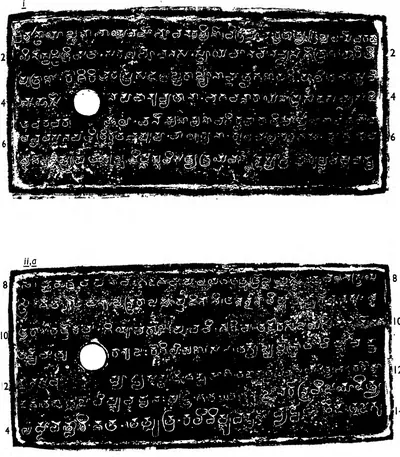 "Mangallu Grant of Amma II", plates i and ii a (Epigraphia Indica XXXI, Plate I (PDF p. 76))Inscription rubbing · 1960
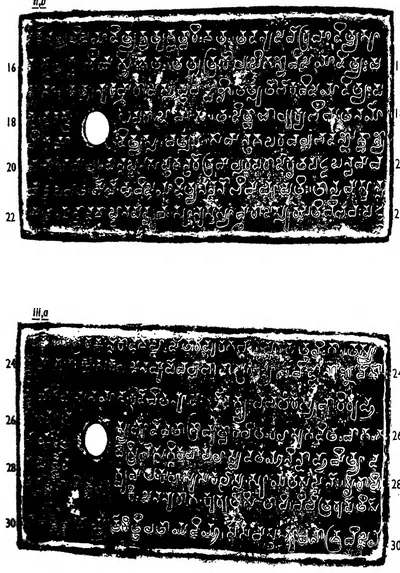 "Mangallu Grant of Amma II", plates ii b and iii a (Epigraphia Indica XXXI, Plate I (PDF p. 77))Inscription rubbing · 1960
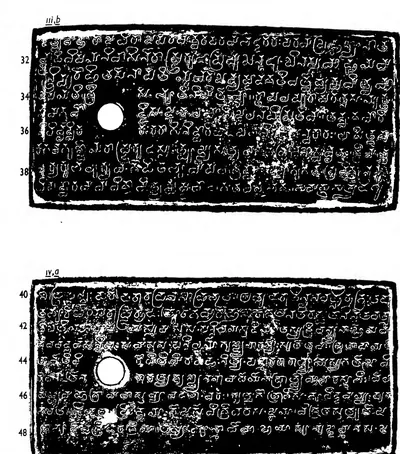 "Mangallu Grant of Amma II", plates iii b and iv a (Epigraphia Indica XXXI, Plate II (PDF p. 80))Inscription rubbing · 1960
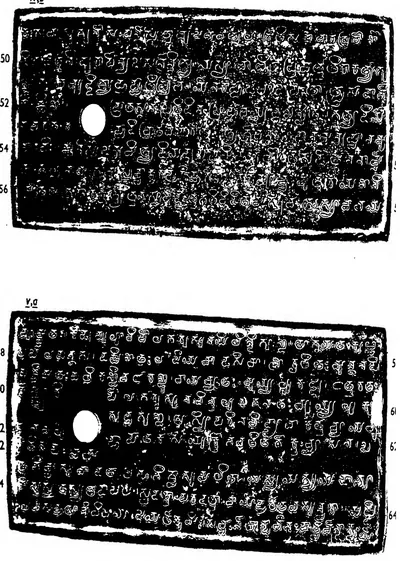 "Mangallu Grant of Amma II", plates iv b and v a (Epigraphia Indica XXXI, Plate II (PDF p. 81))Inscription rubbing · 1960
References
Notes (0)
Sources (6)
Spotted an error on this page? Tell us
Last updated: