Aihole inscription of Pulakesin II
A Sanskrit poem of 37 verses by the Jaina poet Ravikirti, engraved in 634–35 on the Meguti temple at Aihole in Karnataka. It is the main account of the conquests of the Chalukya king Pulakesin II, including his eastern campaign. There he humbled the Kalingas and Kosalas, took Pishtapura (Pithapuram), and ravaged 'the water of Kunala', which Kielhorn identified with the Kolleru lake. He also defeated the Pallava king before Kanchi.
The Aihole inscription is a court poem in praise of the Chalukya king Pulakesin II of Badami. Its verses on his eastern campaign are the earliest account of the Chalukya conquest of the Telugu coast.12 This conquest led to the founding of the Eastern Chalukya kingdom of Vengi.12
The stone and its editions
The inscription is on the east side wall of an old temple called Meguti at Aihole, in the Hungund taluka of the Bijapur district. J. F. Fleet first edited it, with a photo-lithograph, in the Indian Antiquary (Vol. V), and later gave a revised text and translation. F. Kielhorn re-edited it in Epigraphia Indica VI (1901) from an estampage (inked copy) supplied by Fleet.3
Kielhorn called Fleet’s new photo-lithograph “the first true facsimile of this record”.3 There are 19 lines of writing. Nearly all of line 18 and the short line 19 are a later addition.34 They list villages whose revenues were apparently assigned to the temple.34
The text is entirely in verse, 37 verses in many metres.5 The poet Ravikirti says that he built the stone temple of Jinendra (the Jina) and wrote the praise poem.5 He claims the fame of Kalidasa and Bharavi.6 Kielhorn thought the claim overstated, but placed Ravikirti “in the very front rank of court-poets”.674 He showed that Ravikirti modelled his account of the king’s conquests on Raghu’s conquest of the four directions in Kalidasa’s Raghuvamsa.674
Date
Verses 33 and 34 date the temple to 3,735 years after the Bharata war and 556 years of the Saka kings.6 Kielhorn equated this with 634–35.6 Fleet pointed out that it is one of the very few inscriptions dated in the Kali era.648
The eastern campaign
In Kielhorn’s translation, verses 26 to 29 read:1
(V. 26.) Through the excellencies of their householders prominent in the pursuit of the three objects of life, and having broken the pride of other rulers of the earth, the Kalingas with the Kosalas by His army were made to evince signs of fear.
(V. 27.) Hard pressed (pishta) by Him, Pishtapura became a fortress not difficult of access; wonderful (to relate) the ways of the Kali age to Him were quite inaccessible!
(V. 28.) Ravaged by Him, the water of Kunala — coloured with the blood of men killed with many weapons, and the land within it overspread with arrays of accoutred elephants — was like the cloud-covered sky in which the red evening-twilight has risen.
Verse 29 then describes how he caused the splendour of the lord of the Pallavas “to be obscured by the dust of his army, and to vanish behind the walls of Kanchipura”.1 Verses 30 and 31 take him across the Kaveri, where he “caused great prosperity to the Cholas, Keralas and Pandyas”.1
Pishtapura and Kunala
Kielhorn argued that the poem follows the king’s march from north to south down the east coast.56 So its places follow each other “in regular succession”.56 Pishtapura is the modern Pithapuram in the Godavari district.56 In his opinion “the water of Kunala” could only be “the well-known Kolleru lake”, south of Pithapuram between the Godavari and the Krishna.56
Kielhorn noted that other inscriptions mention a fortified island in that lake.56 He connected Kunala with Kolanu, “a Telugu word meaning ‘lake’”.56 He also had “no doubt whatever” that the Kaunala of the poem was the Kaunalaka of Samudragupta’s Allahabad inscription.6 There it is named just before Paishtapuraka.6
Fleet placed Pittapuram about twelve miles north by east of Kakinada (then Cocanada).2 He named the Pallava king of verse 29 as Mahendravarman I.2 Robert Sewell summarised the same passage as the occupation of “the Koler Lake country near Ellore”.9 See Pithapuram.
Footnotes
-
Kielhorn, “Aihole Inscription” (1901), p. 11, verses 26–31 (archive.org (opens in a new tab)). ↩ ↩2 ↩3 ↩4 ↩5
-
J. F. Fleet, “Dynasties of the Kanarese Districts”, Gazetteer of the Bombay Presidency I, pt. II (1896), p. 350 (archive.org (opens in a new tab)). ↩ ↩2 ↩3 ↩4
-
F. Kielhorn, “Aihole Inscription of Pulikesin II”, Epigraphia Indica VI (1901), p. 1 (archive.org (opens in a new tab)). ↩ ↩2 ↩3 ↩4
-
Kielhorn, “Aihole Inscription” (1901), p. 12, verses 33–37 and note 3 (archive.org (opens in a new tab)). ↩ ↩2 ↩3 ↩4 ↩5
-
Kielhorn, “Aihole Inscription” (1901), p. 2 (archive.org (opens in a new tab)). ↩ ↩2 ↩3 ↩4 ↩5 ↩6 ↩7 ↩8
-
Kielhorn, “Aihole Inscription” (1901), p. 3 (archive.org (opens in a new tab)). ↩ ↩2 ↩3 ↩4 ↩5 ↩6 ↩7 ↩8 ↩9 ↩10 ↩11 ↩12 ↩13 ↩14
-
Kielhorn, “Aihole Inscription” (1901), p. 4 (archive.org (opens in a new tab)). ↩ ↩2
-
Fleet, “Dynasties of the Kanarese Districts” (1896), p. 357 (archive.org (opens in a new tab)). ↩
-
Robert Sewell, The Historical Inscriptions of Southern India (1932), p. 23 (archive.org (opens in a new tab)). Paraphrased, except for the short phrase quoted. ↩
Photos
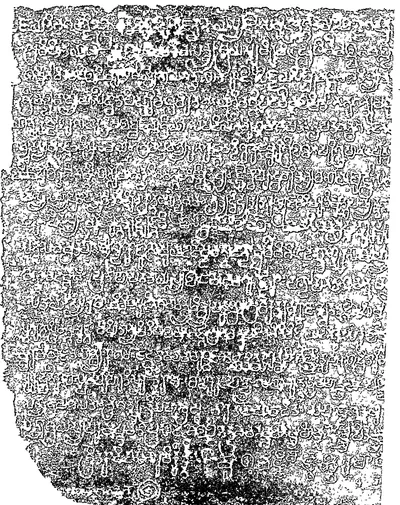 "Aihole Inscription of Pulikesin II.—A.D. 634-35", left part, lines 1-19 (Epigraphia Indica VI, plate between pp. 6 and 7, first page (PDF p. 18 of the archive.org scan in.ernet.dli.2015.56212))Inscription rubbing · 1901
 "Aihole Inscription of Pulikesin II.—A.D. 634-35", middle part (Epigraphia Indica VI, plate between pp. 6 and 7, second page (PDF p. 19 of scan in.ernet.dli.2015.56212))Inscription rubbing · 1901
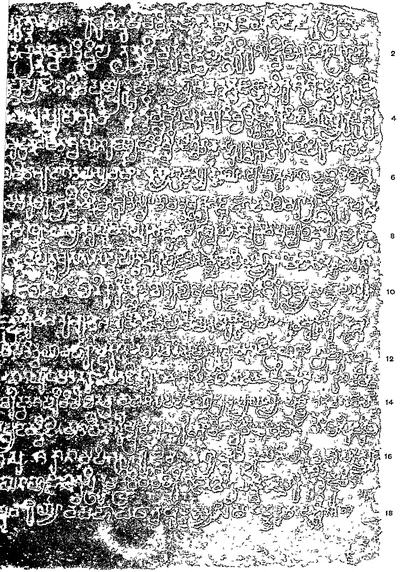 "Aihole Inscription of Pulikesin II.—A.D. 634-35", right part, lines 1-19 (Epigraphia Indica VI, plate between pp. 6 and 7, third page (PDF p. 20 of scan in.ernet.dli.2015.56212))Inscription rubbing · 1901
References
Notes (0)
Sources (3)
Spotted an error on this page? Tell us
Last updated: