Vemalurpadu plates of Amma II
Five undated Sanskrit copper plates of the Eastern Chalukya king Amma II (945–970). The Madras Museum got them in 1910 from a resident of Vemalurpadu, near Phirangipuram in Guntur district. At the request of Durgaraja, great-grandson of Gunaga Vijayaditya III's general Pandaranga, the king gives two fields in the Karma-rashtra district as an agrahara (Brahmin village) to Durgaraja's minister Musiya. E. Hultzsch, who edited them in 1926, found the writer's Sanskrit full of mistakes. The grant adds that Amma II was made heir-apparent at eight and crowned at twelve.
These plates record a gift of land by Amma II, the Eastern Chalukya king crowned in 945.1 The gift was made at the request of a feudatory (subordinate ruler), Durgaraja, for one of his own officers.2 Durgaraja and his great-grandfather Pandaranga, the general of Gunaga Vijayaditya III, are both known from other inscriptions.12
Discovery and description
According to E. Hultzsch, H. Krishna Sastri got the plates for the Madras Museum in 1910 from a Muslim resident of Vemalurpadu.31 Vemalurpadu is a village close to the Phirangipuram railway station in Guntur district.1 Krishna Sastri supplied the ink impressions from which Hultzsch edited them in 1926.3 See Vemuluripadu.
Krishna Sastri’s description is quoted in the edition.1 It gives five plates with raised rims, the first and last written on the inner side only.1 A copper ring 5⅝ inches across holds them together.1 The ring’s ends are fixed in the bottom of a round seal, 3⅝ inches across, whose base is a lotus of eight petals.1
The seal shows a running boar facing left with a fly-whisk (chauri) in front of it.1 Below the boar is the legend Sri-Tribhuvanankusa in old Telugu characters.1 Below the legend is a spread lotus, with the sun and an elephant-goad to the right and the crescent moon to the left.1 The ring had not been cut when the plates came from the Collector of Guntur.1 Plates and seal together weighed 410 tolas.1
Script and language
The writing is well preserved except for parts of the fourth plate.1 The alphabet is Telugu, and the language is Sanskrit prose with 19½ Sanskrit verses.1 The boundaries of the two fields granted are in a mixture of Sanskrit and Telugu.1
Hultzsch thought the writer had only a “very superficial knowledge” of Sanskrit.1 In his view the writer made “an inordinate number of mistakes and omissions” in copying the historical introduction from his office records.1 Verses 9 to 15 were apparently composed by a Brahmin named Bhattagunda.1 Hultzsch judged that they did “not reflect much credit on this panegyrist as a grammarian and poet”.1
The king and his ancestors
The historical introduction is nearly the same as that of the Maliyapundi grant, which Hultzsch had discussed before.1 He noted a corrupt verse that leaves it doubtful whether the reign of Vijayaditya II Narendramrigaraja was given as 48 or 40 years.1 J. F. Fleet had discussed the same disagreement between the grants.14
A verse calls Amma II the son of Bhima II and the grandson of Bhima I.15 It calls him the great-grandson of Vikramanka (Vikramaditya I), who held the rank of heir-apparent but never reigned.15 Hultzsch pointed out that the poet had left out a generation, Vijayaditya IV.15 Amma II was really the great-grandson of Bhima I.15 The same verse refers to an attack on Bhima I by Vallabha, whom Hultzsch took for the Rashtrakuta king Krishna II.15
Verse 13 says that Amma II was anointed heir-apparent at the age of eight and crowned at twelve.16 Hultzsch noted that other grants give the exact date of the coronation, Friday, 5 December 945, in the twelfth year of the king’s age.1 Fleet had worked out the same date in 1891.7 The grant does not say in which year of the reign it was made.1
The grant
At the winter solstice (uttarayana), the king gave an agrahara (village granted to Brahmins) to a Brahmin named Musiya, or Musiyana-sarman.26 Musiya was of the Bharadvaja gotra (clan) and the family of Krovi, and lived at Karamchedu.26 His father bore the honorary title Maharaja, and his grandfather was named Gundamayya.26
The gift was made at the request of Durgaraja, the great-grandson of Pandaranga.26 In Hultzsch’s translation, the king, “pleased with this devoted servant”, replied: “I shall gladly grant an agrahara to your minister”.26 Hultzsch concluded that Musiya was Durgaraja’s minister.26
The order is addressed to “all the ryots, headed by the Rashtrakutas”, of the Karma-rashtra province.6 The gift was two fields, each needing ten kharis of kodrava millet as seed.6 One was cut off on the south side of the village of Anmananguru, and the other on the north side of the village of Andeki.6 Together they were given as two villages named Tumiyaveniyapundi.6 Hultzsch thought this might be the new name of the two fields.6
The agrahara had these boundaries:8
The field boundaries name trees, ponds, salt marshes and the river Gunteru.8 The executor (ajnapti) was “the famous chief of the camp”, whom Hultzsch took to be Durgaraja himself.28 The composer, Bhattagunda of Vangiparru, received two shares of the grant.28
Durgaraja
Hultzsch thought Durgaraja was the royal superintendent of the district (raja-vishay-adhyaksha), or the feudatory chief of Karma-rashtra.2 He had already traced the family in the Maliyapundi grant.910 There Durgaraja appears as the founder of a Jain temple and a descendant of Pandaranga.910 In the same grant Hultzsch found the title “superintendent of the royal camp” (kataka-raja) held by three generations of Pandaranga’s descendants.910
The places
Hultzsch placed Karma-rashtra in parts of the Ongole taluk of Nellore district.2 He noted that other grants put Chendalur in this district, and also Dharmapuram and Kalvakuru in the Addanki division of Ongole taluk.2 He suggested that Andeki might be an old form of the name of Addanki itself.2 He could not trace the four boundary villages without local maps.2
On the Madras Survey map of 1892, Hultzsch found Karanchedu 10 miles west by south of Bapatla.2 He suggested that Vangiparru might be Vangipuram in the Bapatla taluk.2 Both villages appear, as Karanchedu and Vangiparru, in a grant of Vijayaditya II.2
Footnotes
-
Hultzsch, “Vemalurpadu Plates of Ammaraja II” (1926), p. 227 (archive.org (opens in a new tab)). ↩ ↩2 ↩3 ↩4 ↩5 ↩6 ↩7 ↩8 ↩9 ↩10 ↩11 ↩12 ↩13 ↩14 ↩15 ↩16 ↩17 ↩18 ↩19 ↩20 ↩21 ↩22 ↩23 ↩24 ↩25 ↩26 ↩27 ↩28 ↩29 ↩30 ↩31
-
Hultzsch, “Vemalurpadu Plates of Ammaraja II” (1926), p. 228 (archive.org (opens in a new tab)). ↩ ↩2 ↩3 ↩4 ↩5 ↩6 ↩7 ↩8 ↩9 ↩10 ↩11 ↩12 ↩13 ↩14 ↩15 ↩16 ↩17 ↩18
-
E. Hultzsch, “Vemalurpadu Plates of Ammaraja II”, Epigraphia Indica XVIII (1925–26), p. 226 and note 2 (archive.org (opens in a new tab)). ↩ ↩2
-
J. F. Fleet, “The Chronology of the Eastern Chalukya Kings”, Indian Antiquary XX (1891), p. 100 (archive.org (opens in a new tab)). ↩
-
Hultzsch, “Vemalurpadu Plates of Ammaraja II” (1926), p. 233, translation and notes 14–17 (archive.org (opens in a new tab)). ↩ ↩2 ↩3 ↩4 ↩5
-
Hultzsch, “Vemalurpadu Plates of Ammaraja II” (1926), p. 234, translation (archive.org (opens in a new tab)). ↩ ↩2 ↩3 ↩4 ↩5 ↩6 ↩7 ↩8 ↩9 ↩10 ↩11 ↩12
-
Fleet, “The Chronology of the Eastern Chalukya Kings” (1891), p. 271 (archive.org (opens in a new tab)). ↩
-
Hultzsch, “Vemalurpadu Plates of Ammaraja II” (1926), p. 235, translation (archive.org (opens in a new tab)). ↩ ↩2 ↩3 ↩4 ↩5 ↩6 ↩7 ↩8
-
E. Hultzsch, “Maliyapundi Grant of Ammaraja II”, Epigraphia Indica IX (1907–08), p. 49 (archive.org (opens in a new tab)). ↩ ↩2 ↩3
-
Hultzsch, “Maliyapundi Grant of Ammaraja II” (1908), p. 50 (archive.org (opens in a new tab)). ↩ ↩2 ↩3
Photos
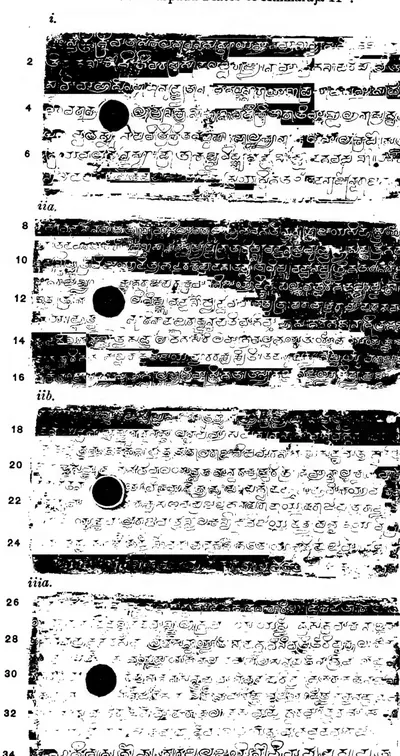 "Vemalurpadu Plates of Ammaraja II", plates i, ii a, ii b and iii a (Epigraphia Indica XVIII, plate between pp. 230 and 231 (PDF p. 292))Inscription rubbing · 1926
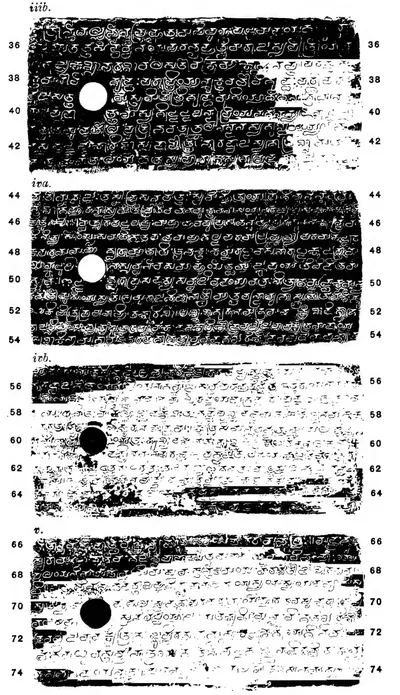 "Vemalurpadu Plates of Ammaraja II", plates iii b, iv a, iv b and v (Epigraphia Indica XVIII, plate between pp. 230 and 231 (PDF p. 293))Inscription rubbing · 1926
References
Notes (0)
Sources (3)
Spotted an error on this page? Tell us
Last updated: