Venkatesvara temple, Tirumala
Temple of Venkatesvara (Srinivasa-Perumal) on the Tirumala hill above Tirupati. Its walls carry inscriptions of Krishnadeva Raya of 1514 and of his queens of 1512–13. It keeps copper statues of the king and his queens Chinnadevi and Tirumaladevi, which the Telugu Rayavachakamu says he set up before the god, and a labelled copper statue of Venkatapati. Fergusson's revisers thought the temple itself 'a fair specimen of a Dravidian temple of the second class'.
The hill temple of Tirupati was closed to Europeans in the nineteenth century.1 So the North Arcot manual of 1894 described only the town around it.1 The most notable building there was “the thousand-pillared mantapam on the skirts of the town”.1 The manual judged it “of much later date than the temple, as the workmanship is of a higher order”.1
James Fergusson’s revisers of 1910 reported an account of the temple,23 written by J. D. B. Gribble, who entered it with a party in 1870.23 Gribble found that the temple “is neither remarkable for its size nor its magnificence”.23 He wrote: “whatever may be done with its immense revenues, they certainly are not applied to its adornment”.23 He called it “a fair specimen of a Dravidian temple of the second class, but in a sad state of dilapidation and disrepair”.23 “It was originally a Saiva temple, but was converted to the worship of Vishnu, by Ramanujacharya, in the 12th century.”23
Krishnadeva Raya’s gifts and statues
V. Rangacharya listed the temple’s Vijayanagara inscriptions in 1919.45 They include:45
- four records of Krishnadeva Raya of Saka 1436 (1514; Saka is an Indian way of counting years) on the second enclosure, in Telugu, Kannada and Tamil, one of which mentions his attack on Prataparudra Gajapati4
- two Telugu records of 1512–13 on the first enclosure, recording gifts by his queens Chimnaji Amma and Tirumalamma5
See the Tirumala inscriptions.
S. Krishnaswami Aiyangar summarised the Telugu chronicle Rayavachakamu.6 It says that at Tirupati the king performed the sixteen great gifts and presented jewels and gold to the god.6 He also had copper statues cast of himself and his two queens, Tirumala Devi and Chinna Devi.6 He “set them before the god of the place that they may signify his constant worship”.6
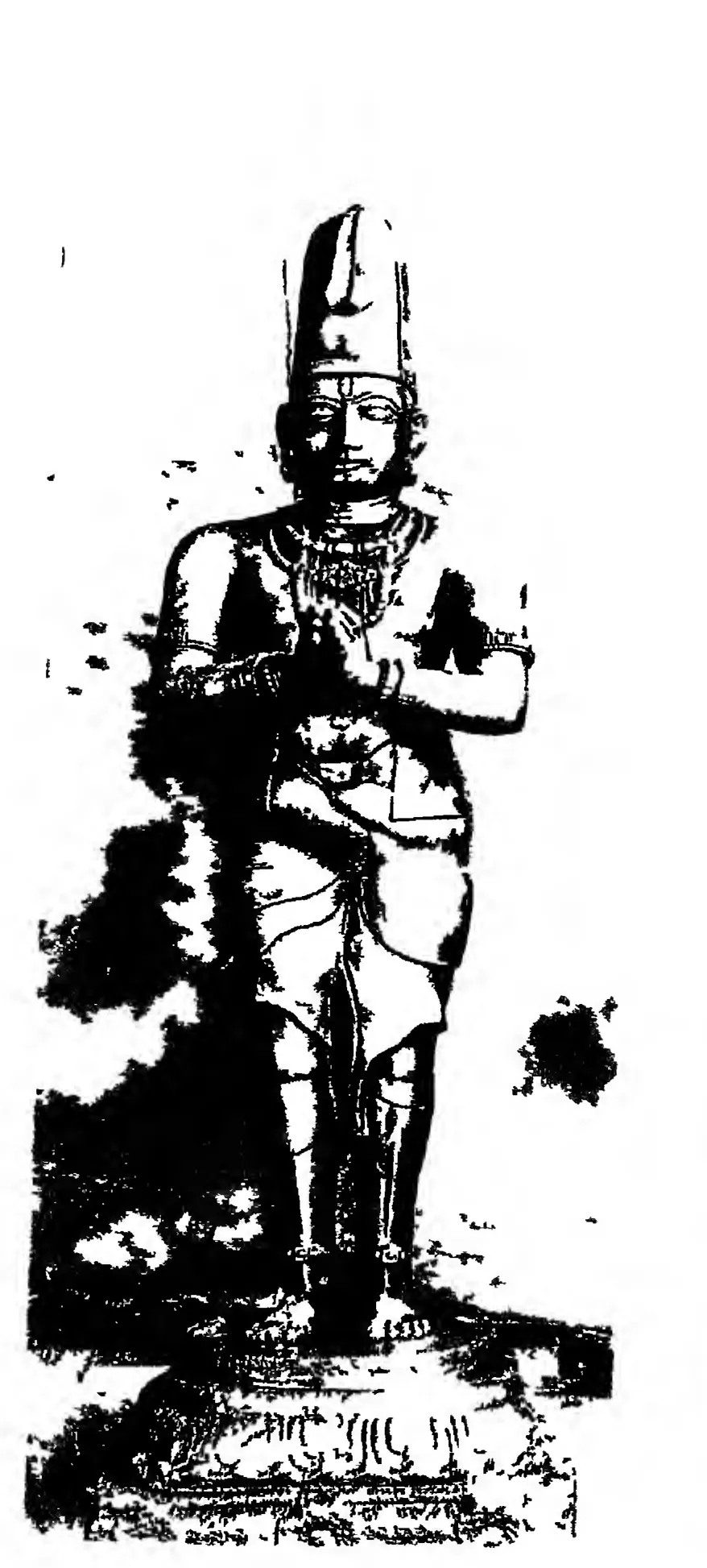
H. Krishna Sastri published a photograph of the statues in 1915.7 “The central figure represents the great Krishnaraya of the second Vijayanagara dynasty; to his right is his queen Chinnadevi and to his left, queen Tirumaladevi.”7 Beside them stood “a copper statue of Venkatapatiraya … labelled in clear Telugu characters of that period”, on the right side of the entrance into the temple.7 There were also two unlabelled stone images of a king and queen, which he thought might be Tirumala and Vengalamba.7
A. H. Longhurst’s guide to Hampi reproduced the photograph as “Metal images of Krishna Raya and his two queens, Tirupati Temple”.8 See Krishnadeva Raya, Venkatapati II and Tirumala.
Neither the chronicle nor the inscriptions summarised by Rangacharya date the casting of the statues.9 Rangacharya refers to the Epigraphist’s report for 1904 for a description of them.9 A Tamil record of 1531 on the central shrine “refers also to an earlier grant by Krishnaraya-Maharaya”.9
Footnotes
-
Arthur F. Cox, rev. Harold A. Stuart, Madras District Manuals: North Arcot, Vol. II (1894), p. 331 (archive.org (opens in a new tab)). ↩ ↩2 ↩3 ↩4
-
James Fergusson, History of Indian and Eastern Architecture, Vol. I, revised by James Burgess (1910), p. 404, note 2 (archive.org (opens in a new tab)). ↩ ↩2 ↩3 ↩4 ↩5 ↩6
-
Fergusson, Indian and Eastern Architecture, Vol. I (1910), p. 407, note continued (archive.org (opens in a new tab)). ↩ ↩2 ↩3 ↩4 ↩5 ↩6
-
V. Rangacharya, A Topographical List of the Inscriptions of the Madras Presidency, Vol. I (1919), p. 472, Chittoor Nos. 9-A to 9-D (archive.org (opens in a new tab)). ↩ ↩2 ↩3
-
Rangacharya, Topographical List, Vol. I (1919), p. 473, Chittoor Nos. 9-M and 9-N (archive.org (opens in a new tab)). ↩ ↩2 ↩3
-
S. Krishnaswami Aiyangar (ed.), Sources of Vijayanagar History (1919), p. 117, extract from the Rayavachakamu (archive.org (opens in a new tab)). ↩ ↩2 ↩3 ↩4
-
H. Krishna Sastri, “The Third Vijayanagara Dynasty; its Viceroys and Ministers”, Archaeological Survey of India, Annual Report 1911–12 (1915), p. 189 and note 3 (archive.org (opens in a new tab)). ↩ ↩2 ↩3 ↩4
-
A. H. Longhurst, Hampi Ruins Described and Illustrated, 3rd ed. (1933), fig. 14 (archive.org (opens in a new tab)). ↩
-
Rangacharya, Topographical List, Vol. I (1919), p. 475, Chittoor No. 20 (archive.org (opens in a new tab)). ↩ ↩2 ↩3
Photos
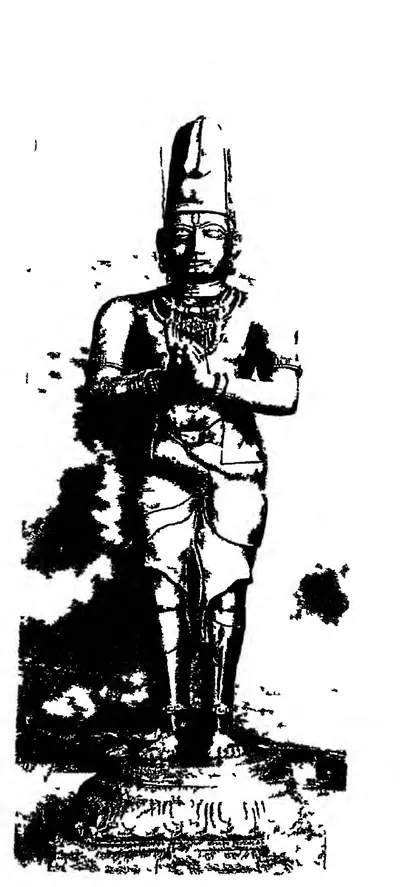 "A king, perhaps Tirumala", unlabelled stone image in the Tirumala temple (ASI Annual Report 1911-12, plate LXXVI, fig. 5 (PDF p. 354))Historic photograph · 1915
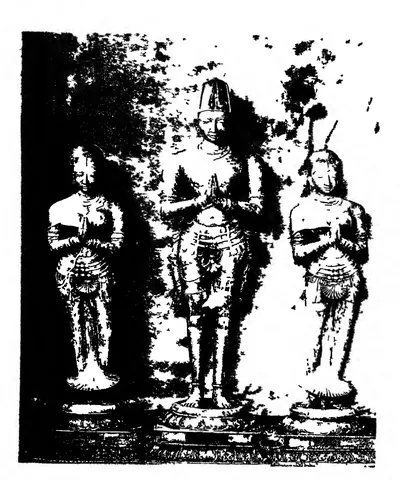 "Chinnadevi", "Krishnaraya-Maharaya" and "Tirumaladevi", copper statues in the Tirumala temple (ASI Annual Report 1911-12, plate LXXVI, figs. 1-3 (PDF p. 354))Historic photograph · 1915
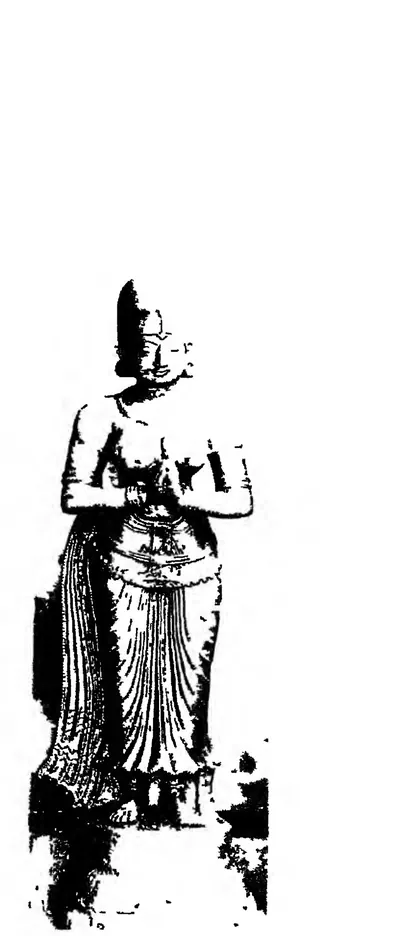 "His queen, perhaps Vengalamba", unlabelled stone image in the Tirumala temple (ASI Annual Report 1911-12, plate LXXVI, fig. 6 (PDF p. 354))Historic photograph · 1915
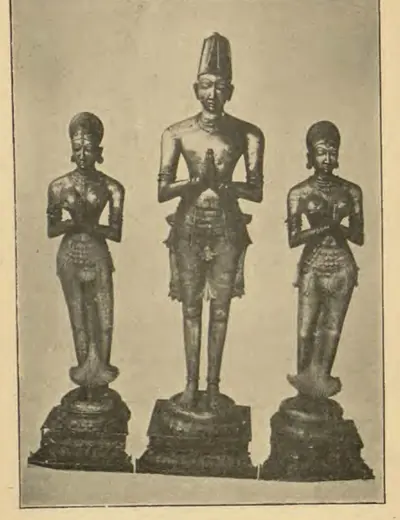 "Metal images of Krishna Raya and his two queens, Tirupati Temple, Chittoor District" (Longhurst, Hampi Ruins, 3rd ed. 1933, fig. 14, p. 42 (PDF p. 56))Historic photograph · 1933
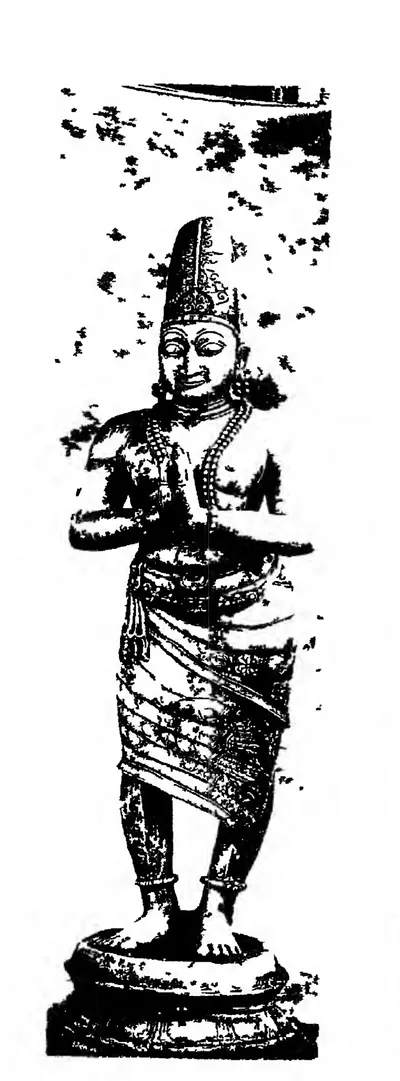 "Venkatapatiraya", labelled copper statue at the entrance of the Tirumala temple (ASI Annual Report 1911-12, plate LXXVI, fig. 4 (PDF p. 354))Historic photograph · 1915
Related
Inscriptions
References
Notes (0)
Sources (6)
Spotted an error on this page? Tell us
Last updated: