Ali Adil Shah II
Eighth Adil Shahi sultan of Bijapur (r. 1656–1672). Aurangzeb invaded the kingdom when he came to the throne, claiming that he was not Muhammad Adil Shah's son. His reign saw the rise of Shivaji and the rebellion of Siddi Jauhar, the Abyssinian governor of Kurnool. Royal campaigns brought the Kurnool province and the Raichur country back under control, before the Mughal treaties of 1666–68 cut down the kingdom.
Ali succeeded Muhammad Adil Shah in November 1656.1 According to Jadunath Sarkar, he was “a youth of 18 years, and the only son of the late king”.1 He was crowned through the efforts of the minister Khan Muhammad and the queen Bari Sahiba.1 Sarkar says that he died on 24 November 1672.2 See the Adil Shahis of Bijapur.
A disputed birth
The emperor’s son Aurangzeb was then viceroy (governor) of the Deccan.1 He at once urged an invasion “on the plea that Ali was not really a son of the deceased”.1
Sarkar sets out the two versions.3 According to him, the Mughals declared Ali to be “a stranger of unknown origin whom the late Sultan had brought up like a son”.3 The Bijapur side said that Ali was born to Muhammad Adil Shah on 27 August 1638.3 They said that the queen Bari Sahiba brought him up in her own apartments.3 Sarkar thought he was possibly the son of a slave-girl of the harem, and under Islamic law this did not bar him from the throne.3
Cousens says that Shah Jahan “denounced Ali as spurious”.4 Shah Jahan argued “that Muhammad had no male offspring, and hence the state had lapsed to the empire for want of a legitimate heir”.4 Aurangzeb laid siege to Bijapur in 1657.45 But he made a quick peace when he heard of his father’s illness.45
Shivaji and Siddi Jauhar
The Marathas under Shivaji now became Bijapur’s chief enemy. After Shivaji killed the Bijapur general Afzal Khan in 1659, Grant Duff says, the court chose a new commander.6 He was “an Abyssinian officer, Seedee Johur”, then in command at Kurnool (Kurnoul).6 He had done especially well in various services in the Carnatic.6
Siddi Jauhar besieged Shivaji in Panhala in 1660 and let him escape.789 He was accused of taking a bribe.789 He then “withdrew towards Kurnoul, the place of his government and Jagheer” (land grant).789 In 1662 he rose against the king and was killed by his own followers.789
Ali spent two years in the Karnatak.89 There he brought Raichur and Torgal under control and restored order.89
Sarkar sums up the years from 1661 to 1666.102 In those years, he says, the king “took the field in person” and “curbed the growing power of Shivaji”.102 He forced the rebellious Abyssinian officers of the “N. E. province (Karnul)” back into submission.102 He “humbled the rebel Rajah of Bednur”, and in the end he drove back the Mughal invasion under Jai Singh.102 See Siddi Jauhar and Kurnool.
Sarkar describes Bijapur under Ali and his son as a state of military fiefs (lands held in return for military service).11 In it the Abyssinians were “ruling over the eastern province, viz., the Karnul district and a part of the Raichur Doab”.11
The shrinking kingdom
The Mughal general Jai Singh, with Shivaji as his ally, besieged Bijapur in 1666.12 He was forced to retire.12 But two years later, the Bombay gazetteer says, a treaty with the Mughals made the Bhima the kingdom’s northern boundary.12 Ali agreed to pay Shivaji £30,000 (Rs. 3 lakhs) a year, so that Shivaji would not levy chauth (a quarter of the revenue).12
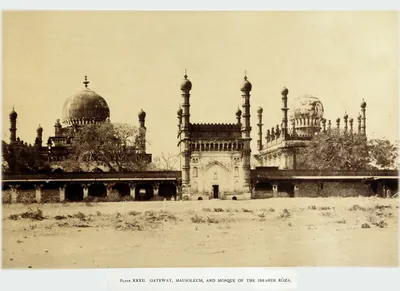
Cousens says that Ali “died of paralysis” in 1672, in his thirty-fifth year.13 He left his son “a shattered heritage, shorn of some of its best possessions”.13 In Cousens’s words, his unfinished mausoleum (tomb) is “the finest ruin in the city”.13 His son and successor was Sikandar Adil Shah.13
Footnotes
-
Jadunath Sarkar, History of Aurangzib, Vols. I–II (1912), p. 145 (archive.org (opens in a new tab)). ↩ ↩2 ↩3 ↩4 ↩5
-
Jadunath Sarkar, History of Aurangzib, Vol. IV (2nd ed., 1930), p. 157 (archive.org (opens in a new tab)). ↩ ↩2 ↩3 ↩4 ↩5
-
Sarkar, Aurangzib I–II (1912), p. 161 (archive.org (opens in a new tab)). ↩ ↩2 ↩3 ↩4 ↩5
-
Henry Cousens, Bijapur and its Architectural Remains (Archaeological Survey of India, Imperial Series, Vol. XXXVII, 1916), p. 16 (archive.org (opens in a new tab)). ↩ ↩2 ↩3 ↩4
-
James M. Campbell (ed.), Gazetteer of the Bombay Presidency, Vol. XXIII: Bijapur (1884), p. 429 (archive.org (opens in a new tab)). ↩ ↩2
-
James Grant Duff, A History of the Mahrattas, Vol. I (1826), p. 178 (archive.org (opens in a new tab)). ↩ ↩2 ↩3
-
Grant Duff, History of the Mahrattas, Vol. I (1826), p. 182 (archive.org (opens in a new tab)). ↩ ↩2 ↩3 ↩4
-
Grant Duff, History of the Mahrattas, Vol. I (1826), p. 186 (archive.org (opens in a new tab)). ↩ ↩2 ↩3 ↩4 ↩5 ↩6
-
Grant Duff, History of the Mahrattas, Vol. I (1826), p. 187 (archive.org (opens in a new tab)). ↩ ↩2 ↩3 ↩4 ↩5 ↩6
-
Sarkar, Aurangzib IV (1930), p. 156 and note (archive.org (opens in a new tab)). ↩ ↩2 ↩3 ↩4
-
Sarkar, Aurangzib IV (1930), p. 151 (archive.org (opens in a new tab)). ↩ ↩2
-
Bombay Gazetteer, Vol. XXIII: Bijapur (1884), p. 431 (archive.org (opens in a new tab)). ↩ ↩2 ↩3 ↩4
-
Cousens, Bijapur and its Architectural Remains (1916), p. 17 (archive.org (opens in a new tab)). ↩ ↩2 ↩3 ↩4
Photos
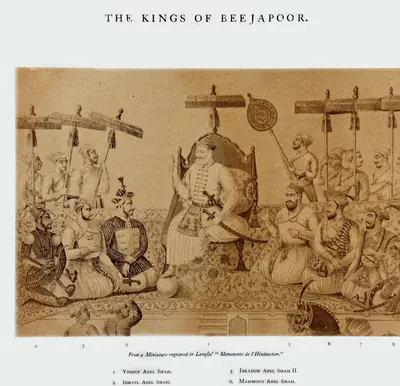 "The Kings of Beejapoor": the eight Adil Shahi kings from Yusuf to Sikandar, from a miniature engraved in Langlès' Monuments de l'Hindoustan (Taylor and Fergusson, Architecture at Beejapoor, 1866, frontispiece)Book plate · 1866
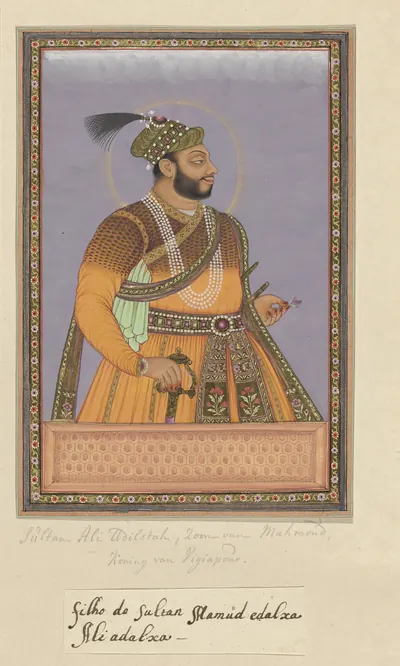 Ali Adil Shah (II): Deccani portrait, about 1686, Witsen album, Rijksmuseum (RP-T-00-3186-41); Dutch title: "Portrait of Ali Adil Shah, son of Sultan Mahmud; after his father he was ruler of Bijapur"Other · c. 1686
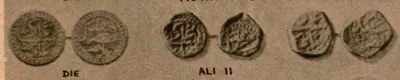 Copper coins of Ali Adil Shah II with the reconstructed die (Cousens 1916, pl. CXV, row 8)Coin · 1916
Related
Dynasties
References
Notes (0)
Sources (5)
Spotted an error on this page? Tell us
Last updated: