Muhammad Adil Shah
Seventh Adil Shahi sultan of Bijapur (r. 1627–1656), called Mahmud in some histories, and the builder of the Gol Gumbaz. He made peace with Shah Jahan in 1636 and then sent his armies into the Karnatak, with Shahji Bhonsle among the commanders. Bijapur took Jinji and Vellore, Penukonda (1652, by a Mackenzie manuscript) and the uplands of the Bellary and Anantapur country. It divided the Karnatak with Golconda's minister Mir Jumla.
Muhammad was a younger son of Ibrahim Adil Shah II.1 In 1627 the ministers Mustafa Khan (Mirza Muhammad Amin Lari) and Khawas Khan raised him to the throne “at the immature age of fifteen”.1 They put him in place of his elder brother Darvesh Padshah.1 The Bombay gazetteer calls him Mahmud Shah.2 Jadunath Sarkar dates his death to 4 November 1656.3 See the Adil Shahis of Bijapur.
Peace with the Mughals
The first years of the reign were spent in war with the Mughals over what was left of the Ahmadnagar kingdom.24 The Bombay gazetteer describes a Mughal siege of Bijapur by Asaf Khan in 1631.24 It describes an invasion by Khan Dauran in 1635, when the country for twenty miles round the capital was laid waste to starve the enemy.24
The peace that followed confirmed Muhammad in the frontier districts and the Konkan.4 In return, the gazetteer says, “he agreed to pay a yearly tribute of £200,000 (Rs. 20 lakhs) and to cease to aid Shahaji, who was still in arms against the Emperor”.4 Cousens adds that Shahji “was soon taken into favour and was given a command in the Bijapur service”.5 See the Mughals in the Telugu country.
The Karnatak conquests
Now free in the north, Bijapur turned south and east.6 Grant Duff, the historian of the Marathas (1826), says that an expedition was planned against the Karnatak.6 Shahji “was nominated second in command, under his friend Rendoollah Khan” (Randaula Khan).6 He was promised a jagir (land grant) of Kolar, Bangalore, Hoskote, Ballapur and Sira.6
The Bombay gazetteer says that in 1637 Shahji led an expedition into the Madras Karnatak.4 It “was so successful that the limits of the Bijapur kingdom were extended to the Bay of Bengal”.4
Sarkar describes the two Deccan kingdoms closing on the Karnatak “as between the two jaws of a monster”.78 Golconda came from the north.78 “Bijapur advanced conquering southwards and then turned east till it occupied the coast between Jinji and Tanjore”.78 Between them lay the kingdom of Chandragiri, the last remnant of Vijayanagara.78
Sriranga, its king, “lost Jinji to the former and Chandragiri to the latter”.910 He asked the Mughals for help.910 Then the Bijapuri generals “captured the fort of Vellore, ‘the best in the Karnatak’”.910 See Chandragiri.
Closer to the Telugu country, the Anantapur gazetteer quotes a Mackenzie manuscript.11 It says that Penukonda “eventually fell to Bijapur in 1652 in an inglorious manner”.11 Its governor Konati Nayudu was bribed with a large jagir that included Kundurpi.11 The gazetteer adds that the conquerors pulled down many temples and built mosques from their materials.11 Kurnool, taken under Ibrahim II, was ruled by deputies from Bijapur throughout the reign.12 See Penukonda and Kurnool.
Partition with Golconda
On the Golconda side the minister Mir Jumla led the conquest.8 His “crowning feat was the capture of the rock-fortress of Gandikota, hitherto deemed impregnable”.8
Sarkar says that when Mir Jumla fell out with his king, he “offered to enter the service of the Sultan of Bijapur, and to hold the Karnatak of him”.1314 He sent Muhammad lockets set with jewels taken from the raja of Chandragiri.1314 He also settled the quarrel between the two conquering armies.1314 In Sarkar’s words, “by mutual consent a line drawn east to west some distance north of Jinji became the boundary between Adil Shahi Karnatak and Qutb Shahi Karnatak”.1314
The governor of the Bijapuri Karnatak at the time was an Abyssinian, Ikhlas Khan.14 See Gandikota and the Gandikota fort.
The kingdom at its greatest
Sarkar used the Bijapur history Basatin-us-Salatin.15 He says that at Muhammad’s death the kingdom “stretched from the Arabian Sea to the Bay of Bengal, across the entire Indian peninsula”.15 Its yearly revenue was 7 krores and 84 lakhs of rupees, besides the tribute of vassal rajas.15 Its dependent states covered “the Bellary and Karnul districts of Madras, and much of the kingdom of Mysore”.15
The Bombay gazetteer says that he reformed the revenue system after the examples of Malik Ambar and the Mughals.16 His army was powerful, but “his military force was greatly scattered”.16 “Large bodies were employed in reducing the refractory vassals in the Madras Karnatak.”16 Cousens says that he struck gold coins in his own name, and two of them were found with copper coins of the dynasty.17
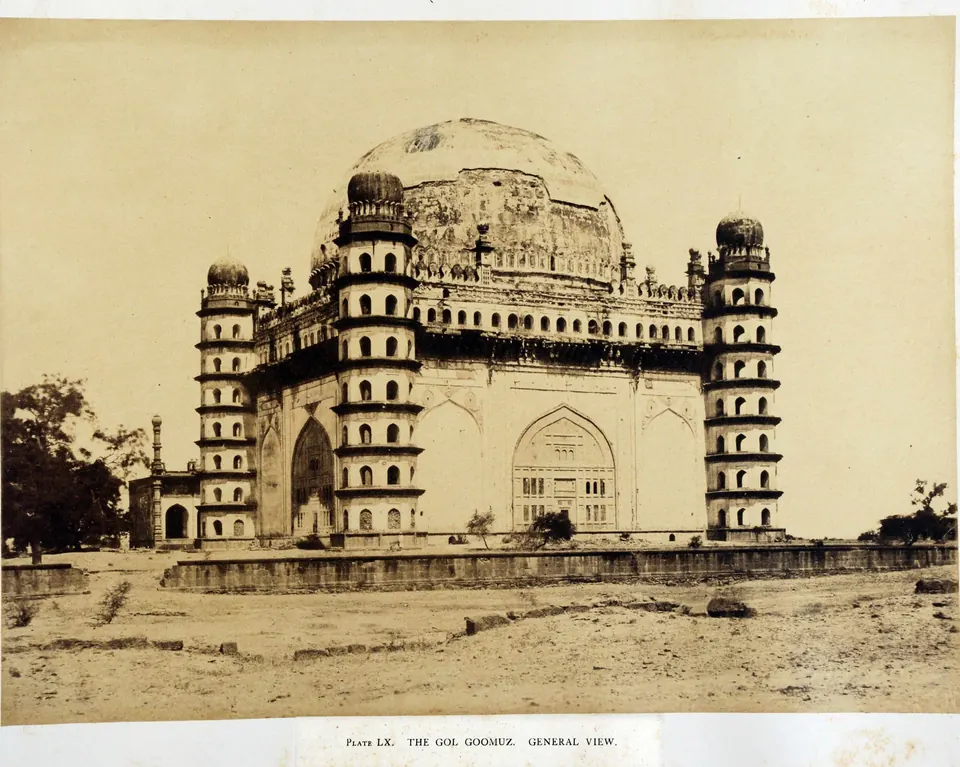
He spent the twenty years of peace after 1636 on buildings at Bijapur.5 Above all he built his own tomb, the Gol Gumbaz, and the Athar Mahall, later the shrine of the relics of the Prophet.5 See Bijapur.
Family
Sarkar says that the crown passed to Ali Adil Shah II, “a youth of 18 years, and the only son of the late king”.3 This was through the efforts of the minister Khan Muhammad and the queen, Bari Sahiba, “a sister of the Golkonda king”.3 The Bombay gazetteer says instead that Muhammad “married the daughter of Abdulla of Golkonda”.4
Aurangzeb disputed Ali’s birth.18 Sarkar notes that “who Ali’s mother was is not explicitly stated in the Bijapur history”.18 See Ali Adil Shah II and Abdullah Qutb Shah.
Footnotes
-
Henry Cousens, Bijapur and its Architectural Remains (Archaeological Survey of India, Imperial Series, Vol. XXXVII, 1916), p. 14 (archive.org (opens in a new tab)). ↩ ↩2 ↩3
-
James M. Campbell (ed.), Gazetteer of the Bombay Presidency, Vol. XXIII: Bijapur (1884), p. 425 (archive.org (opens in a new tab)). ↩ ↩2 ↩3 ↩4
-
Jadunath Sarkar, History of Aurangzib, Vols. I–II (1912), p. 145 (archive.org (opens in a new tab)). ↩ ↩2 ↩3
-
Bombay Gazetteer, Vol. XXIII: Bijapur (1884), p. 426 (archive.org (opens in a new tab)). ↩ ↩2 ↩3 ↩4 ↩5 ↩6 ↩7 ↩8
-
Cousens, Bijapur and its Architectural Remains (1916), p. 15 (archive.org (opens in a new tab)). ↩ ↩2 ↩3
-
James Grant Duff, A History of the Mahrattas, Vol. I (1826), p. 121 (archive.org (opens in a new tab)). ↩ ↩2 ↩3 ↩4
-
Sarkar, Aurangzib I–II (1912), p. 119 (archive.org (opens in a new tab)). ↩ ↩2 ↩3 ↩4
-
Sarkar, Aurangzib I–II (1912), p. 120 (archive.org (opens in a new tab)). ↩ ↩2 ↩3 ↩4 ↩5 ↩6
-
Sarkar, Aurangzib I–II (1912), p. 138 (archive.org (opens in a new tab)). ↩ ↩2 ↩3
-
Sarkar, Aurangzib I–II (1912), p. 139 (archive.org (opens in a new tab)). ↩ ↩2 ↩3
-
W. Francis, Madras District Gazetteers: Anantapur (1905), p. 192 (archive.org (opens in a new tab)). ↩ ↩2 ↩3 ↩4
-
Narahari Gopalakristnamah Chetty, A Manual of the Kurnool District (1886), p. 29 (archive.org (opens in a new tab)). ↩
-
Sarkar, Aurangzib I–II (1912), p. 122 (archive.org (opens in a new tab)). ↩ ↩2 ↩3 ↩4
-
Sarkar, Aurangzib I–II (1912), p. 123 (archive.org (opens in a new tab)). ↩ ↩2 ↩3 ↩4 ↩5
-
Jadunath Sarkar, History of Aurangzib, Vol. IV (2nd ed., 1930), p. 155 and note (archive.org (opens in a new tab)). ↩ ↩2 ↩3 ↩4
-
Bombay Gazetteer, Vol. XXIII: Bijapur (1884), p. 428 (archive.org (opens in a new tab)). ↩ ↩2 ↩3
-
Cousens, Bijapur and its Architectural Remains (1916), p. 128 and pl. CXV (archive.org (opens in a new tab)). ↩
-
Sarkar, Aurangzib I–II (1912), p. 161 (archive.org (opens in a new tab)). ↩ ↩2
Photos
 "The Gol Goomuz. General View": the tomb of Muhammad Adil Shah at Bijapur (Taylor and Fergusson, Architecture at Beejapoor, 1866, pl. LX)Historic photograph · 1866
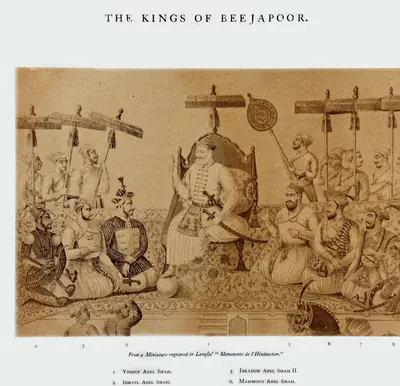 "The Kings of Beejapoor": the eight Adil Shahi kings from Yusuf to Sikandar, from a miniature engraved in Langlès' Monuments de l'Hindoustan (Taylor and Fergusson, Architecture at Beejapoor, 1866, frontispiece)Book plate · 1866
 Copper coins of Muhammad Adil Shah with the reconstructed die (Cousens 1916, pl. CXV, row 5)Coin · 1916
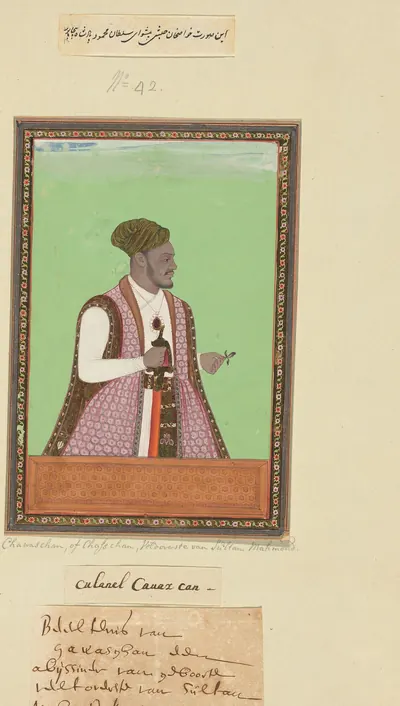 Khawas Khan "the Abyssinian", commander-in-chief (peshwa) of Sultan Mahmud of Bijapur: Deccani portrait, about 1686, Witsen album, Rijksmuseum (RP-T-00-3186-42)Other · c. 1686
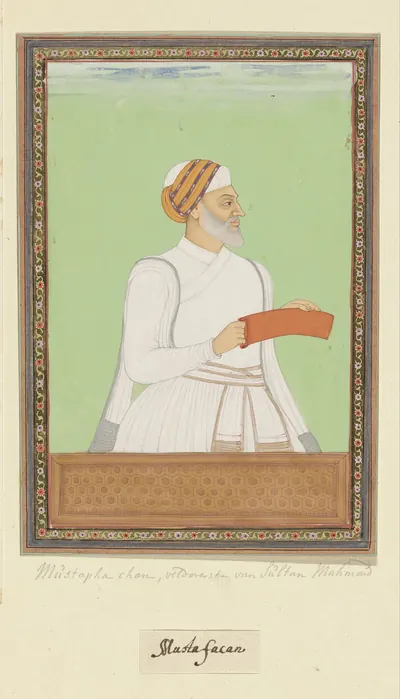 Mustafa Khan, commander-in-chief of Sultan Mahmud of Bijapur: Deccani portrait, about 1686, Witsen album, Rijksmuseum (RP-T-00-3186-43)Other · c. 1686
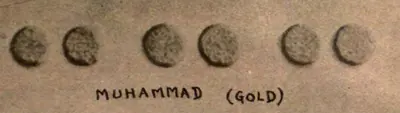 Small gold coins of Muhammad Adil Shah (Cousens 1916, pl. CXV, row 1, "Muhammad (Gold)")Coin · 1916
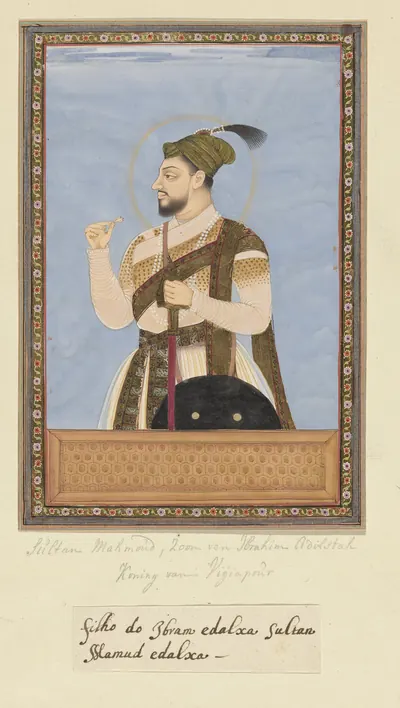 Sultan Mahmud (Muhammad Adil Shah): Deccani portrait, about 1686, Witsen album, Rijksmuseum (RP-T-00-3186-40); Dutch title: "Portrait of Sultan Mahmud, son of Ibrahim Adil Shah; after his father he was ruler of Bijapur"Other · c. 1686
Related
Dynasties
References
Notes (0)
Sources (7)
Spotted an error on this page? Tell us
Last updated: