Baddega I Soladaganda (Chalukya of Vemulavada)
Chalukya king of Vemulavada in the later 9th century, a feudatory of the Rashtrakutas. Pampa and the Parbhani plates praise him as the hero of forty-two battles, called Soladaganda ('the undefeated hero'), who seized a king named Bhima 'as if catching a crocodile' in water. Historians identify Bhima with the Eastern Chalukya king Chalukya-Bhima I. N. Venkataramanayya dated his reign to about 850–895.
Baddega, surnamed Soladaganda, was the most warlike of the early kings of the Chalukyas of Vemulavada.12 Their later records remember him for a single deed, the capture of a king named Bhima.12 Historians identify this Bhima with the Eastern Chalukya king Chalukya-Bhima I.12
Family
Baddega was the son of Yuddhamalla II, and the great-grandson of Arikesari I.13 In Rice’s translation of Pampa, Narasimha’s eldest son was Dugdhamalla, and Dugdhamalla’s eldest son was Baddega.45 Baddega’s son was Yuddhamalla III, who succeeded him about 895.67
Forty-two battles and the capture of Bhima
Pampa’s family history, as Rice translated it, praises Baddega’s courage.4 It says that he made his valour famous “in fighting forty-two great battles”.4 He earned the title Solada Ganda, “invincible champion”.4 And “as if catching a crocodile, he entered the water and boldly seized Bhima”.4
The Parbhani plates of his descendant Arikesari III use the same image.7 In N. Venkataramanayya’s summary, they say that Baddiga seized Bhima in battle as though he were catching a crocodile in water.7
J. F. Fleet, writing in 1896, thought that this Bhima “may be the Eastern Chalukya Bhima I”, who reigned from about 888 to 918.2 Rice had earlier suggested that Bhima was a Chalukya named in the Anamkonda inscription of the Kakatiya Rudradeva.2 Fleet rejected this, because that record is of 1162–63.2 Venkataramanayya also identified him with Chalukya-Bhima I, whom he dated to 892–921.31
Venkataramanayya’s account
Venkataramanayya pieced the story together from the Eastern Chalukya side.31 Some tenth-century Eastern Chalukya inscriptions say that Gunaga Vijayaditya III gave protection to Baddega.31 Venkataramanayya took this to mean that Baddega fell into his hands when the Rashtrakuta king Krishna II was defeated.31
After Vijayaditya’s death in 892 the Rashtrakutas invaded Vengi at least twice.896 Venkataramanayya noted that the crocodile simile places the capture in Bhima’s own element, water.896 From this he argued that Baddega seized him during the second invasion, when the Rashtrakuta army reached the heart of Vengi.896 Bhima soon escaped and went back to ruling his kingdom.896
The editors of The Early History of the Deccan (1960) called the capture only an episode in the long wars between the Rashtrakutas and the Eastern Chalukyas.10
Temples and officers
The Vemulavada inscription of Arikesari II names Peddana as its donor.11 It says that Peddana’s father Nagamarya had been the tantrapala (an officer) of King Baddega.11 K. A. Nilakanta Sastri took this Baddega to be the Rashtrakuta king Amoghavarsha III.12 Venkataramanayya read the lines afresh and held that he was Baddega Soladaganda of Vemulavada.12 Venkataramanayya also thought that the Baddegesvara temple at Vemulavada, now the Bhimesvara, was named after Baddega or built by him.13
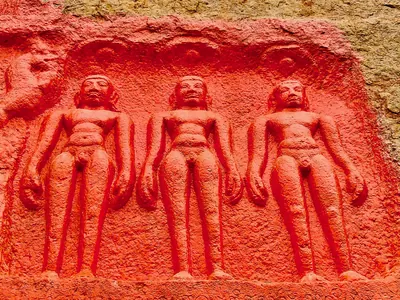
A pedestal inscription on a Jaina image at Vemulavada says that King Baddega of the Chalukya family built the Subhadhama Jinalaya for the Jaina teacher Somadeva.14 Epigraphia Telanganica (2023) lists it under Baddega Soladaganda.14 Venkataramanayya instead gave it to a later Baddega, the father of Arikesari III.15 The Parbhani plates of 966 of that Arikesari give land to the same temple.15 See Somadeva Suri.
Dates
Venkataramanayya allowed Baddega the long reign of about 850 to 895.1617 His reason was that Baddega lived at the same time as both Gunaga Vijayaditya III and Chalukya-Bhima I.1617 He thought Baddega died about 895.6
Footnotes
-
Venkataramanayya, Chalukyas of L(V)emulavada (1953), p. 21 (archive.org (opens in a new tab)). Paraphrased. ↩ ↩2 ↩3 ↩4 ↩5 ↩6 ↩7 ↩8
-
J. F. Fleet, “Dynasties of the Kanarese Districts”, Gazetteer of the Bombay Presidency I, pt. II (1896), p. 381 and note 6 (archive.org (opens in a new tab)). ↩ ↩2 ↩3 ↩4 ↩5 ↩6
-
N. Venkataramanayya, The Chalukyas of L(V)emulavada (1953), p. 10 (archive.org (opens in a new tab)). Paraphrased. ↩ ↩2 ↩3 ↩4 ↩5
-
B. Lewis Rice (ed.), The Pampa Bharata or Vikramarjuna Vijaya of Pampa (1898), introduction, p. 2 (archive.org (opens in a new tab)). ↩ ↩2 ↩3 ↩4 ↩5
-
Rice, Pampa Bharata (1898), “Analysis of the Poem”, p. 1, stanza 23 (archive.org (opens in a new tab)). ↩
-
Venkataramanayya, Chalukyas of L(V)emulavada (1953), p. 24 (archive.org (opens in a new tab)). Paraphrased. ↩ ↩2 ↩3 ↩4 ↩5 ↩6
-
Venkataramanayya, Chalukyas of L(V)emulavada (1953), p. 93, introduction to the Parabhani plates (archive.org (opens in a new tab)). Paraphrased. ↩ ↩2 ↩3
-
Venkataramanayya, Chalukyas of L(V)emulavada (1953), p. 22 (archive.org (opens in a new tab)). Paraphrased. ↩ ↩2 ↩3 ↩4
-
Venkataramanayya, Chalukyas of L(V)emulavada (1953), p. 23 (archive.org (opens in a new tab)). Paraphrased. ↩ ↩2 ↩3 ↩4
-
K. A. Nilakanta Sastri and N. Venkataramanayya, “The Chalukyas of Vemulavada”, appendix C to “The Eastern Chalukyas”, in G. Yazdani (ed.), The Early History of the Deccan, Parts VII–XI (1960), p. 508. Cite-only; paraphrased. ↩
-
Venkataramanayya, Chalukyas of L(V)emulavada (1953), p. 84 (archive.org (opens in a new tab)). Paraphrased. ↩ ↩2
-
Venkataramanayya, Chalukyas of L(V)emulavada (1953), p. 41, note 67 (archive.org (opens in a new tab)). Paraphrased. ↩ ↩2
-
Venkataramanayya, Chalukyas of L(V)emulavada (1953), p. 44 (archive.org (opens in a new tab)). Paraphrased. ↩
-
Gajjala Vasanta Lakshmi (ed.), Epigraphia Telanganica I: Pre-Kakatiya Telangana (2023), p. 87, No. 1, summarising Inscriptions of Karimnagar District, p. 12. Cite-only; paraphrased. ↩ ↩2
-
Venkataramanayya, Chalukyas of L(V)emulavada (1953), p. 45 and note 75 (archive.org (opens in a new tab)). Paraphrased. ↩ ↩2
-
Venkataramanayya, Chalukyas of L(V)emulavada (1953), p. 11 (archive.org (opens in a new tab)). Paraphrased. ↩ ↩2
-
Venkataramanayya, Chalukyas of L(V)emulavada (1953), p. 12 (archive.org (opens in a new tab)). Paraphrased. ↩ ↩2
Related
Dynasties
References
Notes (0)
Sources (5)
Spotted an error on this page? Tell us
Last updated: