Krishna II (Rashtrakuta)
Rashtrakuta king (about 878–914), son of Amoghavarsha I. The Eastern Chalukya Gunaga Vijayaditya III claimed to have frightened him and burnt his city, and a Rashtrakuta grant admits that his enemies once abandoned his capital. Later Eastern Chalukya records in turn admit that his army overran Vengi until Chalukya-Bhima I won it back. A Kannada record of 907 in his reign has been found at Velmajala in Telangana.
Krishna II reigned over the Rashtrakuta kingdom for more than thirty years. His reign saw the fiercest fighting of the long war with the Eastern Chalukyas of Vengi.12 Each side claimed to have overrun the other’s country.12
Family
Krishna II was a son of Amoghavarsha I.3 (See Amoghavarsha I.) His name also appears in the Prakrit form Kannara, and his titles were Akalavarsha and Subhatunga. His queen was a daughter of Kokkalla, the Kalachuri king of Chedi, and a younger sister of Sankuka.3
J. F. Fleet’s earliest certain date for him was in 888, and his latest in 911–12. His father had reigned for sixty-four years by 878.31 So Fleet thought he must have come to the throne very soon after that year.31
The war with Vengi
The records of the Eastern Chalukya king Gunaga Vijayaditya III (844–888) make large claims. In Fleet’s summary, “challenged by the lord of the Rattas, he conquered the unequalled Gangas, cut off the head of Mangi in battle” (the Rattas are the Rashtrakutas).12 He also “frightened ‘the fire-brand’ Krishna (II.), and completely burnt his city (Malkhed)”.12
In the same summary, Krishna II did honour to his arms.12 Fleet added that the Rashtrakuta records themselves contain no allusion (reference) to the war.12
D. R. Bhandarkar found such an allusion in 1903, in the Cambay plates of 930.45 Their verse on Krishna II says that his enemies abandoned “Khetaka”.45 Bhandarkar took this to mean the capital Manyakheta.45
He concluded that Vijayaditya III had defeated Krishna II and occupied his capital.45 He thought that it was then that Krishna’s father-in-law Kokkalla came to his support.45 Robert Sewell accepted this, and dated the sack of Malkhed to between 877 and 888.6
The Eastern Chalukya records also admit the reverse. In Fleet’s words, they say that “later on, the land of Vengi was overrun by the Rashtrakutas under Krishna II., and had to be reconquered by Chalukya-Bhima I.”2
Sewell noted an inscription which says that in Vijayaditya III’s time Vengi was “pervaded by the army of the Rashtrakutas” (overrun by it).7 He inferred that Vijayaditya’s general Pandaranga drove the Rashtrakuta forces out of the Vengi country (see Pandaranga).7
Niravadyapura and Peruvangur
A copper-plate grant of Chalukya-Bhima I was found at Machilipatnam (then Masulipatam) and noticed in 1914.89 It says that Bhima “defeated the army of Krishnavallabha together with his allies”.89 It adds that the “vile kings of Karnata, and Lata” fled before him.89
His son, a prince of sixteen, died “after fighting bravely on the battle-fields at Niravadyapura and Peruvangur-grama”.89 In the second battle he killed, “from the back of his elephant”, the general of the Vallabha king, “called Dandena-Gundaya”.89 The epigraphist identified the Vallabha king with Krishna II.89
He could not place either battlefield.9 But he noted that Niravadya was a surname of a Western Chalukya king Vijayaditya, after whom the city was evidently named.9 Eight years later another epigraphist found Niravadyapura among the boundaries in a grant of 1076 concerning the Vengipura district.10 Sewell summarised the same grant of Bhima I, and called the allies the kings of Gujarat and Karnata.11
Records in Telangana
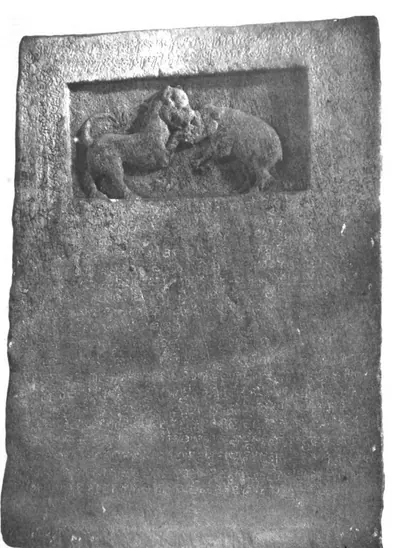
A Telugu and Kannada inscription at Velmajala, in the Bhuvanagiri area of the Nalgonda district, is dated 1 April 907.12 It refers to Akalavarsha (Krishna II).12 It records the gift of a hundred marttars (a land measure) of land to a Jain basadi (temple), and of a garden, by Ravi Chandrayya, a subordinate of the king.12
Successors
Jagattunga, a son of Krishna II, died without coming to the throne.13 Jagattunga’s son Indra III, born of his wife Lakshmi, succeeded his grandfather Krishna II.1314 Another son of Jagattunga, Amoghavarsha III (Vaddiga), was born of his second wife Govindamba.13
Fleet explained that the Sangli grant makes Lakshmi a daughter of Ranavigraha, and the Karda grant a daughter of Sankaragana.13 In his view the two names belong to one man, a brother of Krishna II’s queen.13 So Lakshmi and Govindamba were sisters.13 See Krishna III for the later kings.
Footnotes
-
Fleet, “Dynasties of the Kanarese Districts” (1896), p. 411 (archive.org (opens in a new tab)). ↩ ↩2 ↩3 ↩4 ↩5 ↩6 ↩7 ↩8
-
Fleet, “Dynasties of the Kanarese Districts” (1896), p. 412 (archive.org (opens in a new tab)). ↩ ↩2 ↩3 ↩4 ↩5 ↩6 ↩7
-
J. F. Fleet, “Dynasties of the Kanarese Districts”, Gazetteer of the Bombay Presidency I, pt. II (1896), p. 410 (archive.org (opens in a new tab)). ↩ ↩2 ↩3 ↩4
-
D. R. Bhandarkar, “Cambay Plates of Govinda IV; Saka-Samvat 852”, Epigraphia Indica VII (1903), p. 29 (archive.org (opens in a new tab)). ↩ ↩2 ↩3 ↩4 ↩5
-
Bhandarkar, “Cambay Plates of Govinda IV” (1903), p. 43, translation of verse 13 (archive.org (opens in a new tab)). ↩ ↩2 ↩3 ↩4 ↩5
-
Sewell, Historical Inscriptions (1932), p. 38 (archive.org (opens in a new tab)). Paraphrased. ↩
-
Robert Sewell, The Historical Inscriptions of Southern India (1932), p. 35 (archive.org (opens in a new tab)). Paraphrased. ↩ ↩2
-
Annual Report on Epigraphy, Southern Circle, for 1913–14 (1914), p. 84 (archive.org (opens in a new tab)). ↩ ↩2 ↩3 ↩4 ↩5 ↩6
-
Annual Report on Epigraphy, Southern Circle, for 1913–14 (G.O. No. 920, Public, 4 August 1914), p. 85 (archive.org (opens in a new tab)). ↩ ↩2 ↩3 ↩4 ↩5 ↩6 ↩7 ↩8
-
Annual Report on South-Indian Epigraphy for 1921–22 (1922), p. 98 (archive.org (opens in a new tab)). ↩
-
Sewell, Historical Inscriptions (1932), p. 39 (archive.org (opens in a new tab)). Paraphrased. ↩
-
Gajjala Vasanta Lakshmi (ed.), Epigraphia Telanganica I: Pre-Kakatiya Telangana (2023), p. 79, Rashtrakuta No. 12, summarising Inscriptions of Andhra Pradesh, Nalgonda District I (1992), pp. 1–2. Cite-only; paraphrased. ↩ ↩2 ↩3
-
Fleet, “Dynasties of the Kanarese Districts” (1896), p. 414 (archive.org (opens in a new tab)). ↩ ↩2 ↩3 ↩4 ↩5 ↩6
-
Fleet, “Dynasties of the Kanarese Districts” (1896), p. 415 (archive.org (opens in a new tab)). ↩
Photos
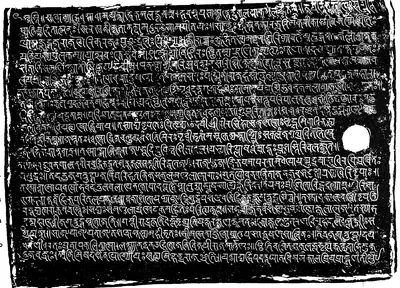 "Cambay Plates of Govinda IV.—Saka-Samvat 852." side i (Epigraphia Indica VII, plate i (between pp. 38 and 39), first page; PDF p. 53 of the archive.org scan epigraphiaindica014351mbp)Inscription rubbing · 1903
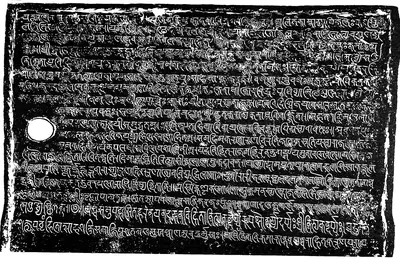 "Cambay Plates of Govinda IV.—Saka-Samvat 852." side iia (Epigraphia Indica VII, plate i (between pp. 38 and 39), second page; PDF p. 54 of the archive.org scan epigraphiaindica014351mbp)Inscription rubbing · 1903
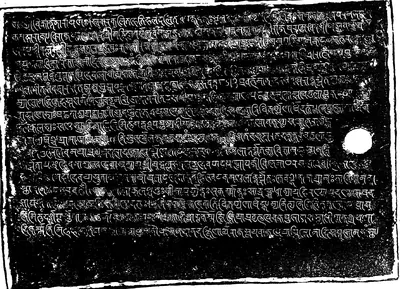 "Cambay Plates of Govinda IV.—Saka-Samvat 852." side iib (Epigraphia Indica VII, plate ii (between pp. 40 and 41), first page; PDF p. 57 of the archive.org scan epigraphiaindica014351mbp)Inscription rubbing · 1903
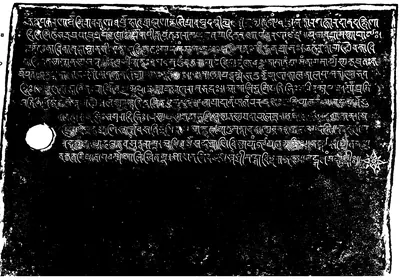 "Cambay Plates of Govinda IV.—Saka-Samvat 852." side iii (Epigraphia Indica VII, plate ii (between pp. 40 and 41), second page; PDF p. 58 of the archive.org scan epigraphiaindica014351mbp)Inscription rubbing · 1903
Related
Dynasties
References
Notes (0)
Sources (6)
Spotted an error on this page? Tell us
Last updated: