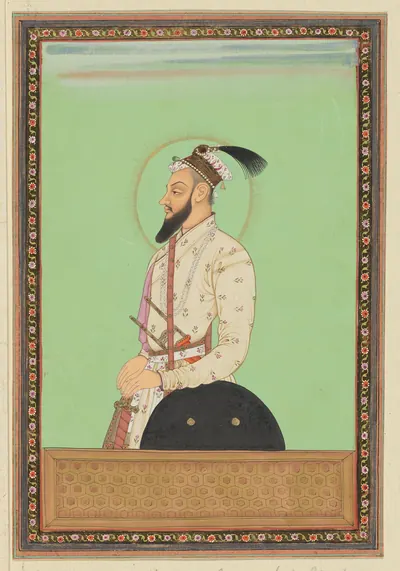
Bahadur Shah I (Shah Alam I)
Bahadur Shah, also called Shah Alam I, was the Mughal emperor from 1707 to 1712, the son of Aurangzeb. He came south to fight his brother Kam Bakhsh, who had made himself emperor at Hyderabad. On 13 January 1709 Kam Bakhsh was defeated and captured near Hyderabad and died the same night, and Bahadur Shah visited the palaces of Hyderabad before going north. Kirmani says he gave Kadapa as a jagir to Abdul Nabi Khan, later Nawab of Cuddapah.
Download
Bahadur Shah, also called Shah Alam I, was the Mughal emperor from 1707 to 1712.12 He came to the Telugu country to fight his brother Kam Bakhsh, who had seized Hyderabad.23 His victory near Hyderabad in 1709 decided the Mughal succession in the Deccan.45 See Mughals in the Telugu country.
The war with Kam Bakhsh
When Aurangzeb died in 1707, his youngest son Kam Bakhsh was on his way to govern Bijapur.2 Kam Bakhsh proclaimed himself emperor and marched on Hyderabad.26 The Nellore manual says that he refused to accept his elder brother, Prince Muazzam, who had taken the throne as Bahadur Shah.7 So Bahadur Shah marched to the Deccan against him.7
On the morning of 13 January 1709 the imperial army advanced on Kam Bakhsh’s camp, a grove near Hyderabad.38 William Irvine tells how Kam Bakhsh, with only a small force, charged the far larger army and shot two quivers of arrows.4 At last, weak from loss of blood, he was surrounded and captured by the Afghans of Daud Khan Panni.4
Kam Bakhsh was brought to Bahadur Shah in the afternoon.5 The emperor went to his brother’s bedside and said, “I had no desire to see you reduced to this state.”5 He washed the dried blood from his brother’s wounds with his own hands and covered him with his own shawl.5 But Kam Bakhsh died during the night.5
Hyderabad and the south
On 17 January 1709 the emperor moved nearer to Hyderabad and visited the battlefield.8 Then he visited the palaces of Hyderabad.8 Before he went north, the Nellore manual says, he gave the viceroyalty of the Deccan to Zulfiqar Khan.7 Zulfiqar Khan stayed at court and left the government to Daud Khan Panni as his deputy.7
R. B. Whitehead’s catalogue of the Lahore Museum coins notes a change at the Hyderabad mint.9 Under Aurangzeb its coins called the city Daru-l-jihad, “abode of holy war”.9 Under Shah Alam I this title was changed to Farkhunda bunyad, “of auspicious foundation”.9
Kadapa
Kirmani, the historian of Haidar Ali, says that Bahadur Shah gave “Kirpa in Jageer”, that is Kadapa as a land grant, to Abdul Nabi Khan.10 The Cuddapah gazetteer calls him “the first Nawab of Cuddapah to assert his control of the district”.11 See the Nawabs of Cuddapah. See Abdul Nabi Khan.
Where the sources disagree
- When Abdul Nabi Khan received Kadapa. Kirmani says it was a grant of Bahadur Shah, who died in 1712.10 The Cuddapah gazetteer (1915) dates the start of Abdul Nabi Khan’s governorship to 1714.11
- Who died of the wounds. Irvine’s text, following two court writers, says that Kam Bakhsh’s son Bariqullah died of an arrow wound soon after the battle.5 Khafi Khan says it was another son, Firuzmand.5
Footnotes
-
Stanley Lane-Poole, The Coins of the Moghul Emperors of Hindustan in the British Museum (1892), pp. xlvii–xlix, table of mint cities (archive.org (opens in a new tab)). ↩
-
William Irvine, ed. Jadunath Sarkar, Later Mughals, Vol. I (1922), pp. 50–51 (archive.org (opens in a new tab)). ↩ ↩2 ↩3 ↩4
-
Irvine, Later Mughals, Vol. I (1922), p. 62 (archive.org (opens in a new tab)). ↩ ↩2
-
Irvine, Later Mughals, Vol. I (1922), p. 63 (archive.org (opens in a new tab)). ↩ ↩2 ↩3
-
Irvine, Later Mughals, Vol. I (1922), p. 64 and note (archive.org (opens in a new tab)). ↩ ↩2 ↩3 ↩4 ↩5 ↩6 ↩7
-
Irvine, Later Mughals, Vol. I (1922), p. 52 and note (archive.org (opens in a new tab)). ↩
-
John A. C. Boswell, A Manual of the Nellore District (1873), p. 444 (archive.org (opens in a new tab)). ↩ ↩2 ↩3 ↩4
-
Irvine, Later Mughals, Vol. I (1922), pp. 66–67 (archive.org (opens in a new tab)). ↩ ↩2 ↩3
-
R. B. Whitehead, Catalogue of Coins in the Panjab Museum, Lahore, Vol. II (1914), p. xcviii (archive.org (opens in a new tab)). ↩ ↩2 ↩3
-
Mir Husain Ali Khan Kirmani, The History of Hydur Naik, tr. W. Miles (1842), p. 271 (archive.org (opens in a new tab)). ↩ ↩2
-
C. F. Brackenbury, Madras District Gazetteers: Cuddapah, Vol. I (1915), p. 41 (archive.org (opens in a new tab)). ↩ ↩2
Photos
References
Notes (0)
Sources (6)
Spotted an error on this page? Tell us
Last updated: